

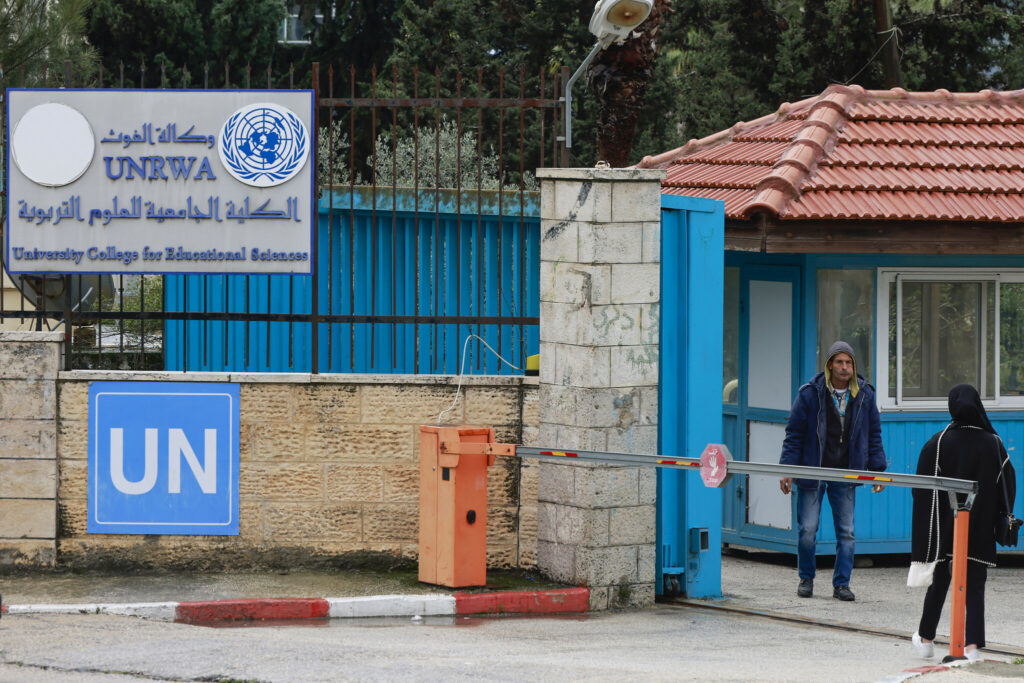
The independent review group on the UN agency for the Palestinian refugees (UNRWA) was established in February by the UN Secretary-General to assess whether the agency complies with its own neutrality commitments. The jury is still out after its report was published on Monday.
As already reported, Belgian Prime Minister Alexander De Croo and several members of his government welcomed the report and called on other countries that had cut their funding to UNRWA to resume their financial support as soon as possible.
A number of countries had resumed their funding without waiting for the results of the UN investigation. The European Commission announced on 29 January that it would review the EU funding to UNRWA in light of the outcome of the investigations but did not wait for the outcome. In fact, there are two more investigations in the pipeline.
After the first Israeli allegations in January that some UNRWA staff had participated in the 7 October terror attack, the UN Secretary-General also activated a separate investigation by the UN’s Office of Internal Oversight Services (OIOS) to determine the veracity of these allegations. This investigation is still on-going.
Another investigation is the Commission’s own audit. On 1 March, the Commission decided to allocate funding to support the Palestinian population through UNRWA and other international partners amid growing concerns about the humanitarian situation in Gaza. On that day, it also reached an agreement with UNRWA about an audit of the agency to be conducted by EU appointed external experts.
This audit has not started yet. After preparations on the guidelines for the audit, the process of selecting an independent audit firm is expected to be launched soon.
After the review group’s report was published, Foreign Affairs Minister Hadja Lahbib was quoted as saying that, "We were right to maintain our support for UNWRA. The Colonna report gives a positive assessment of the organisation's neutrality and reinforces our decision a little more."
She was referring to Catherine Colonna, a former French foreign minister, who chaired the review group. The group included three Scandinavian research organizations: the Swedish Raoul Wallenberg Institute of Human Rights and Humanitarian Law, the Norwegian Chr. Michelsen Institute, and the Danish Institute for Human Rights.
The group’s own neutrality has been questioned by UN Watch, a Swiss NGO established in 1993 to “monitor the performance of the United Nations by the yardstick of its own Charter”. The NGO claims that both the chairperson and the three organisations have a record of previously issued statements demonstrating their positive attitude towards UNRWA and its work.
According to the report, its mandate was to assess whether UNRWA is doing everything within its power to ensure neutrality and respond to allegations of serious neutrality breaches when they are made, “taking into account the context in which it has to work, especially in Gaza”. The group is aware of the challenges of operating amid recurrent conflicts like that in Gaza which is ruled by Hamas.
“In Gaza in particular, Hamas, the de facto ruling entity until October 2023, is designated as a terrorist organization by major donors such as the US and the EU, while other factions also actively oppose the Palestinian Authority.”
The report states that UNRWA’s neutrality challenges differ from those of other international organizations due to the magnitude of its operations, with most personnel being locally recruited and recipients of UNRWA services.
UNRWA and its staff and personnel have a fundamental obligation to maintain neutrality to ensure the integrity of the agency’s mission and the effectiveness of its operations. The review group analysed the mechanisms and procedures currently in place by UNRWA, engaged with various stakeholders, and carried out interviews with more than 200 people.
On paper or in reality
What do the findings show? On paper, there is no doubt that UNRWA has in place mechanisms and procedures to ensure compliance with the humanitarian principles, with emphasis on the principle of neutrality, although its Neutrality Framework was established first in 2017. It might also be true that it possesses a more developed approach to neutrality than other similar UN or NGO entities.
The Framework covers areas including the neutrality of UNRWA staff and other personnel, including their use of social media; neutrality of UNRWA installations; neutrality of UNRWA assets, particularly vehicles; and other areas in relation to UNRWA operations, including donors, partners and agency assistance.
Despite this framework, neutrality-related issues persist, the report admits. They include instances of staff publicly expressing political views, host-country textbooks with problematic content being used in some UNRWA schools, and politicized staff unions making threats against UNRWA management and causing operational disruptions.
Two areas appear in particular difficult to secure against neutrality breaches - UNRWA’s staff and installations - and the report does not give any assurance that UNRWA’s Neutrality Framework has been implemented in those areas.
As regards staff, UNRWA has a vetting system in place to screen staff and personnel before and during employment. It shares staff lists (names and functions) annually with host countries (Lebanon, Jordan and Syria), and with Israel and the US for East Jerusalem, Gaza and the West Bank.
The report notes that Israel has not informed UNRWA of any concerns relating to any UNRWA staff based on these staff lists since 2011. However, it was communicated to UNRWA that Israel does not consider the sharing of the staff list as a screening or vetting process, but as a standard procedure for the registration of UN and diplomatic staff to ensure their privileges and immunities.
As regards installations, the report says that UNRWA has approximately 1,000 installations across its five fields of operations, which include schools, health centres, warehouses, and area, field and headquarters (HQ) offices. The agency is responsible for ensuring the neutrality of these installations, including preventing misuse for political or military objectives.
In reality, UNRWA has not been capable of preventing Hamas from misusing its premises and digging a military tunnel network close to or under them, according to media reports on the Israel - Hamas war. Its staff, some of which identifies with Hamas and its goal, has either turned a blind eye to what Hamas has been doing or been forced to cooperate with them.
The report admits that “critical breaches to the neutrality of UNRWA’s installations and the inviolability of its premises could include the discovery of weapons, military activity, or cavities and tunnel openings, but also of Israeli military incursions”. A limiting factor to the potential discovery of breaches is the fact that UNRWA, as a UN agency, does not have policing, military or wider investigative capacities or competencies required to detect such breaches.
Josep Borrell, High Representative for EU’s foreign affairs and security policy, referred to UN’s review report in his speech on Tuesday in the European Parliamentary plenary. “I think that it is important to read this report,” he said. “It is important to know what this very independent and very professional group of people have been studying and what they tell us.”
“I think there is a strong convergence of views between the analysis and recommendations of this Independent Review Group,” he added, “with the measures that we have been discussing at the EU institutions.”
“We are now waiting to see how we continue our cooperation with UNRWA, because what the report says is that, they have not found any proof of the accusations made against some workers of UNRWA.” According to Borrell, there is only some problem of political neutrality and he calls on the international community to continue to fund UNRWA.
He repeated his call for a Palestinian state, living in peace and security side by side with Israel. At previous occasions, he has said that the EU must continue to fund UNRWA and that the agency cannot be dissolved until there is a Palestinian state.
UNRWA is providing humanitarian and development assistance to 5.7 million registered Palestinian refugees across Jordan, Lebanon, Syria, West Bank, including East Jerusalem, and Gaza, pending a ”just and lasting solution to their plight”. The agency has no mandate to discuss with the host countries about the integration of the refugees. Their number has increased eightfold since the 1948 war because the descendants of the refugees are also accorded refugee status.
