
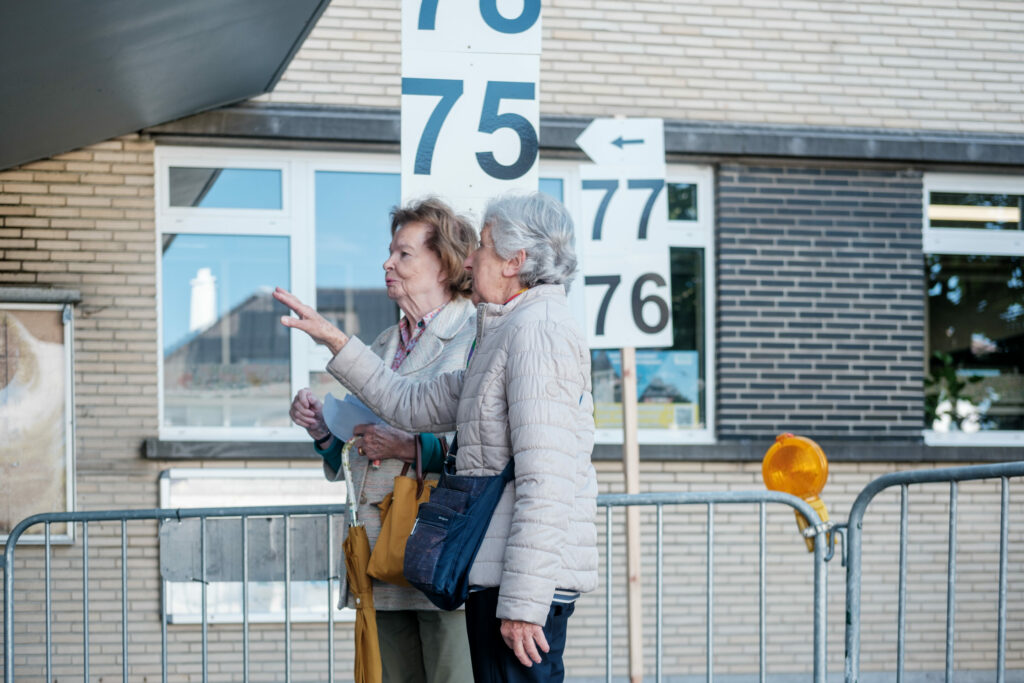
Despite it being against the law to not vote in the Belgian capital, the turnout rate for the Brussels-Capital Region on Sunday was 80%.
For the first time, the Flemish Region legislated to make Sunday's local elections not compulsory for people. The effects were immediately felt: turnout was 63%, a severe drop compared to 2018.
In Brussels and Wallonia, however, attending a polling station on election day is still compulsory, yet this did not stop people from also abstaining from their democratic duty.
How did Brussels vote?
Out of the Brussels municipalities, the lowest turnout rates – people who have not attended a polling station – were recorded in Molenbeek-Saint-Jean (76,3%), City of Brussels (76,9%) and Anderlecht (77,3%). The turnout rate was also lower in places like Schaerbeek (78,5%), Evere (79%), Saint-Gilles (79.1%) and Koekelberg (79,7%).
The highest turnout rate was again recorded in Auderghem (85%), Watermael-Boisfort (84.09%) and Woluwe Saint Pierre (83.61%). The overall average in the Brussels-Capital Region was 80.59%.
In Flanders, where the vote was not mandatory for the first time, the turnout rate was barely 63% – a historic low. Indeed, over one in three eligible voters in Flanders did not vote in October 2024. In Wallonia, the participation rate was higher at 87,7 %.
Last June, one million Belgians across the country did not turn up to vote (out of a population of over 12 million) in the federal and regional elections, with a national turnout of 87.42%.
In the previous federal, regional and European elections (2019), nearly 10% of the country's population refused to vote. Officially, people who do not go to vote risk a penalty of €40 up to €80, but in practice, people seldom get fined.
