
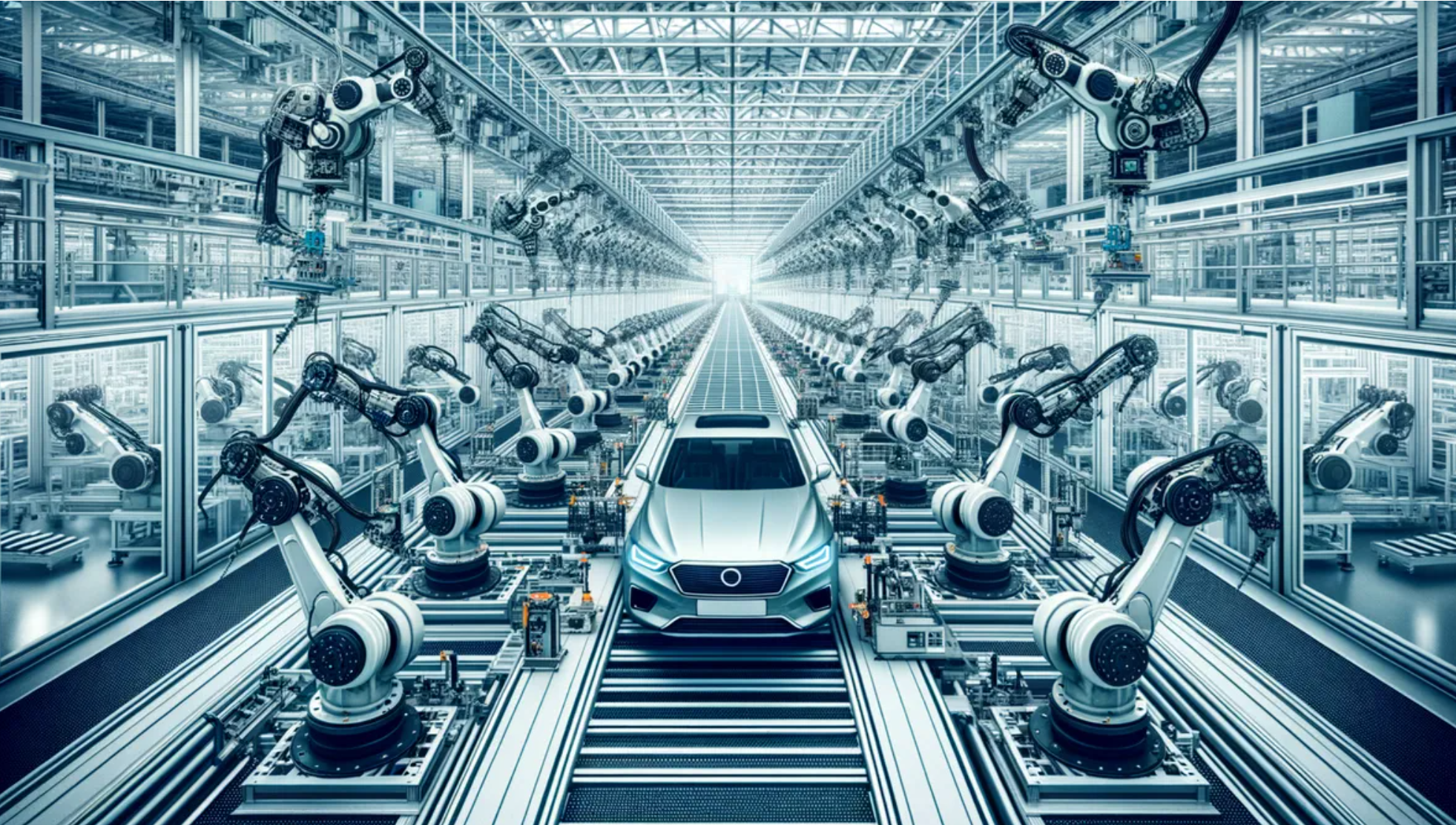
Digitalization of manufacturing is achieved by a host of automated machines, production lines and transportation equipment in factories.
The hardware is controlled and organized by powerful computers and databases with sophisticated software, known as Manufacturing Execution Systems (MES). To connect all this, a variety of data cables and connectors are used.
Cables are the least spectacular, but a most sensitive part of digital production systems at the shop floor. Cables may fail or get damaged by improper handling. And they age and need to be replaced after a certain time of operation, especially when they are installed within moving equipment, such as robot arms.
Step into the future of manufacturing
Visit the factory of Exquisite Automotive, a supplier of car roofs to Great Wall Motors in Baoding in North China’s Hebei province. Here, highly automated production lines with advanced robots perform most of the manufacturing. What one doesn’t see at the shop floor are cables and the casings and tubes to hold and protect them. However, at a closer look one finds numerous boxes for transmission of mobile digital communications signals throughout the workshops.
The factory is a model project for digital manufacturing based on advanced 5G mobile communications, known as 5G-Advanced or 5.5G. The project has been jointly developed by China Unicom, one of China’s public telecommunications companies, Huawei as the provider of the network technology, and Exquisite Automotive in cooperation with Great Wall, its parent company.
5G-A networks provide ultra-high reliability and ultra-low latency, making them the perfect choice for complex manufacturing operations that require high response speeds. Compared to wired networks, 5G-A allows smoother network deployment and makes manufacturing more flexible. Equipment may be easily added or disconnected, similar to connecting a new computer or mobile phone to a network. For the installation of new tools on a robot, for example, 30 to 40 meters of cables and at least six cable connectors can be eliminated.
Also, 5G-A networks greatly improve efficiency of data management by integrating multiple functions, such as data collection and industrial control. At present, such functions are provided by two separate lines in the wired networks used in most factories today. This also solves the problem of equipment using different network protocols that are not interoperable, and greatly increases transparency of the data flow.
According to Fan Ji’an, Chief Scientist for Big Data at China Unicom, 5G-A has the potential to move mobile applications to the center of advanced core manufacturing processes. “We are willing to work with all sectors to create new momentums for innovation, and promote high-quality development by integrating the digital and real economies. Together we want to begin a new chapter in China’s modernization history.”
5G-A networks are set to become a broader global trend in advanced manufacturing. During the Huawei Global Mobile Broadband forum held last October in Dubai, 13 telecom operators jointly launched the first wave of 5G-A networks, commercial use will begin in 2024. China is leading the way in creating new settings for digital manufacturing, since it can build on an already existing large-scale infrastructure of 5G mobile communications. China’s way into digital manufacturing is distinctively driven by the development of infrastructure.
From the perspective of industrial development, 5G-A has the potential of facilitating new industrial ecosystems across industrial sectors and locations. 5-GA can be deployed across factories, e.g. in industrial parks and large-scale industrial facilities like ports, coal mines or power stations. Shared use of 5G-A infrastructure has huge potentials for the digitalization of smaller and medium-sized manufacturing enterprises. It may finally be the trigger to bring SME “onto the cloud”, a key goal of China’s industrial internet strategy.
Challenges remain, of course. A key issue certainly will be pricing and access conditions for SME. How much will companies have to pay for the hardware and service, and is the pricing fair and transparent? At the same time, sensitive production and economic data of companies must be protected. This requires stringent rules and regulations, and a clear definition of the role of service providers and cloud operators.
Finally, 5G-A needs properly skilled workers. The technology makes day-to-day operations at the shop floor easier, but factories and vocational schools must train workers to run the networks and to integrate the digital and non-digital knowledge at the shop floor.
In the global arena, 5G-A entails many opportunities for economic cooperation. Some major international manufacturers such as BMW or Schneider Electric already participate in trial projects in China. For the large-scale deployment of 5G-A across vertical industries and locations, the creation of safe data standards defined and shared by stakeholders is mandatory. European concepts in this field such as Germany’s “Data Space Industry 4.0” or the Catena X project of the EU automotive industry fit well with China’s infrastructure-driven model of manufacturing digitalization.
By: Boy Luethje, Institute for Social Research, University of Frankfurt, Germany
