
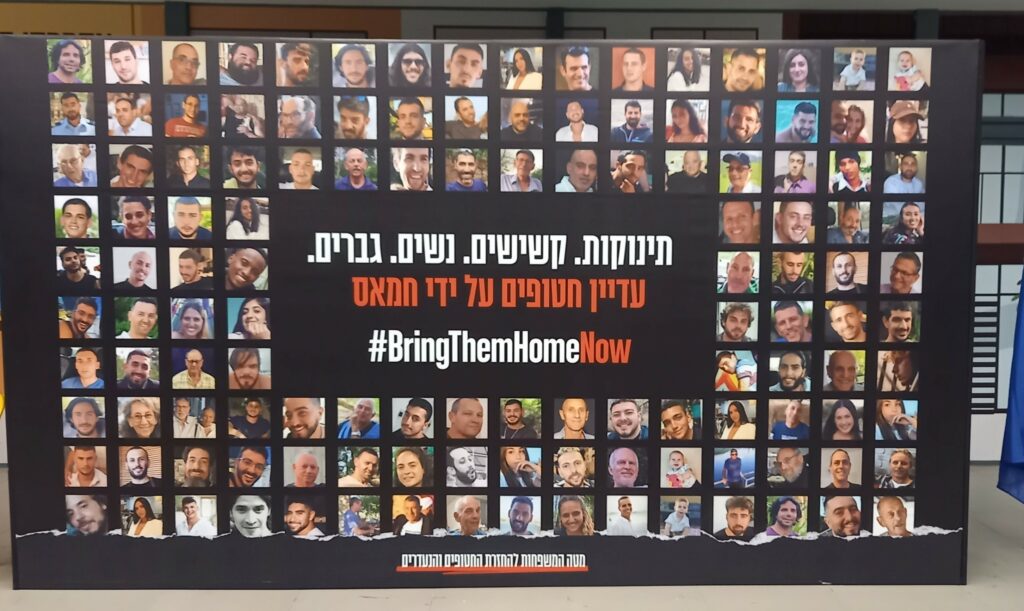
The US and several EU member states called on Thursday on Israel and Hamas to reach a hostage deal in order to bring an immediate ceasefire and avoid an imminent escalation of the war into Rafah in the south of the Gaza Strip.
There are still 133 Israeli hostages kept by Hamas but many of them are believed not be alive any longer. The extraordinary statement is signed by the leaders of those countries who have their own citizens among the hostages: the US, Argentina, Austria, Brazil, Bulgaria, Canada, Columbia, Denmark, France, Germany, Hungary, Poland, Portugal, Romania, Serbia, Spain, Thailand and the UK.
“We call for the immediate release of all hostages held by Hamas, now for over 200 days. They include our citizens. The fate of the hostages and the civilian population in Gaza, who are protected under international law, is of international concern,” the statement says.
The deal on the table to release the hostages would bring an immediate and prolonged ceasefire in Gaza that would facilitate a surge on additional necessary assistance to be delivered throughout Gaza and lead to the credible end of hostilities, the statement added.
The statement is in line with EU’s common position as it was expressed at the latest European Council meeting. The Council reiterated its commitment to work for reaching an immediate ceasefire and the unconditional release of all hostages, as well as providing full, rapid, safe and unhindered access to humanitarian aid at scale for Palestinians in need.
The calls for an immediate ceasefire in Gaza and the unconditional release of the hostages are linked to each other, Peter Stano, EU’s lead spokesperson for foreign affairs and security policy, told The Brussels Times before the foreign affairs council meeting last Monday.
“A ground operation in Rafah must be avoided,” EU’s foreign policy chief Josep Borrell said in his speech in the European Parliament on Tuesday. “There are more than 1.3 million people on the streets of Rafah, without no more shelter than a piece of plastic over their heads. The humanitarian consequences would be catastrophic. Everybody is saying that – the US, the EU, Member States.”
But time is running out for the hostages and the release will not be unconditional. Talks between the parties under the mediation of the US, Egypt and Qatar has been going for weeks without leading to a deal acceptable to both Israel and Hamas. The coming days will be critical for reaching a deal and avoid an Israeli military operation into Rafah in the south of the Gaza Strip at the border with Egypt.
Such an offensive is more imminent than ever. The Israeli military has told the government that it has completed its plans entering Rafah and is now waiting for the government’s decision when to enter the city. The majority of the civilian population who has taken refuge in Rafah has fled from the other parts of the Gaza Strip which have been destroyed in the war.
An evacuation of the civilian population to safer places in Gaza, if at all possible, will have to take place before the launch of an offensive and might take weeks. The military operation is expected to last several months. It would be a colossal Israeli mistake, according to military experts and retired Israeli generals. The only thing which can cancel the Israeli plans is a hostage deal as soon as possible.
In fact, there is already a reasonable deal on the table but the Israeli Prime Minister, Netanyahu, has delayed the talks and is under pressure from his extremist coalition partners not to make any concessions to Hamas. Israel will have to release a large number of Palestinian prisoners in exchange for the hostages and agree to a ceasefire which likely will be prolonged and lead to the end of the war.
Hamas has already suffered a severe blow in the war, which has dragged on for six and a half months. It has lost most of its fighting battalions and does not pose any military threat any longer. Israel has already withdrawn most of its troops from Gaza. What remains of Hamas in Rafah will have to be dealt with politically “the day after”.
Instead, Netanyahu refuses to plan for the day after. He is declaring every day that the goal is “total victory” and that only military pressure will lead to the release of the hostages. Until now, he has been proven wrong. Even the military and security establishment has urged him to accept the latest proposal for a hostage deal and called for a political exit strategy to preserve Israel's military gains.
Further sanctions against Iran
On Thursday, the European Parliament adopted a resolution expressing concerns about Iran’s destabilising role in the Middle East. In the resolution, which was adopted with 357 votes in favour, 20 against and 58 abstentions, the Parliament condemned the drone and missile strike against Israel by Iran and its proxies on the night to Sunday 14 April.
It also deplored the attack against the Islamic Revolutionary Guard Corps (IRGC) in the Iranian consulate in Damascus which has been attributed to Israel. The decision to attack a building which Iran considered as enjoying diplomatic protection misjudged the Iranian response and led to an unprecedented escalation which could have ignited a full-scale war in the region.
While calling on both parties to show maximum constraint, the Parliament welcomed the EU’s decision to expand its current sanctions regime against Iran, including by sanctioning the country’s supply and production of drones and missiles to Russia and the wider Middle East. The MEPs demand that these sanctions be urgently put in place and call for more individuals and entities to be targeted.
The resolution also reiterated the Parliament’s long-standing call to include the IRGC on the EU list of terrorist organisations, stressing that such a decision is long overdue due to malign Iranian activities. It similarly calls on the Council and EU Foreign Policy Chief Josep Borrell to add Hezbollah in its entirety to the same list.
The new sanctions against Iran were agreed at the latest foreign affairs council meeting. As regards sanctions against IRGC, the EU cannot proceed for the moment, according to Borrell. “We need to have a decision by a national authority related with a case of terrorist activities in which the Revolutionary Guards of Iran have been involved.” Some foreign ministers say that IRGC already has been implicated in terrorist attacks on EU soil.
Until now, the EU has not played any major active role in using its leverage to promote a political solution to the conflict. The Council conclusions stated that the EU is ready to work with all partners to avoid further escalation of tensions in the region, notably in Lebanon. It called on all parties to implement the UNSC Resolution 1701 from 2006, which requires Hezbollah to withdraw from the border region.
While Borrell’s engagement with the parties is less visible, European Commission President Ursula von der Leyen is more active. She plans to travel to Lebanon on Thursday together with the Cypriot president to discuss a range of topics, including bilateral relations and the Syrian refugees in the country, according to the Commission’s chief spokesperson on Friday.
It is not clear if she is also on a mission to find a diplomatic solution to the war across the Lebanese – Israeli border. As long as the war in Gaza continues, Hezbollah, Iran’s proxy in Lebanon, is unlikely to agree to end the hostilities and implement the UN resolution. It remains to be seen if the EU will sign a similar agreement with Lebanon as it did recently with Egypt, ignoring human rights concerns.
M. Apelblat
The Brussels Times
