
For people with a psychiatric condition who pose a potential danger to themselves or society, the court can now order "voluntary treatment under conditions".
The new measure – halfway between compulsory admission and voluntary treatment – will allow for greater supervision of people who pose a potential danger. The attack in Schaerbeek on 10 November 2022, in which a police officer died, highlighted the need for such an arrangement, the office of Federal Justice Minister Paul Van Tigchelt said in a press release.
"For persons with psychiatric problems who pose a danger to themselves or their surroundings, voluntary admission should always be the preferred option," Van Tigchelt said. "However, the investigation into the fatal attack on police officer Thomas Monjoie and his colleague has shown that the Justice Department must be able to follow up closely in certain cases."
"Therefore, voluntary conditional treatment is being introduced, with the Justice Department to be informed immediately if treatment is not carried out according to the treatment plan," he added. "Additionally, we have introduced a 48-hour clinical evaluation period so that we can make more informed decisions."

Minister of Justice Paul Van Tigchelt. Credit: Belga / Hatim Kaghat
The legislation will also be aligned with the current understanding of mental health care. The reform regarding mental health care (in collaboration with Federal Health Minister Frank Vandenbroucke) was approved by the plenary of the Federal Parliament.
If a person has an established psychiatric condition, poses a danger to themselves or their surroundings and no other solution such as voluntary admission is possible, the Justice of the Peace can order compulsory admission to the psychiatric ward of a hospital. This is not a punishment, but a protective measure.
In very urgent cases where there is acute danger, the Public Prosecutor can make a provisional decision for compulsory admission – the emergency procedure. Within ten days, the Justice of the Peace must confirm it.
However, compulsory admission is a drastic measure. Therefore, the need for this protection measure must always be carefully weighed against its drawbacks and no compulsory admission can take place if the person wants to be treated voluntarily. Better results can often be achieved in voluntary treatment.
Death of a police officer
As voluntary treatment falls outside the Act of 26 June 1990 'on the Protection of the Person of the Mentally Ill' and therefore outside the jurisdiction of the Justice Department, this makes it difficult for the prosecution to monitor how the treatment is going and whether or not the person in question discontinues admission.
This was one of the elements that emerged during the investigation into the 10 November 2022 attack. The perpetrator was said to be voluntarily admitted for his psychiatric problems, which meant that the Public Prosecutor could not impose forced admission through the emergency procedure.
However, after police transferred the man to the hospital's psychiatric ward, treatment did not start because the perpetrator left. There were serious consequences as a result.
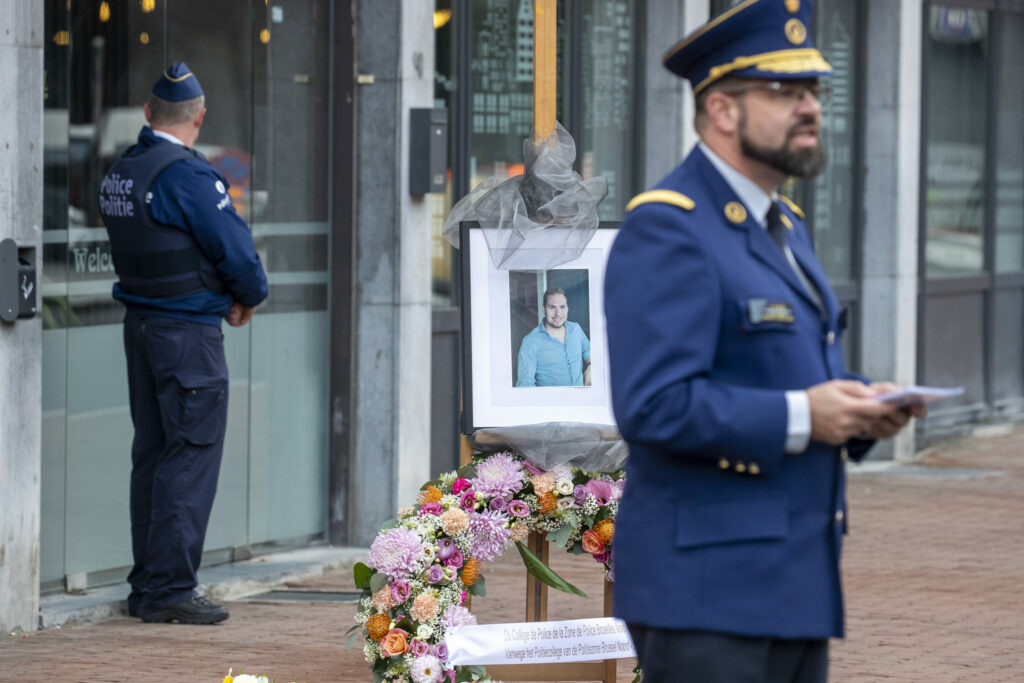
A moment of remembrance for the deceased police officer Thomas Monjoie of the Brussels North Police Zone. Credit: Belga / Nicolas Maeterlinck
A reform of the Act of 26 June 1990 had long been needed to address evolutions in mental health care. On 3 November 2022, the working group appointed for this purpose published its final report.
The first objective was to eliminate the stigma surrounding psychiatric disorders, to use as little coercion as possible and to maximise the use of voluntary alternatives. If compulsory admission is chosen, the duration should not be longer than necessary.
Van Tigchelt and Vandenbroucke worked out a draft law that incorporated the working group's recommendations and also elaborated a modified form of voluntary admission: voluntary treatment under conditions. The bill was approved by the plenary session of the Federal Parliament on 2 May 2024. The reforms below will take effect on 1 January 2025.
Conditional voluntary treatment
Voluntary treatment under conditions is a new measure that falls between forced admission and voluntary treatment. It allows conditions to be attached to this voluntary treatment when a person meets the criteria for compulsory admission but decides to seek voluntary treatment.
This allows the course of treatment to be monitored. Treatment can either be residential or outpatient.
The person must have a treatment plan drawn up in consultation with a doctor and submitted to the Justice of the Peace, who may or may not approve the plan. The doctor supervises the implementation of the treatment plan.

Credit: Belga / David Pintens
If the person no longer wishes to be treated or the conditions imposed are no longer met, the judge and the Public Prosecutor must be informed immediately so that they can take new measures such as compulsory admission.
An emergency procedure is also possible here. The Public Prosecutor can propose voluntary conditional treatment to the Justice of the Peace and impose conditions until the final decision has been made.
Most forced admissions are made through the emergency procedure. To ensure these decisions are well-considered, maximise the use of voluntariness and avoid improper use, a 48-hour clinical evaluation period is provided.
This will enable a better assessment of the person's eligibility for compulsory admission. The evaluation period will also make it possible to check whether a person who proposes to undergo voluntary treatment is credible and, if necessary, attach conditions to this voluntary treatment.
Related News
- 'Triangle of issues': The domino effect of poverty, addiction and mental illness in the Northern Quarter
- One in five adults in Flanders has serious psychological problems
From now on, compulsory hospitalisation will not only be possible in a psychiatric ward of a state-approved hospital, but can also take place in a psychiatric care home, a facility for people with learning disabilities, facilities within addiction services and more.
The aim is to be able to receive and treat the person in a more familiar and adapted environment, avoid interruptions in the care pathway as well as obtain a better distribution. However, the residential institution must meet various criteria regarding safety and the possibility of psychiatric observation.
Additionally, to eliminate the stigma towards people with psychiatric disorders, the terminology of the law will change. Among other things, 'mentally ill persons' will be changed to 'persons with psychiatric disorders' and 'forced admission' will become 'a protective observation measure.'
