

Through the Declaration, European leaders confirm a renewed ambition for the European Pillar of Social Rights, fuelling the hope that the new course will be a social one. However, with a political landscape that is constantly changing, there is the fear that the social agenda will again be pushed to the background by other priorities.
While 1 out of 4 children in the EU are at risk of poverty or social exclusion, persons with disabilities are still discriminated against, and the number of homeless people in the EU has doubled over the past 15 years. Social services face multiple challenges providing quality support. The main reasons are chronic underfunding of the sector and staff shortages. As a consequence, social services are often not sufficiently equipped to innovate and improve their services in order to provide high quality person-centred support. In addition, as Europe’s population is aging, the pressure on social services is likely to increase in the coming years.
While the outlook may look precarious for Europe’s social services there is a saving grace in the form of EU funding and a new initiative to provide tailored technical support to social services wanting to access it. More specifically, around €100 billion of the European Social Fund Plus (ESF+) is to be spent between 2021-2027, with 25% of this being reserved for social inclusion projects and initiatives. That’s essentially €250 million waiting to be unlocked by social care and support providers to strengthen the delivery of quality services and, in turn, invest in improving the lives of the most marginalised members of our society.
Until now, while such EU funds have, on paper, been available to the social services in Europe, multiple barriers have prevented them from accessing key funding programmes such as ESF+. Such barriers include the administrative burden of handling EU-funded projects, rigid and narrow project calls which reduce the potential for EU funds to be used for innovative support and social care service delivery and a lack of knowledge among social services on how to access EU funds.
This is where the HELPDESK (Social Services Helpdesk on EU Funds) project comes in.
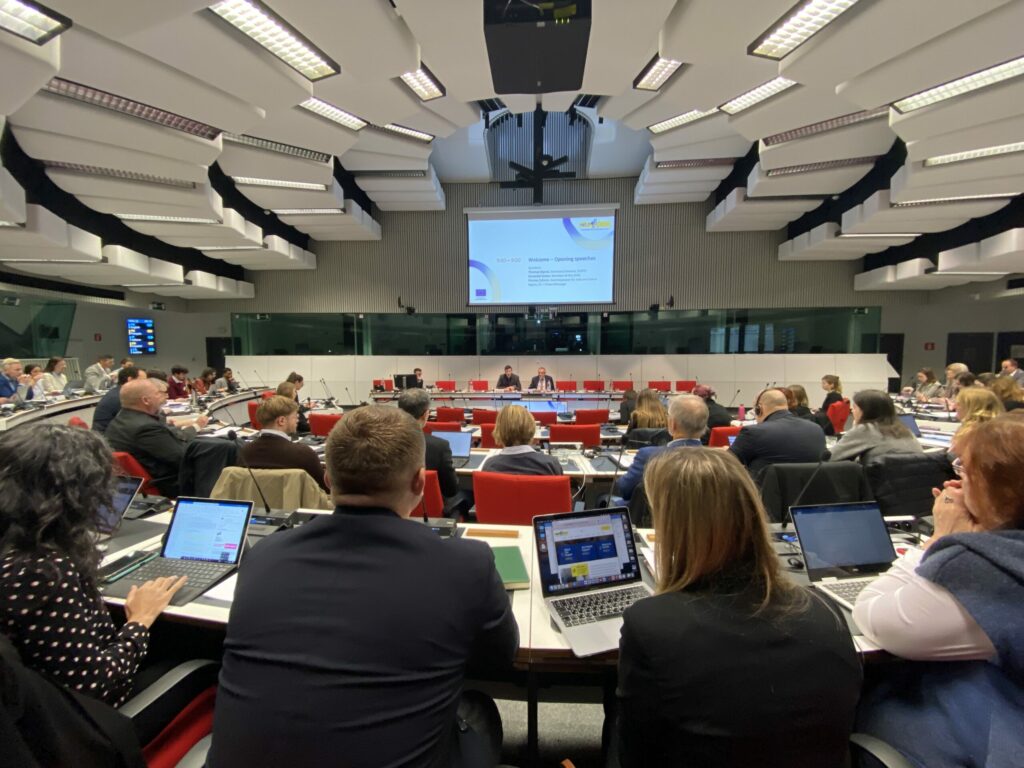
On 16th April the partners of the HELPDESK project hosted over 90 participants from across Europe in Brussels
Launched in May 2022, this EU project has sought to raise awareness of EU funding available to social services and help simplify the complex technical processes of accessing and using these funds. The project has also worked to strengthen the cooperation between relevant actors (including Managing Authorities of EU Funds), so that these funds are allocated to appropriate initiatives and facilitate a transition towards community-based and person-centred support.
To achieve these goals, the partnership of HELPDESK has developed a Facilitation Toolkit for Social Services Projects to help Managing Authorities streamline the project management process and help services effectively respond to the administrative and technical challenges encountered at every stage of a project cycle. The project has also launched an E-training for Social Services on how to successfully fund their EU projects and published Policy Guidance for Managing Authorities, the European Commission and social service providers with recommendations and practical steps on how to use EU funds for quality social inclusion projects.
The positive feedback the training received – as well as the wide interest the initiative has attracted – highlights the need to keep supporting social services and building their capacity. This is not to say that the EU’s HELPDESK is perfect – challenges for social services to access EU funds remain.
Though HELPDESK does not provide all the answers, it’s certainly an important stepping stone in enabling social services to access EU funds and supporting Managing Authorities to facilitate this process. With this, the project has laid a smooth foundation, upon which the EU and Member States can continue building a sustainable, effective and easily accessible channel for social services to utilise funds dedicated to them. As the HELPDESK project comes to an end there is an urgent need for continued commitment of the EU to make its funding opportunities more accessible to social service providers.
According to Lilith Alink, EASPD Policy and Project Officer and coordinator of the project, “EU funds have the potential to encourage Member States to go one step further, to not only invest in upholding the status quo, but to pilot new services and upscale successful social initiatives to ultimately improve the lives of the people who rely on such services.”
Unlocking EU funds for social services is the key to safeguarding human rights for everyone living in Europe while delivering on the initial promises of the European Pillar of Social Rights. The HELPDESK project has allowed us to see a more social Europe on the horizon. Now is the time for the EU and its Member States to act to ensure that we continue to move towards it.
To find out more about the HELPDESK project, click here.
