
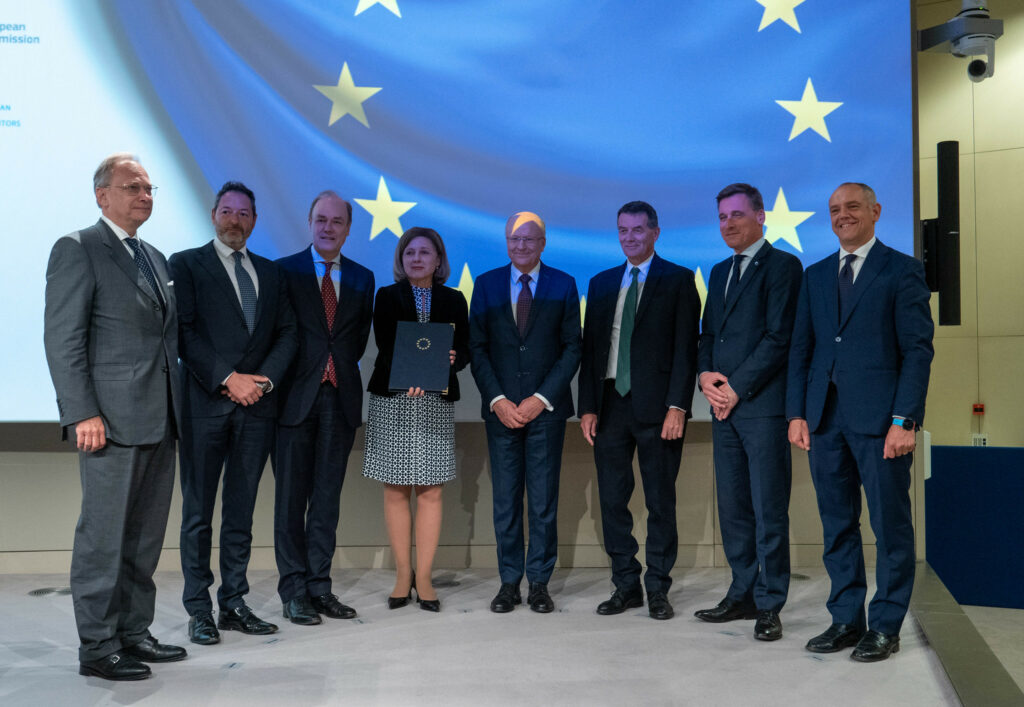
In a ceremony on Wednesday, eight EU institutions signed the founding agreement on the establishment of an interinstitutional body for ethical standards for members of institutions and advisory bodies.
The EU Ethics body is expected to strengthen integrity, transparency and accountability in European decision-making after recurring scandals such as the Qatargate corruption scandal in the European Parliament. The European Commission had announced an ethics body already in the beginning of its mandate and proposed the new body in June 2023 following the disclosure of the scandal.
Other EU institutions may also become party to the agreement, such as the European Investment Bank. The EU High Representative for Foreign Affairs and Security Policy (currently Josep Borell), is also party to the agreement in his or her function as President of the Foreign Affairs Council.
In order to guarantee the independence of the judiciary, the role of the Court of Justice of the European Union in the context of the agreement should be limited to that of an observer, according to the agreement. This role would allow it to benefit from the Body’s common minimum standards in the reflection on its own ethical rules.
The representatives of each party to the agreement will chair the ethics body on a rotating basis for a term of 1 year. They shall, in principle, be at the level of a Vice-President or at an equivalent level.
The ethics body will be assisted by five independent experts who shall attend all meetings of the body as observers and shall advise the members of the body on any ethical question related to its mandate of the body. It will also have a secretariat hosted at the European Commission.
Belgian Ambassador Willem van de Voorde, who had chaired the negotiations leading to the agreement on behalf of the EU Presidency, said at the signing ceremony that the Council welcomes the agreement as an important first step in the development of a common ethics culture at European level.
“The Council is firmly committed to a more transparent, honest, effective and accountable Union,” he assured. “To enjoy the full trust of our citizens, we must ensure that the members of the European institutions behave in an exemplary manner and uphold the highest standards of integrity and ethics. . . in particular by developing common minimum standards for political leaders. We will prevent, rather than cure."
The European Court of Auditors (ECA) is one of the participating institutions in the interinstitutional body. The EU financial watchdog had previously called for such action in a special audit report in 2019 and sees the establishment of the new body as the implementation of its recommendations in the audit report.
“The principles of accountability, transparency and ethics stand as indispensable pillars of our Union, and are essential to its democratic, legitimate, and effective governance,” said ECA president Tony Murphy. “This interinstitutional initiative demonstrates that there is a commitment to work together towards a common culture on ethics, which will also further increase citizens' trust in the EU institutions.”
Asked if he foresees more steps after the first step of establishing an ethics body, he told The Brussels Times that the signature of the agreement was indeed a first step towards a shared culture of ethics.
“But let us not forget that our work does not end here. The signing of this agreement lays the foundation for a more ethical and transparent Europe. It’s up to each and every one of us to uphold these principles in our daily work, to lead by example, and to ensure that the ideals we stand for are reflected in everything we do. ECA is steadfast in its commitment to this cause."
The agreement states that the task of the new body is to develop “common minimum standards” for the conduct of the members of the parties in a defined number of areas listed in the agreement (see below). The body shall agree on standards within 6 months following the appointment of both its members and the independent experts.
However, nothing in the agreement should prevent a party from imposing higher ethical requirements on its members. Nor should anything in the agreement, under any circumstance, constitute grounds for lowering the ethical standards already applied by a party.
How do you assess the risk that the new body will agree on insufficient minimum standards?
“Standards are a vital for providing us with a consistent framework and benchmark to evaluate performance and to maintain quality,” ECA president Murphy replied. “In our special report on ethical frameworks in EU institutions, we already called for such actions five years ago. We are very pleased our report bore fruit and that we are her today, setting up this body together."
“The minimum standards should be seen as benchmarks that bodies are anticipated to achieve, offering a foundational framework' which is important. The ECA remains dedicated to the regular review of our ethical framework to ensure its relevance and alignment with the evolving environment.”
| The common minimum standards shall relate to the following areas: (a) financial and non-financial interests to be declared by the members of the Parties; (b) external activities of the members of the Parties during their terms of office; (c) the acceptance of gifts, hospitality, or travel offered by third parties to the members of the Parties during their terms of office; (d) the acceptance of awards, decorations, prizes and honours by the members of the Parties during their terms of office; (e) activities of the members of the Parties after the end of their terms of office; |
The agreement adds as a complementary transparency measure the 2021 Interinstitutional agreement on a mandatory transparency register, as regards meetings of members of the parties with interest representatives (lobbyists). For the recent ECA audit of the transparency register and its current loopholes, click here.
M. Apelblat
The Brussels Times
