
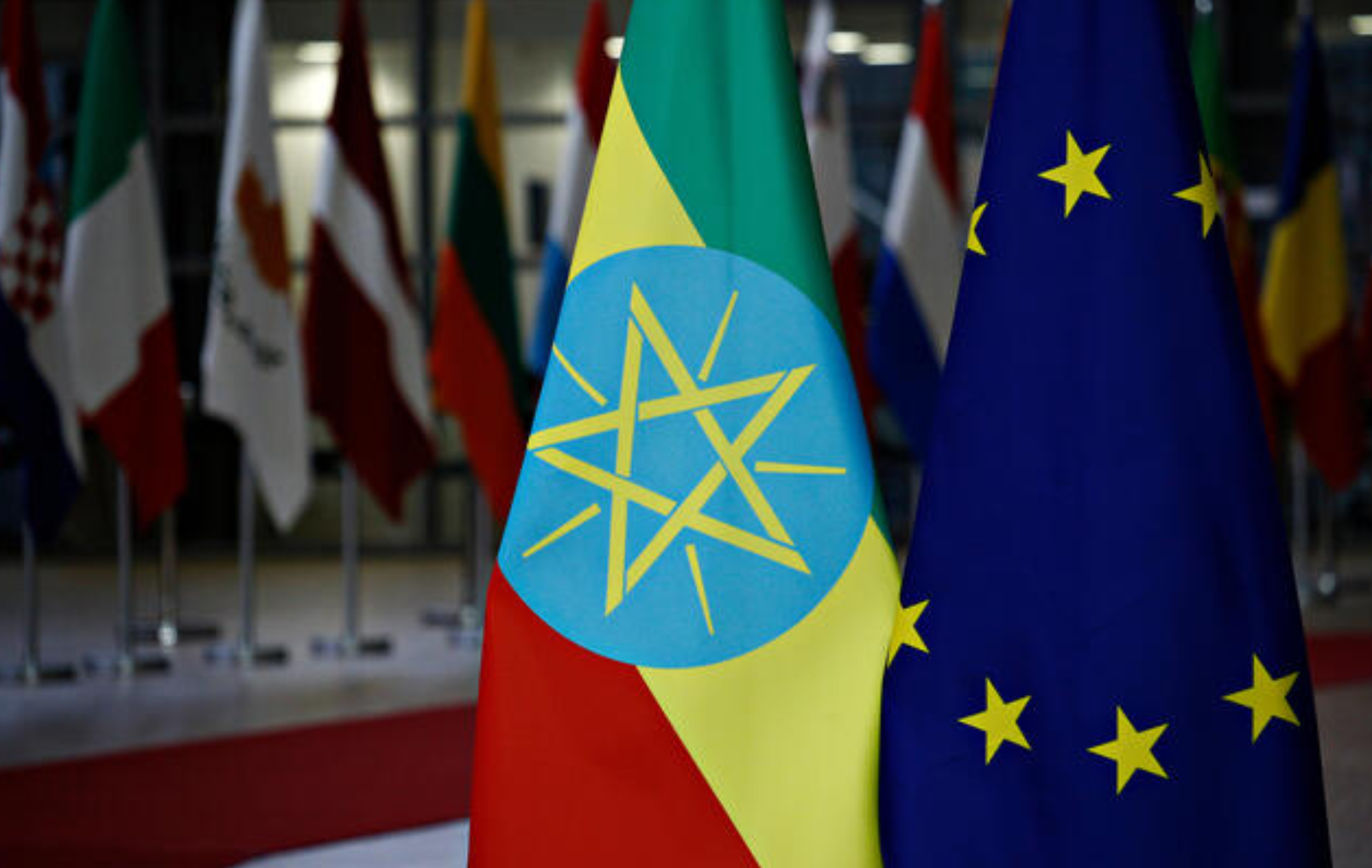
Ethiopia and the European Union enjoy close to half a century partnership, with strong and long-standing bilateral relationships. This relationship has been broad and deep, and it has been steadily growing over the years and enhanced into a “Towards Strategic Partnership” level in 2016.
The focus of the partnership is anchored in six pillars of cooperation: Governance and Human Rights; Regional Peace and Security, Countering Terrorism and Violent Radicalism; Migration; Social and Economic Development as well as Investment and Trade, and Climate Change and Environmental Cooperation.
The two sides have concluded several rounds of consultation to meet the pillars set in their strategic partnership. This has created an enabling environment in creating understanding on issues such as fostering peace and security in the Horn of Africa region, including contributions of both sides in fighting terrorism. The European Union has extended timely support for the capacity building of institutions that focus on democratic governance, such as the National Dialogue Commission and the Ethiopian Election Board.
The partnership has also made it possible to have a mutually beneficial collaboration in supporting the successive development plans in Ethiopia. Programs supported through the European Development Fund (EDF) can be cited in this regard that range from health sector development to environment-related projects. The collaboration with the European Investment Bank (EIB) is also quite longstanding, currently focusing on energy, social development, job creation and support for women entrepreneurs and SMEs.
In the past three years, following the conflict in the Northern part of Ethiopia and particularly the signing of the Pretoria Peace Agreement, the EU has been one of the partners that extended support to various resilience and reconstruction efforts in Ethiopia within the Post-Cotonou partnership framework that range from Disarmament, Demobilization, and Reintegration (DDR), to health and education to agriculture resilience.
Ethiopia is the second most populous country in Sub-Sahara Africa, with a growing population of over 120 million, and around two-thirds of the population is under the age of 30. Its economy has been one of the fastest growing in Africa since the early 2000s. The IMF forecasts estimate that Ethiopia's GDP will grow by 6.1 percent this year and 6.2 percent in 2024, surpassing global and regional growth rates.
The government has implemented policy reforms and incentive packages to attract foreign direct investment. Coupled with the policy incentives, the country's abundant natural resources, affordable and trainable labour, a well developing infrastructure-including, the Ethiopian Airlines with over 100 international destinations, and a growing consumer market are some of the key elements that make Ethiopia an attractive destination for European investors.
With this potential, the flow of foreign direct investment from the European Union to Ethiopia has been on a positive trend, gradually increasing over time. It is estimated that the total Foreign Direct Investment from Europe to Ethiopia has reached almost 1 billion euros, with the majority of companies operating in the manufacturing, agriculture, and service sectors.
Source : Ministry of Finance Ethiopia
In terms of trade, Ethiopia imports over 10% of the country's overall imports from the EU, mainly consisting of machinery and chemical products. On the other hand, the EU is one of the top export destinations for Ethiopian goods, mainly agricultural products like coffee and cut-flowers. According to the United Nations COMTRADE international trade report in 2022, the EU imported $957.74 million worth of goods from Ethiopia and exported $1.39 billion worth of goods, resulting in a positive trade balance for the EU.
Ethiopian products have been covered with the preferential trade access that the European Union extends to LDCs under the Everything But Arms (EBA) initiative. The EU needs to build on this initiative and give more attention that some non-tariff measures will not erode the trade preference that is important for countries like Ethiopia and the end users in Europe.
Ethiopia and the European Union are collaborating in the areas of climate change and environmental protection. Ethiopia is taking climate change and environmental concerns into account in its development policies such as Climate-Resilient Green Economy Strategy, which aims to address both climate change adaptation and mitigation. The country has also launched a national reforestation program called the Green Legacy Initiative, which plans to plant billions of trees to fight land degradation and to protect the environment. Through the Green Legacy initiative, since 2019, Ethiopia has planted more than 30 billion seedlings. As climate change is high on the global agenda, the EU and Ethiopia have further opportunities to collaborate in developing clean and sustainable development projects that range from energy to industrialisation.
Source : https://www.fanabc.com
Normalization of the Strategic Partnership
On the onset of the conflict that was sparked in the Northern part of Ethiopia in November 2020, the relations between Ethiopia and the European Union had passed through some challenges. Nevertheless, there was a very sound approach by both sides in keeping a successive engagement and dialogue. This has helped the revitalisation process between the two sides.
The peace agreement signed in Pretoria on the 2nd of November 2022 has taken a step ahead the process of normalization of relationship between the European Union and the Ethiopian government. The statement of the European Union Foreign Affairs Council on 24 April 2023 was one concrete signal in this regards.
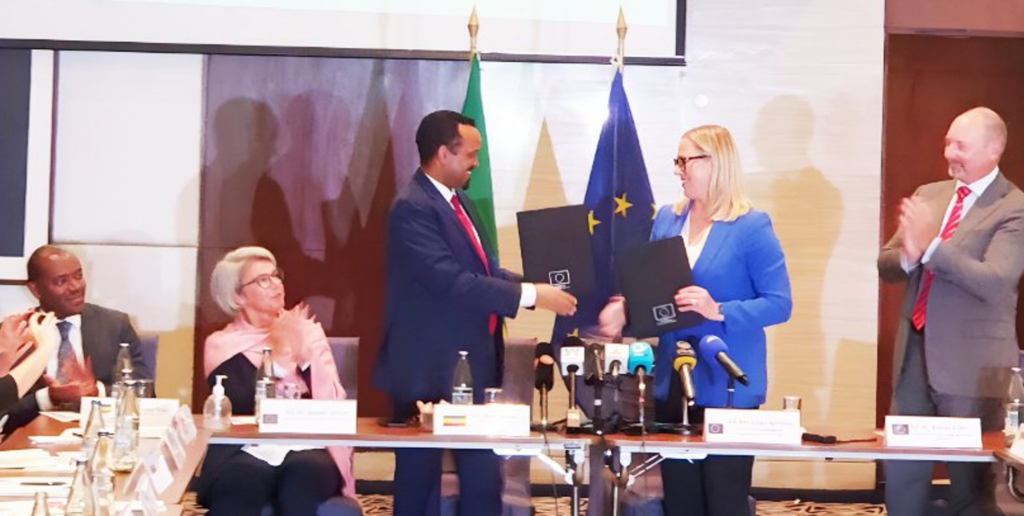
On October 3, 2023, the Multiannual Indicative Program (MIP) 2024-2027 was launched by H.E. Mr. Ahmed Shide, Minister of Finance, and H.E. Ms. Jutta Urpilainen, European Commissioner for International Partnerships in Addis Ababa.
During the launching ceremony, Ahmed Shide, the Minister of Finance of Ethiopia, stated that the signing of the MIP was of great importance to Ethiopia. He further added that the EU had been a strategic partner for Ethiopia for the last 40 years, supporting its economic development and reforms. The Minister expressed optimism that the signing of the MIP will pave the way for a normal development partnership with the EU.
Both parties also underscored the launching of the new cooperation framework will provide an opportunity to refresh and further strengthen the long-standing historic partnership between Ethiopia and the EU. The MIP envelope will avail EUR 650 million in the form of grants to finance development programs focused on the priority areas of Green Deal, Human Development, and Governance and Peace, aimed at improving the living standards of all Ethiopians.
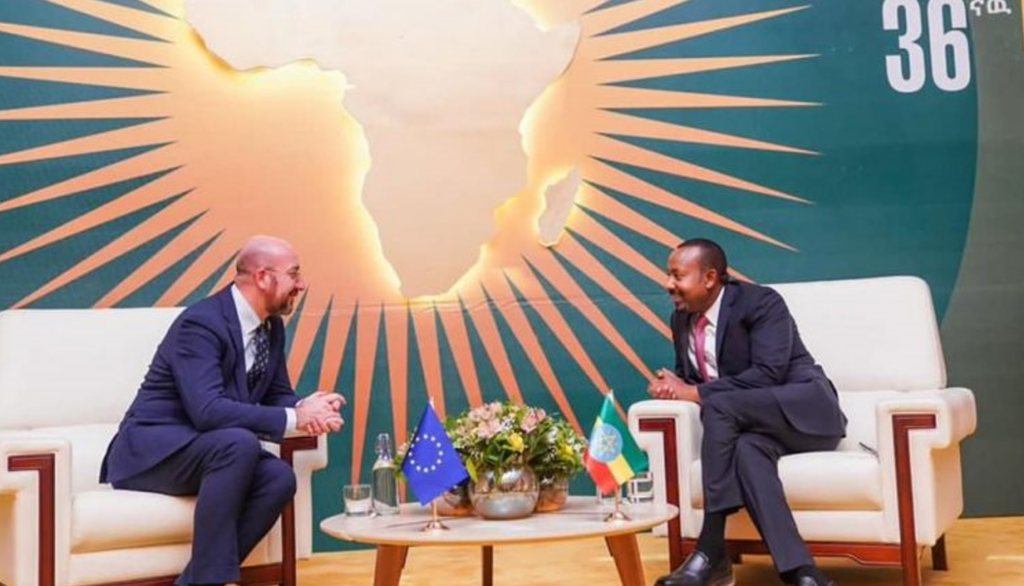
Ethio-EU relations were sustained through the visionary approach the leaders of the two sides have taken, including by conducting several higher-level exchanges of visits and exchange of communications. The visit of H.E. Prime Minister Abiy Ahmed in Brussels during the AU-EU summit in February 2021. The visit of President Charles Michel in Addis Ababa during the AU Assembly in 2022 and 2023 were living testimonies to this fact. It is an opportune moment now to make use of the fresh opportunities at hand to advance the relations to its next hights.
