
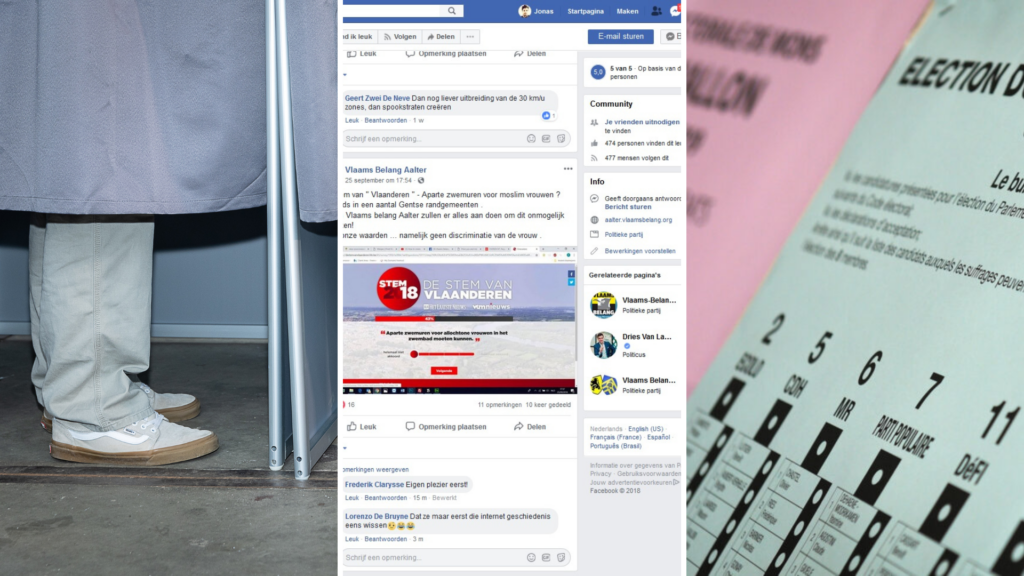
Several political parties and their leaders in Flanders continue to target their social media advertising based on ethnicity – despite recently tightened EU legislation to prevent this.
Flemish political parties including the far-right Vlaams Belang and green party Groen, as well as their leaders, still appear to be targeting certain posts on Facebook and Instagram (the social media platforms owned by Meta) based on people's backgrounds, despite stricter EU legislation.
In other cases, they are deliberately not targeting them with their ads for that same reason, according to De Tijd's report which was based on data from Meta's ad library.
Facebook's parent company, Meta, compiles a detailed profile of all its users through several algorithms, using personal profile information as well as the pages liked by users and even their location. Political parties eagerly use this data to target their sponsored content as specifically as possible.
However, recent EU legislation on the transparency and targeting of political advertising states that special categories of personal data, such as data revealing racial or ethnic origin or political opinions, cannot be used for profiling in paid political ads.
Prohibit with ban
All parties "microtarget" in some shape or form, but the use varies (for example, Open VLD and Vooruit don't use this tactic as often). Vlaams Belang only uses this form of targeting to exclude people. De Tijd found profiles linked to Morocco, Syria, Afghanistan or even Indonesia by Facebook or Instagram are less likely to see the ads Vlaams Belang pays for.
Meanwhile, Groen co-leaders Nadia Naji and Jeremie Vaneeckhout are spending money to reach people interested in, for example, Moroccan cuisine. This means how these Flemish parties and politicians are targeting voters on social media borders on the limits of violating this legislation. The left-wing PVDA and Christian Democratic Party CD&V use data both to attract people and exclude them.
In a reaction, Groen said it is "actively looking for that part of the population that we believe is more in touch with our programme," but denied the claim that this is ethnic profiling. The party added that, if there is evidence of ethnic profiling, Meta should remove this possibility for all political advertisers. Meanwhile, Vlaams Belang argued it uses targeting "like everyone else".
Experts explained this "microtargeting" is still possible because parties use a loophole in regulations: rather than excluding a Flemish party with, for example, Iranian roots, they choose to target or exclude Flemish families who show an interest in Indonesia or are linked to the country in some other indirect way. The current law is still too vague, and only a complete ban would suffice to stop this practice, experts added.
In any, the tightening of rules on this profiling will not yet come into force until the end of next year, meaning it does not yet apply to this election. However, researcher Gunther Van den Eynden of the KU Leuven told VRT NWS that political parties should not hide behind this timeframe and that they should be aware of the legislation and its updates.
Money talks
It is no secret that Belgian parties, particularly those active in Flanders, are among the biggest spenders in Europe for political advertising on social media, a trend started after the far-right Vlaams Belang party achieved very successful 2019 electoral results as the only party to place large-scale paid ads on Facebook.
Belgian political parties spent slightly more than €6 million in 2023 to reach their electorate with political advertising on Facebook and, to a much lesser extent, Instagram in 2023. In the three months running up to the elections on 9 June, more than €870,000 went to sponsored content, despite the blackout period during which spending is restricted. Vlaams Belang's page was the biggest spender, with ads costing over €300,000.
Related News
- Global ambitions and local results: The Mayor's mission to make Brussels a 'smart city'
- Make Flanders ours again? Vlaams Belang uses image of South African model for campaign posters
An analysis of Meta's ad library by digital marketing expert Xavier Degraux showed Belgium is the third most-targeted European country for political ads on Facebook and Instagram (€3.29 is spent on ads per person). Only Denmark, with €6.55 per capita (still over five years), and Sweden, with €5.79, are above Belgium.
The large majority of ads were targeted at people in the Flemish Region (74.4%) followed by 16.1% in the Brussels-Capital Region and 9.5% in Wallonia. Additionally, only Flemish parties and political figures ended in the top 10 main advertisers in the "political, electoral or social interest " category.
