

In Brussels, childcare for infants is a real problem. And the reason? The crying lack of public day-care facilities. A reality that forces parents to find solutions, to help each other out, and that often pushes mothers to sacrifice their professional careers.
The problem is even more glaring for expatriate families, due to the absence of family, a nearby extended network or accessible information.
This is what happened to Marie, from Brussels, and Courtenay, originally from Canada, who moved to the capital in 2021, when their little boy Harrison was born. For them, “it's not motherhood that penalises women's careers, it's the lack of day-care places.”
Have your say on this issue! The Degroof Petercam Foundation has just launched a citizen consultation on this subject. The aim is to gather citizens' opinions on the reconciliation of work and parenthood. All proposals will be looked at in order to come up with a concrete action plan. To take part, click here, or submit your answers directly in the box below.
A crying shortage of public day-care facilities
In July 2022, Courtenay gets pregnant. Knowing how overcrowded the nurseries were, Marie registered her unborn baby directly on the waiting lists. “Everywhere, we were told to be patient, and we were for many long months... only to end up not finding a single spot,” Marie explains.
The moms finally received an e-mail indicating that their baby could have a spot... in November 2024, more than two years after registering!
“When we go there, the carers and management are very understanding, but they're simply overwhelmed.” In the Fédération Wallonie Bruxelles, 2 out of 5 parents are unable to find a place in a day-care center for their child.
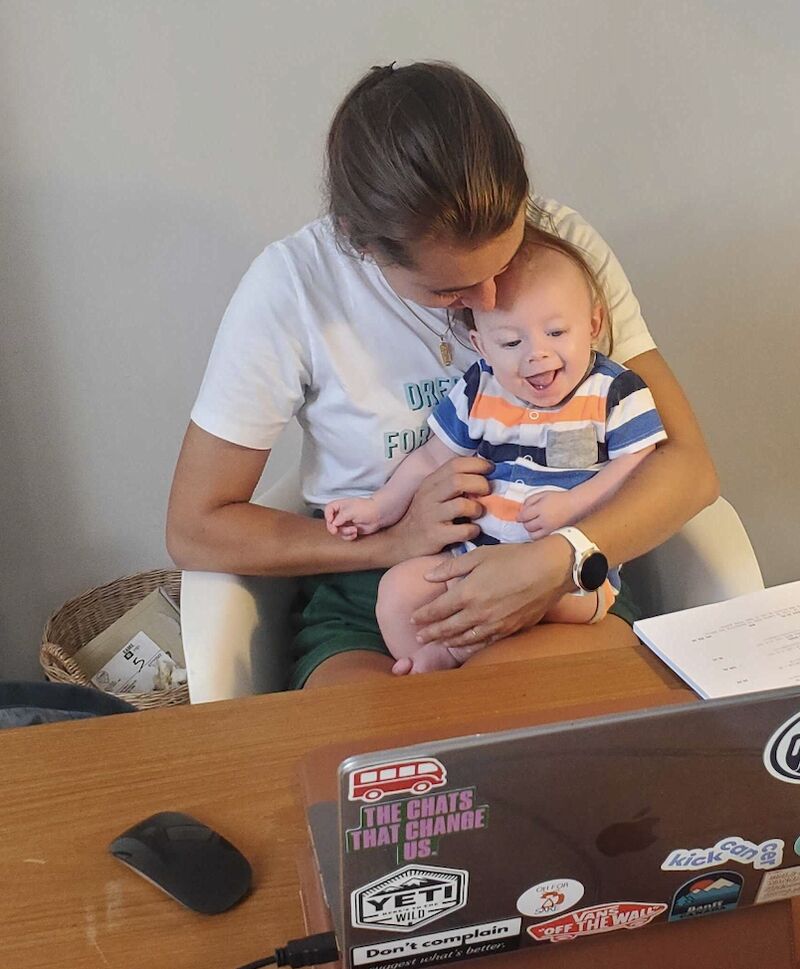
It took Marie and her partner more than 2 years on the waiting list before they finally received a spot for their child at the nursery.
Administrative tangles and lack of information
And this lack of day-care solutions isn't the only problem parents face: “When you're a first-time parent, you don't even know what to do or who to ask!” explains Marie. And all the more so when you're an expatriate, and don't speak French or Dutch. Many parents find themselves at a loss when faced with a lack of accessible information, and lost in the administrative maze.
Lack of day-care: an obstacle to women's employment and careers
This lack of childcare means that parents have to find solutions, often to the detriment of their careers.
In the Fédération Wallonie Bruxelles, 1 parent in 5 is obliged to look after their child themselves, for lack of an alternative. This is what happened to Courtenay, who put her career on hold while she found a solution.
In total, almost 50% of mothers reduce or stop their professional activity in the year following the birth of their child (compared with only 6% of fathers).
According to Marie, it's not motherhood per se that penalises mothers' careers, but the lack of day-care space: “Mothers are put in such a situation that they're forced to choose between their career and their family life. They're forced to find solutions, and as it's at the cost of their child, they'll always prioritise it. At the end of the day, it's the parents who pay, and the state does nothing to help them.”
Helping each other make up for the lack of day-care facilities
Financially too, the lack of public day-care facilities widens the gap. If both parents work, they can sometimes afford a private day care center, sometimes up to 1,200 euros a month! This is what 9 out of 10 parents are forced to do.
A situation that penalises families on more modest incomes all the more... "In this situation, parents are forced to get by on their own: we take turns in the neighborhood, with one looking after 2-3 children on Mondays, the other on Tuesdays; we hire baby sitters, etc. But it's still a short-term solution, which means that non-professionals have to look after several children."
What are the solutions?
For Marie, it's a matter of taking care of children from kindergarten to university, but without worrying about early childhood. “Especially as it would be fairly easy: the flow of children is predictable, we know when they're going into the nursery and when they're coming out. All babies must be able to go to an affordable, quality day-care facility."
Until recently, this issue didn't seem to be a political or social priority, but things are gradually starting to move. As evidenced by the public consultation on parenthood and work, launched by the Degroof Petercam Foundation, parents are calling for more day-care facilities, for companies and employers to be made more aware of the importance of equality between men and women with regard to parenthood, and for arrangements such as telecommuting, flexible working hours and so on. Don't hesitate to take part in the public consultation below.
With a focus on giving parents a voice and finding solutions, the Degroof Petercam Foundation has just launched a public consultation on the subject of reconciling parenthood and work. The proposals will be analysed in order to come up with a concrete action plan. To take part, click here or submit your answers directly in the above box.
