
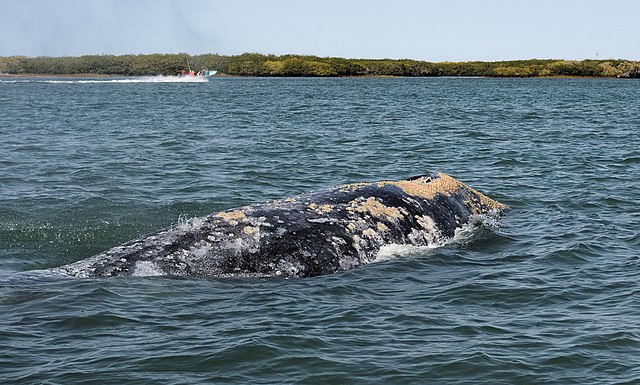
Pacific grey whales have shrunk by 13% in two decades, according to a recent research article that sheds light on the impact of climate change on marine mammals.
This size reduction could significantly affect the whales’ ability to reproduce and survive, in addition to having an impact on their feeding system, scientists warn in the research article, published in the Global Change Biology journal.
The researchers focused on a small group of around 200 north-eastern Pacific grey whales. Known as ecosystem sentinels, these whales tend to stay near the coast and feed in shallower, warmer waters than other grey whale populations.
Previous studies have revealed this group is less robust than other whales, being smaller and thinner.
"Now we know they have been shrinking in body size over the past 20-40 years, which may be an early warning sign that the population is at risk of declining," Kevin Bierlich, co-author of the article, told AFP on Thursday.
Researchers analysed drone images taken between 2016 and 2022 of 130 whales whose ages they knew or could estimate, and noticed an average 13% reduction in adult size between individuals born in 2000 and those born in 2020. This reduction amounted to about 1.65 metres for whales measuring around 13 metres.
The shrinkage is even more pronounced in females, who historically were larger than males and are now of equal size. “Size is crucial for animals,” notes Enrico Pirotta, the research article’s lead researcher. “It influences their behaviour, physiology, life cycle, and has ripple effects on the species and population of which they are a part,” he explains.
Reproduction is particularly affected, with smaller young potentially having lower survival rates. Interestingly, the researchers identified a correlation between this size reduction and the disruption in ocean cycles caused by climate change, especially currents that foster the growth of plankton, the whales’ primary source of food.
The article was published in the Global Change Biology journal under the title 'Modeling individual growth reveals decreasing gray whale body length and correlations with ocean climate indices at multiple scales.'
