
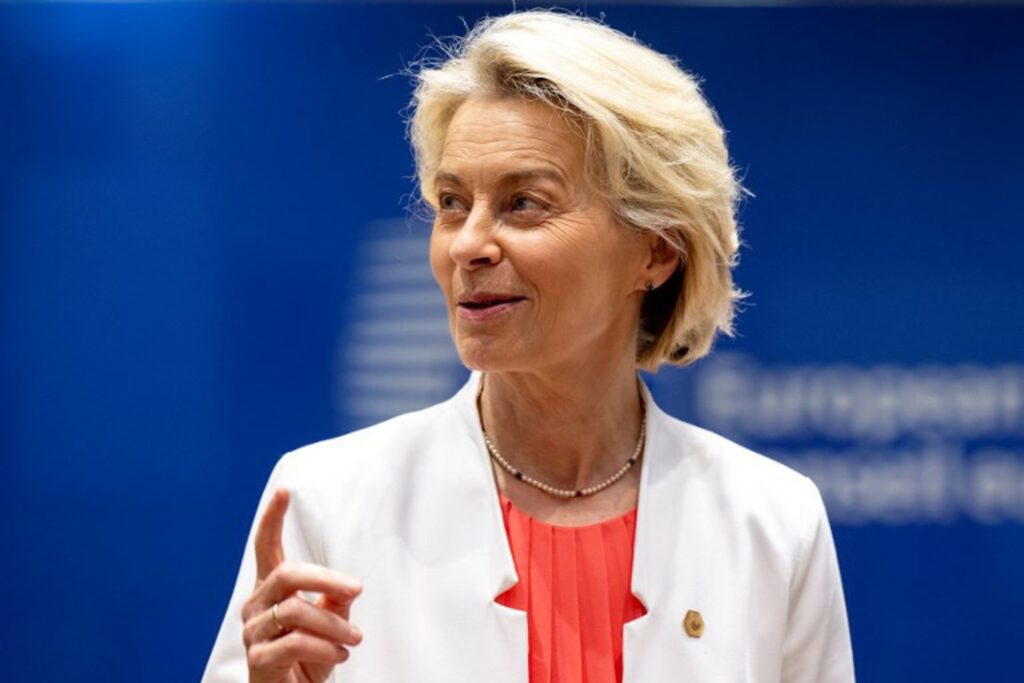
The European Socialist Party (PSE) formally expressed its support on Tuesday for the reappointment of German Conservative Ursula von der Leyen as head of the European Commission, providing far-right political groups are excluded from negotiations.
The Socialist and Democratic group (S&D) in the European Parliament holds an estimated 136 seats, according to the still provisional election results from 9 June. They remain the second largest party in the assembly, next to the European People’s Party (EPP) with an estimated 190 seats.
Both parties are negotiating with the third largest party, the liberals and centrists of Renew Europe, who hold 80 seats. Their aim is to continue the coalition that has supported von der Leyen during the previous legislature. Unlike in 2019, this year the German candidate is the EPP’s lead candidate (Spitzenkandidat) for the European Commission.
"The PSE continues to support the Spitzenkandidaten system and is prepared to back the EPP’s candidate for the presidency of the European Commission, so long as the negotiations don’t involve far-right political factions and the programme reflects real need to strengthen our Union," the party stated in a release.
On Monday evening, EU heads of state and government dined in Brussels to discuss the allocation of the top positions in the European Union. One initial proposal reinstates Ursula von der Leyen (EPP) to the Commission and Roberta Metsola to the European Parliament.
Having won the European elections, the European People's Party (EPP, pro-European conservatives) is in a good position to confirm its main candidate, Ursula von der Leyen, for a second five-year term, as well as Malta's Roberta Metsola for a new term at the head of the European Parliament.
In this scenario, the Presidency of the European Council, the circle of heads of state and government of the EU-27, could fall to the Socialists & Democrats (S&D), who came second in the European elections.
Antonio Costa belongs to this family. He led Portugal from 2015 until this year, but was forced to resign after being named in an investigation into influence peddling in the construction of a data centre in the coastal town of Sines. The Portuguese has not been charged, but the investigation is still ongoing.
However, no agreement was found on Monday evening. Tensions rose when the EPP – who has been threatening an alliance with the far-right – proposed to the Socialists that the European Council president’s term should be be split into two 2.5-year chunks — and the EPP would get one of them, report Politico and Euronews.
"Last night’s exchanges were merely the first step in a longer negotiation process," stated the PSE. German Chancellor Olaf Scholz and Spanish Prime Minister Pedro Sanchez are their negotiators at the Council, with the party expressing "full support".
