
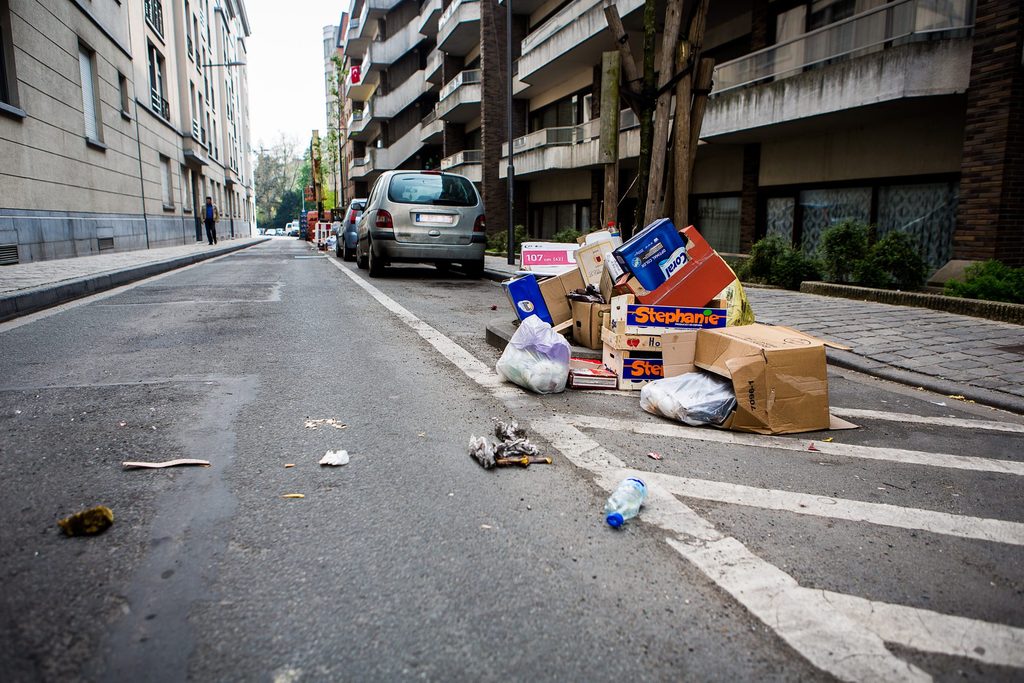
Aside from being an annoyance, litter also harms the environment and people's health, while cleaning it up bears a high cost for society. One study aiming to understand who is most likely to litter and why found that an integrated approach is needed to solve the issue.
Litter is in the top three biggest annoyances for people in Flanders, the regional government's annual Municipal-City Monitor showed. The majority feel it makes their living environment less pleasant to live, work or relax in, another survey by Mooimakers, a multi-organisational initiative against litter and fly-tipping, found. It also costs society handsomely to clean the messes up.
Still, the issue remains commonplace: almost 20% of the respondents to Mooimakers' survey, mostly young people, indicated they take few steps to avoid littering.
Generational gap
Mooimakers looked at the factors that lead to littering and found various behavioural profiles within Flanders regarding litter, with age being the biggest discerning factor. "Other socio-demographic factors, such as gender, province of residence, social class, there are no significant differences," the study's researchers pointed out.
With the survey results, they identified four groups. The first two – the "Principled" and the "Accidentals", together represent about 80% of the population and people in both groups are highly motivated not to leave litter behind.
The first group, accounting for 51% of respondents, with more over-55s than the other three groups, has a strong intrinsic norm against leaving litter. People in the second group (30%) also have a strong intrinsic norm, but sometimes leave litter when they are not the causal factor, for example when it is windy or their litter falls on the ground. Among people in this group, the average age is 50.
Then come the so-called "Justifiers", which make up about 10% of respondents. "These people justify littering by using external factors as excuses, such as others do it too, there is already litter or the sewer drain is better than on the street anyway," the researchers wrote. This perpetuates the problem. The average age of this group is 36, and 54% of them are between 16 and 34 years old.
Finally comes the "Indifferent" group, including people who have no motivation to avoid littering and leaving their waste lying about. "They do not see the problem and argue that litter decays and does not harm nature." The average age here is 39, and 53% are aged between 16 and 34.
Related News
- Rubbish collections: Brussels-Propreté prepares to hand out more fines
- Over 350 tonnes of litter cleared at 'Great Cleanup' in Wallonia
According to the study, a major cause lies in a lack of knowledge about the negative effects of litter – "there is a misconception that small items like chewing gum or cigarette butts do not harm the environment" – as well as small obstacles such as a lack of bins in the neighbourhood that cause litter to end up on the streets.
"The common thread among these reasons is a lack of information, knowledge and infrastructure. A small minority feels that the responsibility of littering does not lie with citizens," the researchers noted. They therefore stressed that placing more litter bins alone is not the only solution, but that information campaigns about the consequences of littering are needed too to change people's behaviour.
