
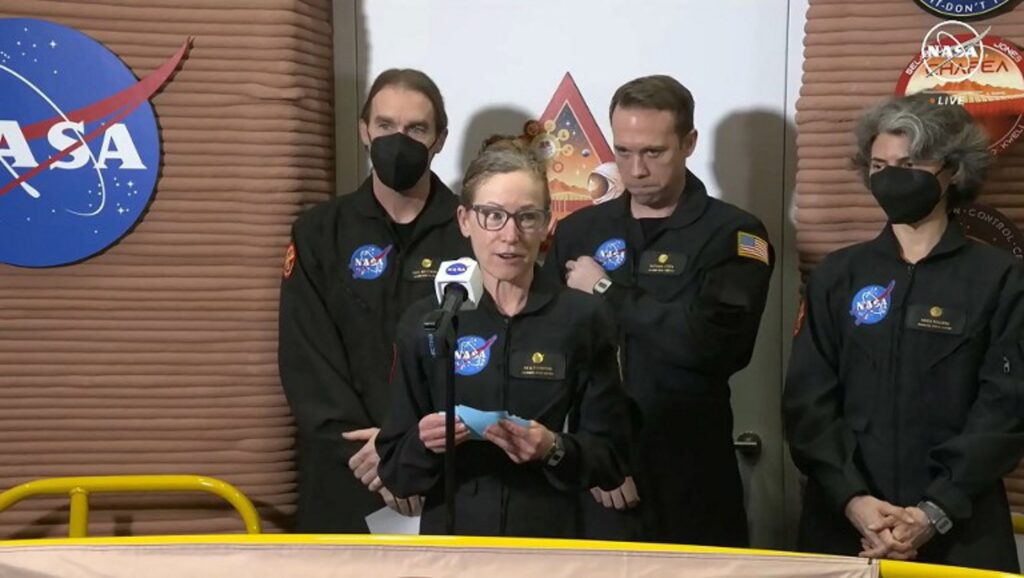
Four scientists have concluded a 378-day mission living in Mars-like conditions in Houston, USA, on Saturday, looking to pave the way for human habitation on the red planet.
The team, consisting of Anca Selariu, Ross Brockwell, Nathan Jones and team leader Kelly Haston, were confined within a “Martian habitat” in Houston, Texas as part of a NASA study.
During this time they grew vegetables, walked on red sand, and worked under additional strain factors like isolation, confinement, and slowed communication with “Earth” and their families.
Their temporary home, known as “Mars Dune Alpha”, was a 160-square-meter structure built by 3D printers which included bedrooms, a gym, communal areas, and even a vertical farm for growing their own food.
An adjacent area, separate from the habitat and covered in red sand, served as the base for their “Martian walks.”
The team spent the entirety of their mission “conducting vital scientific research, mainly focusing on nutrition and its effects on performance, as we prepare to send humans to Mars,” Steve Koerner, Deputy Director of NASA’s Johnson Space Center, said.
This was the first of three crew health and performance exploration missions of NASA’s Analog project.
Another year-long simulation of life on Mars took place in a Hawaiian habitat from 2015 to 2016; NASA participated in this endeavour but was not in charge.
Under the Artemis programme, NASA plans to return humans to the moon to better understand how to live away from Earth long-term, thus setting the stage for a Mars voyage possibly around the end of the 2030s.
