
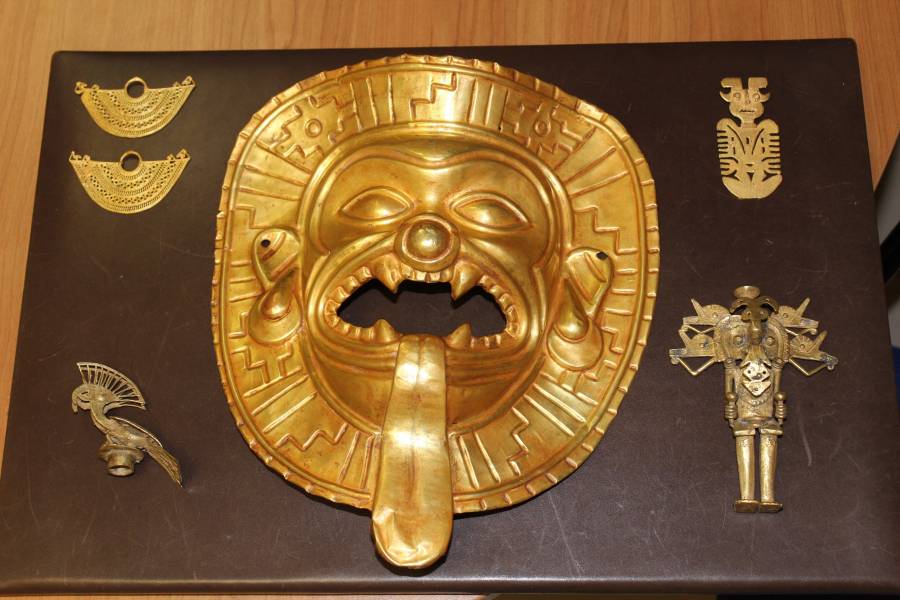
Interpol has announced the recovery of over 6,000 works of art and dozens of arrests, as a result of an annual operation linking Interpol, Europol and law enforcers in multiple European countries.
The eighth edition of 'Pandora,' an operation against international art trafficking, involved customs and law enforcement authorities from 25 countries. Spearheaded by Spain's Guardia Civil, with the support of Europol and Interpol, the operation led to the arrest of 85 persons and the recovery of over 6 400 cultural goods.
According to Interpol, 'Pandora VIII' involved “several thousand checks” at various locations, including airports, ports, border crossings, auction houses, museums, private residences and even the Internet.
In one of the many interventions, Spanish authorities, working in collaboration with their Ukrainian colleagues, intercepted 11 gold objects, valued at €60 million, that had been stolen in Ukraine and illegally transported to Spain. This was part of a trafficking operation in Scythian cultural archaeological items.
In the Czech Republic, police seized a statue of Saint Bartholomew, traced back to the middle of the 17th century, that was stolen from a chapel in the town of Rimov in 1994 and was of national cultural significance.
French authorities, for their part, seized a work of art by Vietnamese artist Mai Thur, that had been illegally exported and whose value was estimated at around €170,000.
The countries participating in 'Pandora VIII' included Albania, Austria, Bosnia-Herzegovina, Bulgaria, Czech Republic, Croatia, Cyprus, France, Germany, Greece, Ireland, Italy, Latvia, Malta, Montenegro, Netherlands, Norway, Poland, Portugal, Romania, Spain, Serbia, Sweden, Ukraine and the UK.
