

Last year, Belgium saw the highest rate of shoplifting in a decade, according to the latest Federal Police statistics. As a result, supermarkets are calling for government intervention to "finally address the issue".
A total of 24,021 shoplifting cases were recorded across the country in 2023, the latest crime statistics report shows. Since 2018, food has consistently been the most-stolen product type, according to data from the Federal Police. Last year, 9,576 incidents of this crime were related to food items.
However, the actual figure dramatically outnumbers the documented incidents as shop owners only report around 11% of thefts, according to Luc Ardies, director of Buurtsuper.be (the federation of independent supermarket operators).
The local police will always come to a store in the event of a shoplifting incident, a spokesperson for the Brussels-Capital/Ixelles police zone told The Brussels Times. Only in exceptional cases – such as when dealing with an emergency – will the police not attend the scene.
However, the supermarket operators' federation believes that the government needs to do more to make shoplifting a priority. According to Ardies, one method would be to adopt the Afrekenen met winkeldieven ('Settling with shoplifters') approach, originally proposed in 2017.
This initiative allows for shoplifting cases to be addressed without the police's direct intervention. Shoplifters who are caught must pay compensation to the shopkeeper, who then formalises the incident via a form they forward to the police, resulting in an official report.
Despite an initial positive reception by politicians, the initiative faced criticism from the police. The main reasons, according to Ardis, were the fact that a new ICT system would need to be developed and that shoplifting by minors would not be addressed, as they would not be able to pay for the settlement. As a result, the proposal "died a quiet death," Ardies told The Brussels Times.
In 2022, a new approach was introduced: the Lik-op-stuk beleid, or 'Tit-for-Tat' policy. With this policy, the police would come to the scene of a shoplifting incident to write up a report and issue a fine.
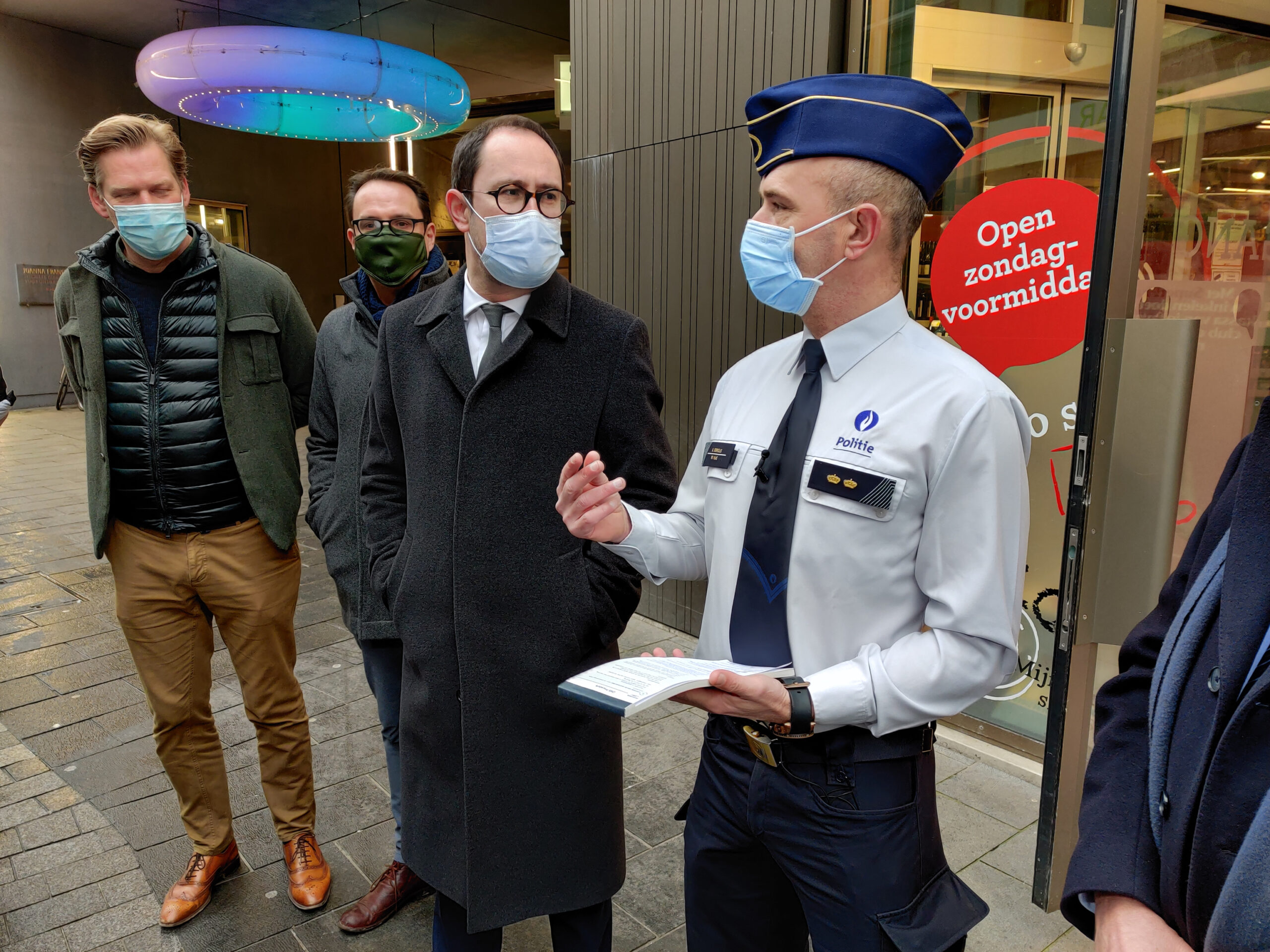
Former Justice Minister Vincent Van Quickenborne and Information Management officer for the VLAS police zone Koen Derous pictured during a press conference following the launch of 'Tit-for-Tat' fines in 2022. Credit: Belga / Maaike Tijssens
Although it made headlines at the time, Ardies claims that the policy "never actually took off the ground, because in most cases the police don't want to bother coming to the scene." He believes more concrete action must be taken: "If after so many years neither the police nor Public Prosecutors see fit to organise a decent prosecution or enforcement policy, then we want to try ['Settling with shoplifters']."
Nine in ten shop owners are faced with shoplifters every week, according to Buurtsuper.be. The impact of shoplifting can result in businesses losing up to half their net profit, the federation stated in a press release.
A survey last year revealed that four in ten Belgians steal at least one item from supermarkets. For those using the self-scanning option, the statistics rise to one in three.
