
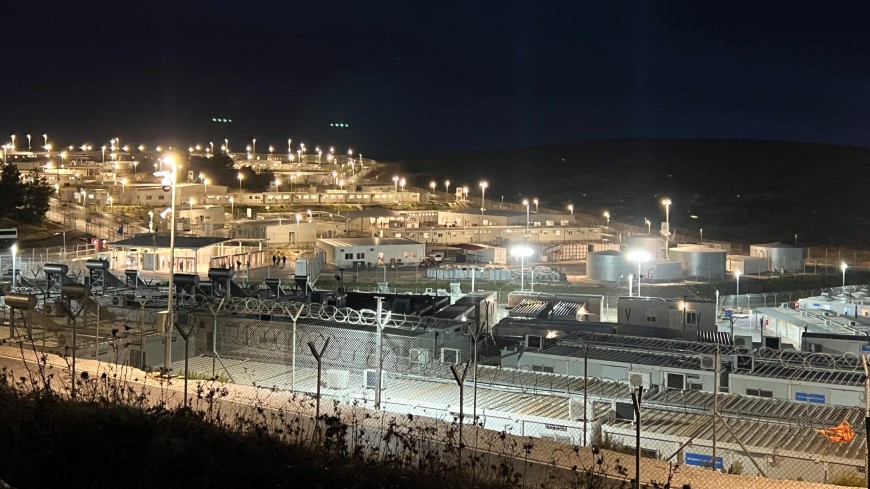
Asylum seekers on the Greek island Samos are unlawfully deprived of their liberty under inhuman conditions in a detention centre which has been funded by the EU, according to a report issued by Amnesty International on Tuesday.
The research was conducted between December 2023 and July 2024. Amnesty was able to visit the centre on Samos and speak to residents and representatives of the Greek authorities. The report includes drawings by asylum seekers showing their feelings and experiences of life in the centre. The study is also based on interviews with civil society organizations and UN agencies.
The report reveals indiscriminate use of “restrictions of freedom” orders subjecting residents to unlawful and arbitrary detention, says Amnesty. Residents are systematically subjected to orders which confine them to the centre for up to 25 days or even more from their entry. The restrictions exceed the legitimate limits in international law.
“Under the pretext of registering and identifying people, the Greek authorities are de facto detaining all residents upon arrival, including people in vulnerable situations, in violation of their rights,” says Deprose Muchena, Senior Director, Regional Human Rights Impact at Amnesty International. “This is all happening in an EU-funded site that is supposed to be compliant with European standards.”
After fires devastated the Moria refugee camp on the Greek island of Lesvos in 2020, the European Commission provided €276 million of EU funds for new “multi-purpose” centres, promising better conditions. The sites were designed to comprise reception and pre-return detention facilities. On Samos, a so-called “Closed Controlled Access Centre” was the first to be opened in 2021.
As a result of increased arrivals in 2023, the centre on Samos became overcrowded. “The EU promised these centres would be up to European standards”, says Deprose Muchena.
“Instead, we found a dystopian nightmare: a highly securitized camp lacking in the most basic infrastructure. Security cameras and barbed wire scale the centre creating a prison-like environment. People does not have enough water or adequate healthcare, and, in some cases, even beds. All the while being unable to leave the centre for weeks, sometimes months on end.”
He fears that the detention conditions in the closed centres can be copied by other Member States when the new EU Pact Migration and Asylum will be implemented. “Samos provides a window into the future of the Pact and offers a critical opportunity for the EU and its member states to change course.”

European Commission President Ursula von der Leyen and EU leaders visited the Evros region on the border between Greece and Turkey in March 2020, credit: EU
This was not what the European Commission had expected. In connection with the outbreak of tension at the Greek-Turkish border in 2020, when Turkey pushed refugees across the border, the situation on the islands in the Aegean Sea became unacceptable, causing a backlash among the local population. Greece was forced to temporarily suspend asylum application procedures.
“The limit to what can be done in the islands has been reached,” said Margaritis Schinas, Commission Vice-President for Promoting our European Way of Life. “The new Greek government has enacted a new law which is being implemented to transfer migrants to new centers in the mainland.”
Although restrictions of freedom orders apply to all migrants in the closed centres, they almost exclusively affect ‘racialized’ asylum seekers. “People in the centre are predominantly people from Africa and the Middle East, and as such people from ethnic groups and minorities that are subject to stereotype and prejudice,” Adriana Tidona, the migration researcher who drafted the report, told The Brussels Times.
The findings in Amnesty’s report are confirmed in a recent report published by the Council of Europe's Committee for the Prevention of Torture and Inhuman or Degrading Treatment or Punishment (CPT). Following a visit to Greece in November 2023, the committee urges the Greek authorities to improve the conditions in the country’s immigration detention facilities.
The CPT report deals especially with the newly-built and EU-funded closed centres on the Aegean islands of Lesvos, Kos and Samos but the CPT visited also police stations and pre-removal detention centres in the mainland. “While our conclusions overlap in many respects, the reports are independent of each other,” Tidona commented.
CPT found that a great number of persons in the closed centres on the islands were deprived of their liberty way beyond the time limits provided by law and without benefiting from the legal safeguards related to detention, including access to a lawyer and interpreters. The living conditions for many of the persons met by the CPT could only be described as inhuman and degrading, CPT writes.
Does the European Commission monitor the conditions in the closed centres on the Greek islands? A Commission spokesperson replied that the Commission is aware of the reports and stressed that the Member States must provide adequate living conditions in line with EU rules.
The Commission says that it is continuously supporting Greece to improve the conditions and build additional centres in both the mainland and the islands. But in January 2023, the Commission initiated infringement procedures against Greece relating to restrictions of freedom and reception conditions in the centres. That case is still on-going, with no deadline set.
The number of refugees and migrants arriving in Greece increased in 2023 and amounted to ca 49,000, the majority of them by sea. During the same period, 800 persons were reported dead or missing. As of 31 December 2023, ca 27,000 people have been granted temporary protection in Greece. Half of the 32,900 people inside the Greek reception system were residing on the islands.
M. Apelblat
The Brussels Times
