
The Middle East was on the brink of a full-scale war on Sunday morning when Israel carried out a pre-emptive air strike against Hezbollah’s rocket launching sites in southern Lebanon just minutes before the Shiite Iranian proxy had planned to attack targets in northern and central Israel.
Israel says that its air strike, involving over 100 jet fighters, destroyed thousands of Hezbollah’s rocket and launchers, including some of its precise missiles. Hezbollah’s counter-attack followed directly afterwards but did not cause much damage and most of the up to 300 rockets and drones that were fired by Hezbollah were either intercepted or struck open areas.
The Israeli pre-emptive attack, based on exact intelligence, might have averted a full-scale war with devastating consequences for both countries in case Hezbollah would have succeeded in its planned attack. The strikes on both sides were followed by a deceptive calm along the Israeli-Lebanese border. The situation has returned to what it was before which means that it can easily spiral out of control.
The massive strikes did not come as a surprise. The region has been bracing for reprisal attacks by Iran and Hezbollah since the killings of Hezbollah’s top commander in Beirut and Hamas’ political leader in Teheran. While Iran seemed deterred and announced that it would give the ceasefire and hostage talks a chance, Hezbollah threatened to attack Israel on its own irrespective of the talks.
Hezbollah did not even wait for the high-level talks that took place in Cairo under the mediation of the US, Egypt and Qatar to end. In his speech on Sunday, Hassan Nasrallah, the leader of Hezbollah, was defiant and said that it could attack again if its attack had not been successful enough. But for the first time he said that Lebanon could take a breath and relax, at least for now.
On Sunday afternoon, EU’s high representative for foreign affairs and security policy, Josep Borrell, seemed also to have taken a breath of relief. In a tweet, without mentioning that the region just had escaped escalation to full-scale war, he wrote that “the situation in the Middle East has reached a critical level of dangerosity.”
In another tweet on Monday, he described the most massive air strikes until now as “heavy crossfire” without distinguishing between the two sides. In fact, the Middle East reached a critical level almost directly after 7 October last year, when Hezbollah started an unprovoked low-intensity war in solidarity with Hamas. The war keeps escalating and can erupt to full-scale war by miscalculation.
Borrell added that he supports the Lebanese prime-minister’s “call for the immediate application of UNSCR 1701, in addition to the much-needed ceasefire in Gaza” to avert the risk of a full-blown war. He also spoke to the Lebanese foreign minister about it. Borrell is referring to a UN Security Council resolution from 2006 which never was implemented by Lebanon.
Israel has withdrawn from Lebanon (besides a contested strip of land). Hezbollah was obliged to withdraw from the south of Lebanon, to be replaced by Lebanese government forces, but is still there. Hezbollah is stronger than ever, armed by Iran despite an arms embargo on Lebanon. Current mediation talks under the US and France to find a diplomatic solution have so far failed.
During her visit in Lebanon in beginning of May, European Commission President Ursula von der Leyen announced that the EU will provide a financial assistance package for Lebanon worth €1 billion for 2024 to 2027. She also mentioned that the EU is deeply concerned about the volatile situation in South Lebanon.
“What is at stake is the security of both Lebanon and Israel. The two cannot be disassociated. So, we call for the full implementation of the UN Security Council Resolution 1701 by all parties.” A settlement would enable 100,000 displaced Lebanese citizens and up to 80,000 displaced Israelis to return to their homes on both sides of the border.
However, this was hardly mentioned by the Lebanese government during the meeting. It is helpless against Hezbollah which has become a state within the state, acting as a proxy of Iran with the most powerful militia in the country and veto power in the government. EU has been forced to separate between its policy on Hezbollah and its economic ties with Lebanon as if they are unrelated issues.
“The EU assistance to Lebanon is being implemented independently of what is going on between Hezbollah and Israel,” EU’s lead foreign affairs spokesperson Peter Stano told The Brussels Times.
As regards Lebanon, Iran and other problematic third countries, the EU applies a policy of “critical engagement” using carrots and sticks to make them change course. High Representative Borrell focuses in particular on diplomacy and dialogue, with a teaspoon of sanctions, with Iran. His spokesperson explains that the EU calls on all actors in the region to take steps to de-escalate.
In a recent telephone call to Iran’s new foreign minister, Borrell spoke diplomatically about “prospects for renewed engagement on all files of mutual interest, incl. the need for de-escalation & restraint.” The new foreign minister has tweeted that “the Israeli occupying regime will pay a heavy price” for the killing of Palestinian leader Ismail Haniyeh.
An Iranian reprisal attack against Israel seems only a matter of timing but depends on the outcome of the talks on Gaza that continue on a lower level. As long as they continue, it will refrain from an attack. The Iranian regime, with a newly elected president which is considered as moderate, is more afraid than Hezbollah of the devastating consequences of a full-scale war.
After months of negotiations, both Hamas and Israel had in principle agreed on the terms of a ceasefire-hostage deal. A three-phase roadmap to an enduring ceasefire and the release of the hostages was disclosed by US President Biden on 31 May. Since then, however, Netanyahu’s far-right government in Israel has added conditions that jeopardise the deal.
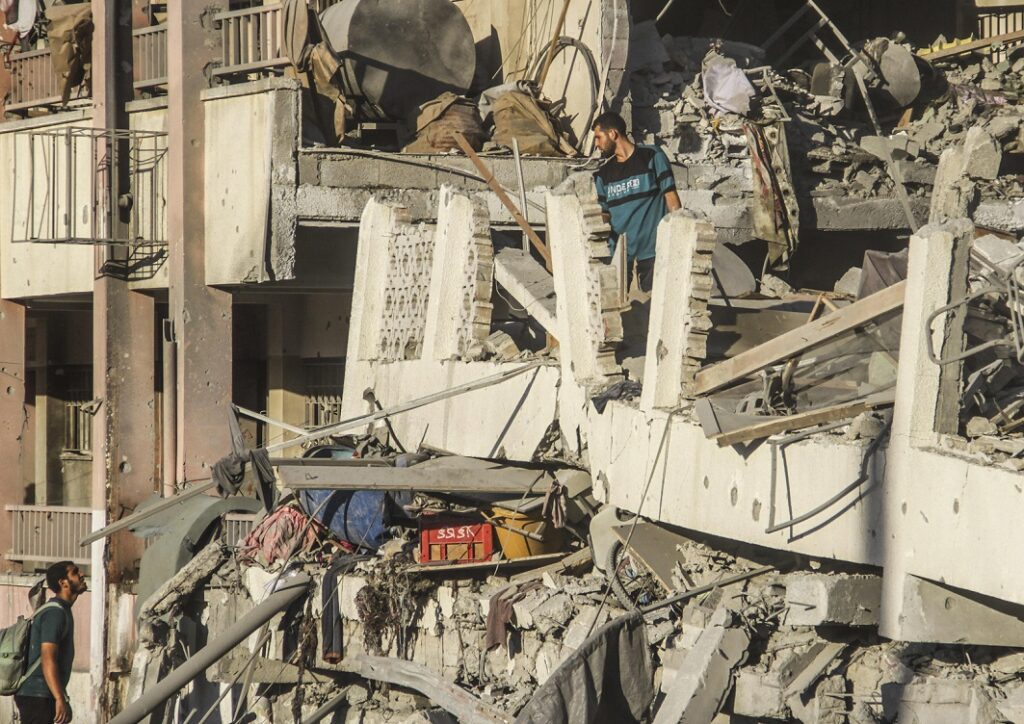
A ceasefire-hostage deal would end the war, enable more humanitarian aid and jumpstart the rebuilding of Gaza. Credit: Belga
However, according to recent opinion polls, a majority of the Israeli population supports a ceasefire-hostage deal which would bring the hostages home before they all are dead and end the war in Gaza and the untenable situation in the north. The latter would hopefully lead to a political solution based on the implementation of UNSC resolution 1701.
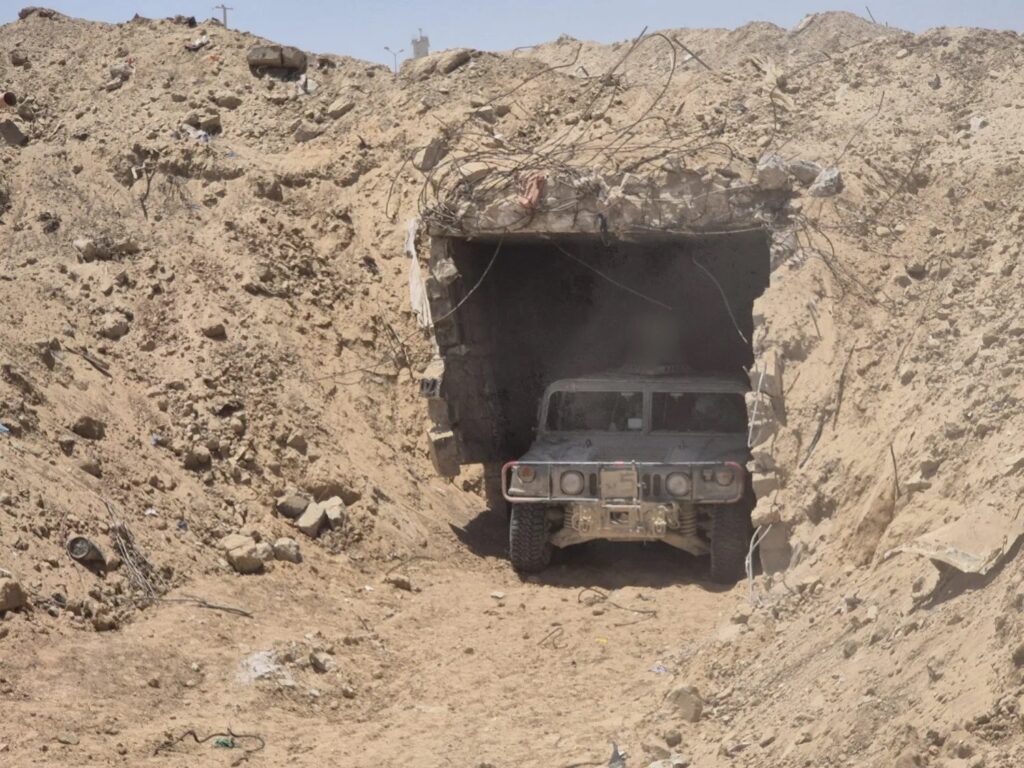
A critical stumbling stone in the talks is the so-called Philadelphi corridor along the border between Egypt and the Gaza Strip. Israel conquered it after it already had agreed to the roadmap. Since then, most of the tunnels that were used for smuggling of weapons into Gaza have been destroyed but the current government insists on an Israeli presence in the corridor against the advice of the military.
The EU could play a constructive role in bridging the gap between the two sides by deploying its Border Assistance Mission (EUBAM) to control the crossing point at Rafah between Gaza and Egypt. The issue has been discussed in the foreign affairs council but no decision has been taken yet as it requires the agreement of all involved.
The EU is in no hurry to decide after the summer break. Asked if the Defence and Foreign Affairs Ministers Council meeting in Brussels this week (29 August) will take any decision that could contribute to a solution in the Middle East, Peter Stano, the spokesperson, replied that no decisions will be taken at the meeting as it is an informal meeting.
Meetings of this kind serve the EU foreign ministers as a forum to discuss more thoroughly and freely than in the formal council format, he added. As regards the policy of “critical engagement” with some third countries, he explained that it depends on the country. Overall, it means that the EU continues to engage with a country with which it disagrees and delivers critical messages to it.
Whether this policy works or not is up to the Member States to review and evaluate, according to the spokesperson. It is also up to them to initiate a change of the approach to the country concerned.
