
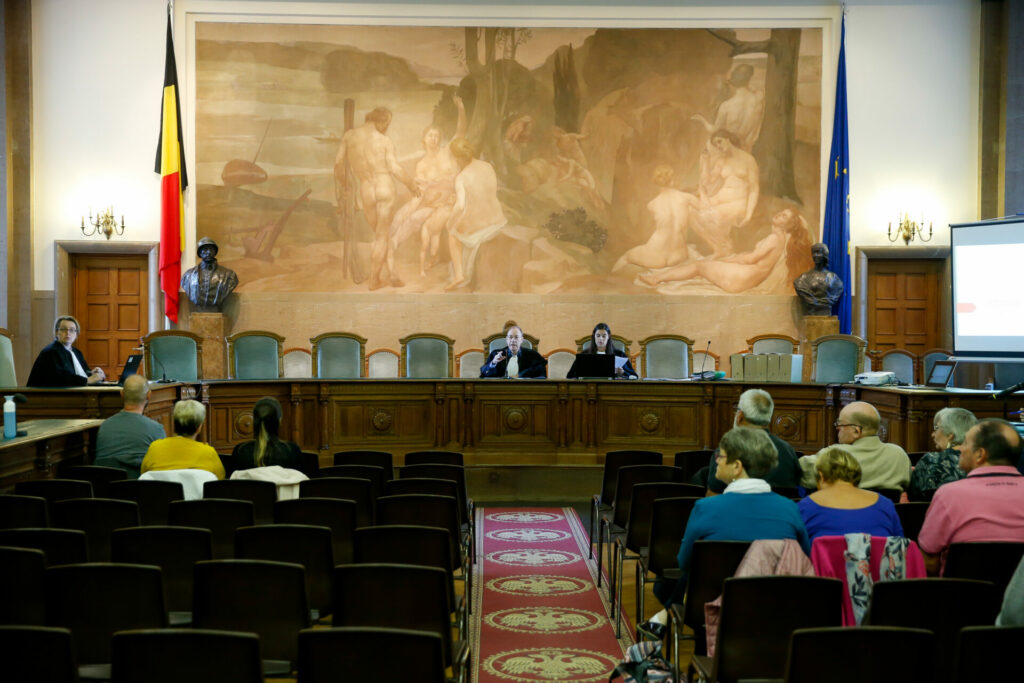
In a speech marking the beginning of the court year in Belgium, the chief prosecutor at the country's court of final appeal has called for the judiciary, legislature and executive to work together to uphold the rule of law.
Speaking on Monday, Attorney General at the Court of Cassation Ria Mortier expressed her concerns about whether ongoing government formation talks would result in the rule of law in Belgium being strengthened or weakened.
Addressing members of the highest court as well as the Public Prosecutors Office, Mortier noted that 2024 has already raised many questions about the state of the rule of law in Belgium.
It is based on the idea that all people, institutions and entities in a country, including the Belgian State itself, are accountable to the same laws - and nobody is "above the law".
In July, the European Commission highlighted "serious concerns" for rule of law in Belgium, and earlier in May the Belgian Federal Institute for Human Rights also warned of the risk of erosion of the principle.
The excessive "instrumentalisation of law" by the Federal Government (rather than parliament), is a severe issue. This is increasingly used by governments to initiate laws and policies to address short term issues within their mandate. This was one of the several factors listed by Mortier as hampering the rule of law.
Swift legislative action can be useful in crisis situations, Mortier acknowledged, but she said that using legal rules to try and change social behaviours will not always work. She said that this practice fails to capture the complexity of reality, and can erode public trust in legislation, the government, and eventually undermine the rule of law.
Mortier also noted that under-resourcing of the judiciary is a threat to the balancing of powers. She said the discretionary power to fund justice should not rest with the government, but instead rely on transparent, objective criteria that guarantee judicial stability.
The attorney general called for unity and dialogue between the government, parliament and judiciary, to help preserve the concept of the rule of law – which she said is "the guardian of our fundamental rights and a bulwark against arbitrary decisions".
"Joining forces is key... We should talk more with each other rather than about each other. We share enough common interests. Above all, we have the necessity of laying the foundations for a strong, resilient rule of law," she said.
