
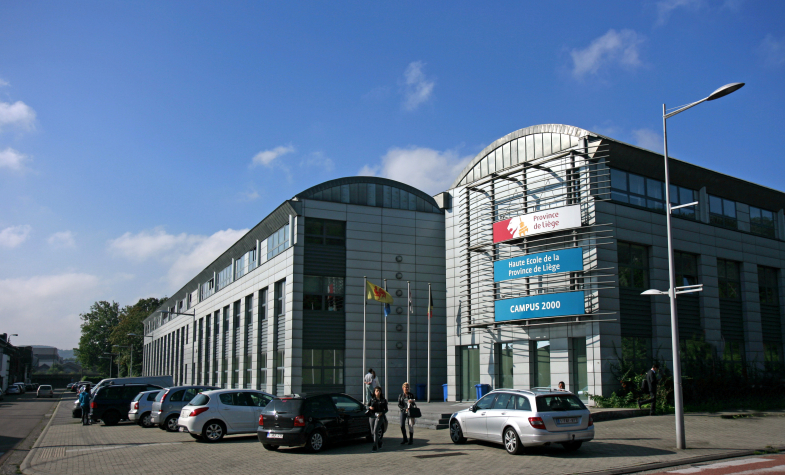
The Province of Liège has applied for permits to extend the Barbou campus of the Haute École de la Province de Liège (HEPL) and construct new buildings on the sites of two polytechnics.
Luc Gillard, André Denis and Muriel Brodure-Willain, members of the provincial parliament, said on Tuesday that the aim was to provide students with high-quality infrastructure.
The project, price-tagged at almost €50 million, is part of a rationalisation process the province has undertaken with regard to its property assets.
Student intake to go up by 10% on the Barbou Campus
The three new buildings will be built for students attending the Barbou campus in Liège and the polytechnics in the towns of Seraing and Huy, to replace outdated premises.
In Liège, the new building will be constructed on the site of the former Bavière Hospital. It will house the HEPL's Paramedical, Health and Motor Skills’ departments, currently located on the Barbou campus and in a neighbouring building on the Quai Godefroid Kurth. Eventually, students will occupy the Barbou campus and its extension in nearby Bavière. The budget for extending the Barbou campus is more than €36 million.
Some 3,000 students, 10% more than last year, will move from the ageing Kurth building to the new one. This will create a real health centre, enabling interaction with the services on site, Muriel Brodure-Willain, the provincial parliamentarian responsible for education, explained.
This means "larger, brighter, more pleasant spaces that will meet a certain demand, given that this public is growing," she added. "The trend was stationary and even slightly down after Covid, but now the figures have been rising again for two years. We can see that the profession is becoming attractive again."
High-tech, environmentally friendly buildings
The new 9,500 m² building will be arranged over four levels. It will include nine auditoriums with 120 to 450 seats, 15 classrooms with 25 to 80 seats, six specialised classrooms for practical work, two cyber-classes and a refectory. A learning centre, a place for study and documentation with extended opening hours, will also be accessible to students through a separate entrance.
The future campus will also benefit from the latest technologies, particularly in terms of energy efficiency and accessibility. "Particular attention will be paid to soft mobility, with 200 covered spaces planned for bicycles. There will also be 294 photovoltaic panels to supply the building with electricity," said André Denis, the provincial legislator responsible for infrastructure.
In Seraing and Huy, several buildings will no longer be used for school purposes, and they will be sold. To replace them, a new building will be constructed on the sites of the two polytechnics, thanks to subsidies obtained under the European Union's recovery and resilience plan.
Permit applications have been submitted, and the new facilities could be available for the start of the 2027 academic year.
