
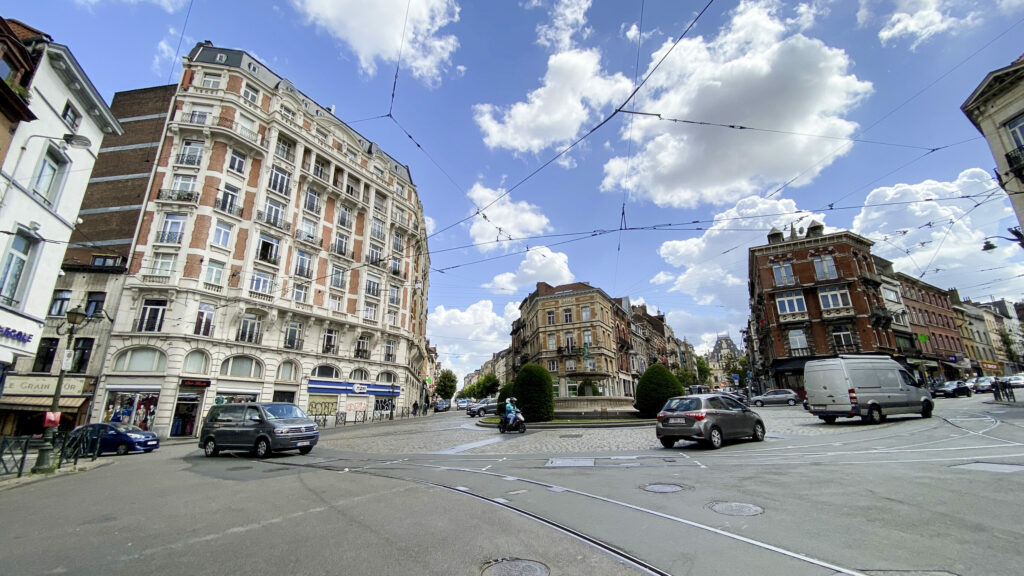
Brussels is one of Europe's most polluted cities, but some areas score particularly bad when it comes to air quality – notably two busy neighbourhoods in Ixelles and Saint-Gilles municipalities.
Air quality in the Brussels-Capital Region improved significantly in the past decade, with levels of nitrogen dioxide (NO2) – with the highest documented impact on human health – dropping remarkably.
The biggest driver for this has been the Low Emission Zones (LEZ), progressively eliminating the most polluting vehicles, which are the main source of NO2. However, this improvement is not seen in all neighbourhoods.
One-year measurements taken by the NGO Les chercheurs d'air near Place Flagey (Ixelles) and the Barrière de Saint-Gilles between June 2023 and 2024 have demonstrated that people there are exposed to unhealthy annual concentrations of NO2.
"Generally speaking, all the measurement points are exposed to average annual concentrations of the pollutant that exceed the WHO recommendation of 10μg/m3," the NGO's Director, Pierre Dornier, said.
At the tram stop near Place Flagey, an average annual concentration of 33μg/m3 was recorded, while in June 2024, the monthly levels were as high as 44μg/m3. Over the same period, at the Barrière's intersection, the average annual concentrations were 28.6µg/m3.
"None of the Ixelles measuring points complied with the WHO threshold," said Dornier.
"These results show that certain squares, such as Flagey, are hard hit by air pollution," said Dornier. "Yet these are places where many Brussels residents play, relax and shop."
Even though health experts have called for WHO's advisory values to become the standards that governments are subjected to, only the European limit value of 40µg/m3 is currently legally binding. However, even this more tolerant value was exceeded at Flagey.
Delaying progress
These results are in line with those from other measurements carried out by the Brussels city movement Bral in Schaerbeek. In all places there, NO2 values were well above the WHO's recommended average of 10µg/m³. Two residential streets were even found to be as polluted as the major traffic axis Arts-Loi. Bral argued that the continued dominance of cars was at the root of the problem.
Both organisations presented their findings at a time when the topic of air pollution and how it will be tackled have been pushed to the forefront of political debates. Several parties are pushing to delay the next stage of the LEZ by two years, despite the fact that more than 900 Brussels residents die prematurely every year as a result of air pollution from road traffic.
"A delay would weaken the LEZ and slow down the fight against air pollution in Ixelles and Saint-Gilles, among others," Dornier said. "Everything possible must be done by our elected representatives to improve air quality."
The two locations were chosen for the study because new circulation plans to lower emissions were recently implemented – even though the NGO argued the Ixelles plan was less ambitious than initially announced. By analysing these locations, the NGO wants to understand the long-term impact of reducing cars on air quality.
"If Saint-Gilles remains unchanged, it should eventually help to improve air quality in Barrière, among other places." The air quality study will continue over the next two years.
