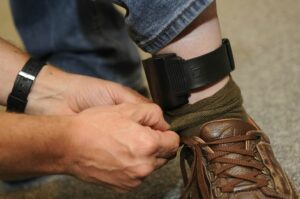
The legal aid non-profit, Rizome Axl, has installed audio terminals that broadcast testimonies from former prisoners placed on electronic bracelets in four emblematic locations in the Belgian capital.
The initiative is part of the National Prison Days, which run until 24 November. Its aim is to deconstruct the stereotypes surrounding this form of surveillance, and advocate for better alternatives to prison.
The audio terminals, installed at the Law Courts, Brussels Parliament, MuntPunt and Maison de la Culture in Saint-Gilles, broadcast the testimonies of former prisoners who were fitted with electronic ankle bracelets when they were released from prison.
The bracelets impede rehabilitation, groups say
The bracelet means "a different kind of isolation, but isolation nonetheless," one ex-prisoner can be heard saying. "Permanent stress, because the timetables have to be respected to the letter’"; “a very limited perimeter, even inside your house,” others say.
As Rizome observes in its daily newspaper, the electronic bracelet, often seen as a favour, actually complicates the reintegration process for convicts who have been granted early release.
"Leaving prison is already a perilous and complex stage in itself: you have to build a new project, find accommodation, training, a job, etc.," Jean Vander Wee, project manager at Rizome-Bxl, explains.
An extension of prison
"The electronic bracelet further limits the chances of reintegration. The electronic bracelet limits the range of possibilities even more, since it is sometimes refused in certain centres and in certain housing."
Moreover, a person on an electronic tag is only entitled to a ‘prisoner maintenance allowance,’ which averages €650 per month for a single individual. This allowance is well below the poverty line, says Rhizome.
The Belgian human rights league, LDH, which is associated with the audio terminal project, also sees the electronic bracelet as an extension of prison. "These alternative measures do not replace prison, they add to it," says Manuel Lambert, legal adviser at the LDH.
Serious alternatives to the all-prison policy needed
Despite this, the bracelets are increasingly used in Belgium. Last year, more than 11,000 people were under electronic surveillance in the country, while some 12,500 were incarcerated.
For Rhizome-Bxl and the LDH, these bracelets are nothing more than a "millstone around the neck of rehabilitation."
The two organisations are therefore calling on the authorities to develop a "serious policy of alternatives to the all-prison policy advocated by the parties negotiating to form a federal government."
