

The European Commission marked on Tuesday the 1000th day since the start of Russia’s unprovoked war of aggression against Ukraine on 24 February 2022 with a statement of solidarity with Ukraine.
On Monday evening, the Ukrainian flag was illuminated on the Berlaymont building in Brussels where the Commission’s headquarters are located. The 1000th day of relentless war, which escalated during the weekend with the heaviest Russian bombardment in months of civilian infrastructure and electricity systems in Ukraine, was also marked by the EU Member States, among them Belgium.
The European Commission stands firm in its commitment and solidarity with Ukraine. Since the beginning of the full-scale invasion, the EU and its Member States have mobilised unprecedented economic, humanitarian, and military assistance to Ukraine and Ukrainians, totalling so far around €124 billion. It has also provided protection to 4 million people who fled the war.
“Russia has to pay for one thousand days of crimes and destruction,” Commission President Ursula von der Leyen said in the statement.
“Today is a day of mourning, but also a day of promise. We promise to keep standing by your side, for as long as it takes. Ukraine's future is in our Union. Your freedom is our freedom. And our Union is your home.”
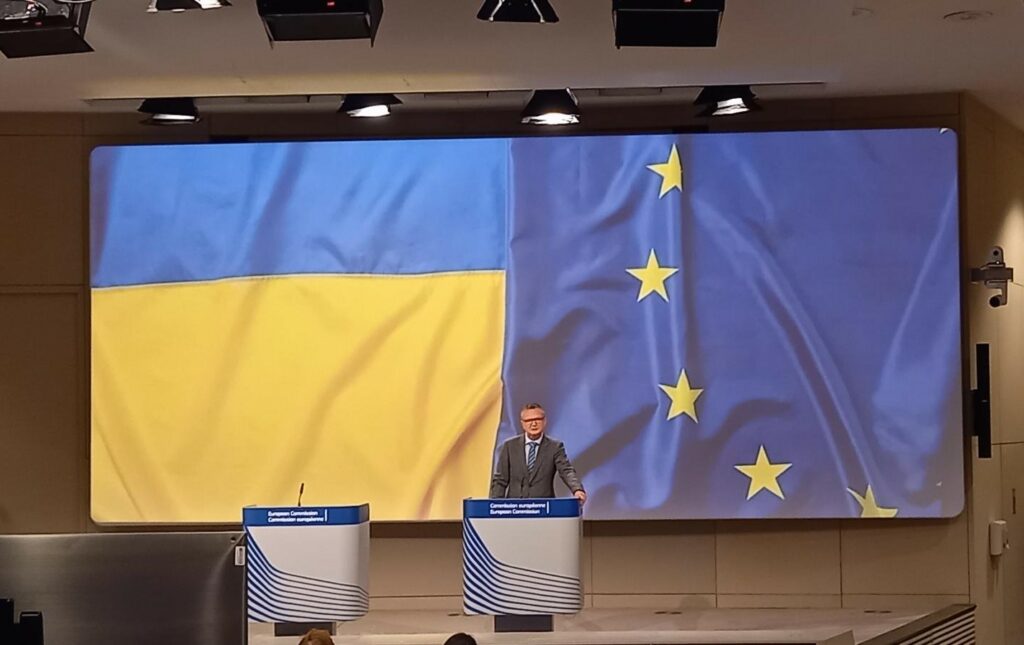
The Commission's press room on 19 November 2024, credit: The Brussels Times
Russia’s war of aggression against Ukraine was one of the main topics at the Foreign Affairs Council meeting on Monday. The EU foreign ministers were updated on video link by Ukraine's Minister of Foreign Affairs, Andrii Sybiha, on the latest developments on the ground and the most pressing Ukrainian needs.
“It is the time for Europe to step up,“ said EU’s High Representative for Foreign Affairs and Security Policy, Josep Borrell, who chaired what he hoped would be his last council meeting as High Representative.
“It's time for Europe to take its strategic responsibilities in front of Ukraine. […] History will ultimately judge us on what we did when we had to face difficult times.”
The Council has only published a brief description of the discussions. In his two press remarks on Monday evening, Borrell admitted that “Too many times we have not been united. Too many times, discussions took too long. You cannot pretend to be a geopolitical power if you are taking days and weeks and months to reach agreements to act. My last call to my colleagues will be to be more united and take decisions quicker.”
He was sorry that he might not be able to submit his last proposal about the unblocking of the European Peace Facility but said that he still is hopeful. He did not mention by name the country (Hungary) which is blocking the Facility.
“Each step that is left without reaction encourages Russia to escalate further. No reaction, more escalation. They (Russia) started by weaponizing food, by weaponizing energy using the winter as a weapon. Then they resort to Iranian drones and missiles, and military supplies from North Korea. And now even with North Korean soldiers on the borders of Ukraine.
“Without North Korea, without Iran, without China - Russia could not support its military effort. It could not continue fighting the war,” he concluded.
His successor as High Representative, Commissioner-designate Kaja Kallas, will not only have to unite the EU in sanctioning those three countries but also to face the unpredictable new US administration which might cut military aid to Ukraine.
The only concrete Council decision was to broaden the scope of the EU framework for restrictive measures against Iran by prohibiting the export, transfer, supply or sale from the EU to Iran of components used for missiles in addition to the existing prohibition on drone components.
The Council adopted restrictive measures against one individual and four entities: Iran’s national maritime carrier and its director, and three Russian shipping companies. Even Borrell himself downplayed the impact of these measure. The decision mentioned, for the first time, that the scope of the measures also includes Iran’s support to “armed groups and entities in the Middle East and the Red Sea region”.
Another first was the Commission’s approval last week of financial support for common defence procurement under the European Defence Industry Reinforcement through Common Procurement (EDIRPA). Five projects have been selected, involving together 20 Member States. The programme supports the procurement of defence capabilities of the EU Member States and Norway.
Most selected projects (air and missile defence systems, armoured vehicles and ammunition) also include procurement of defence products intended for Ukraine. Some of the production and procurements have already started, a Commission spokesperson told The Brussels Times. The milestone for finalising the procurement is 24 months from the signature of the grant agreements.
