
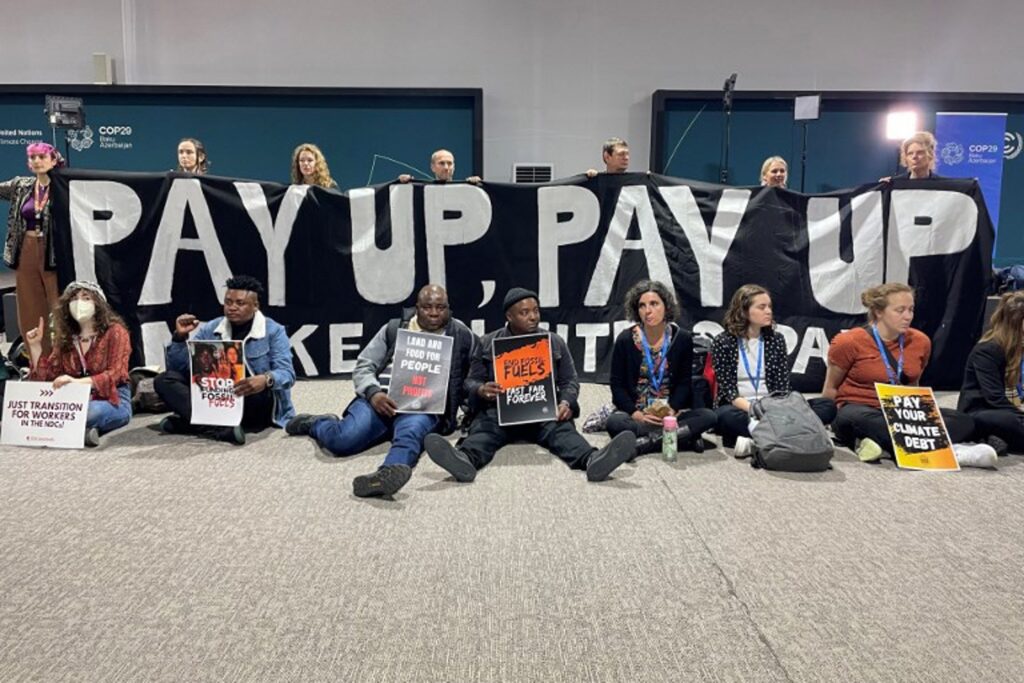
The UN Climate Change Conference in Baku, Azerbaijan, is close to finishing on Friday but it will require intensive negotiations during the final hours if a unanimous agreement between all 198 parties is to be reached. This happened at the end of the previous conference (COP28) in Dubai.
The EU’s chief negotiator Wopke Hoekstra, admitted to press earlier this week that the parties are very far apart. Hoekstra, who is also Commissioner-designate for Climate, Net-Zero and Clean Growth in the incoming new Commission, admitted that the geopolitical context is difficult.
In reference to the UNEP Emissions Gap Report, which says the world will miss the 1.5°C target set out in the 2015 Paris Agreement, Hoekstra questioned what a "good result" would look like. He said that the EU is on the right track after having reduced its greenhouse gas emissions by over 8% in 2023. But he noted that the rest of the world is obviously lagging behind and spoke of an un-named "elephant in the room".
Last year this was the United Arab Emirates, which hosted the event and plans to double its oil production. It insisted on changing the final conclusions from "phasing out" fossil fuels to the more vague "transitioning away" from them.
This year resistance is coming from Saudi Arabia, which is blocking an agreement even on a global transition from fossil fuels, the New York Times reported. Saudi Arabia is the world’s biggest oil exporter and despite accepting the COP28 commitment to "transitioning away" from fossil fuels, it has since opposed UN resolutions in this respect and used procedural objections to block serious talks at COP29.
This reduces the likelihood of fruitful last-minute negotiations. UN rules require that COP decisions are taken by unanimity.
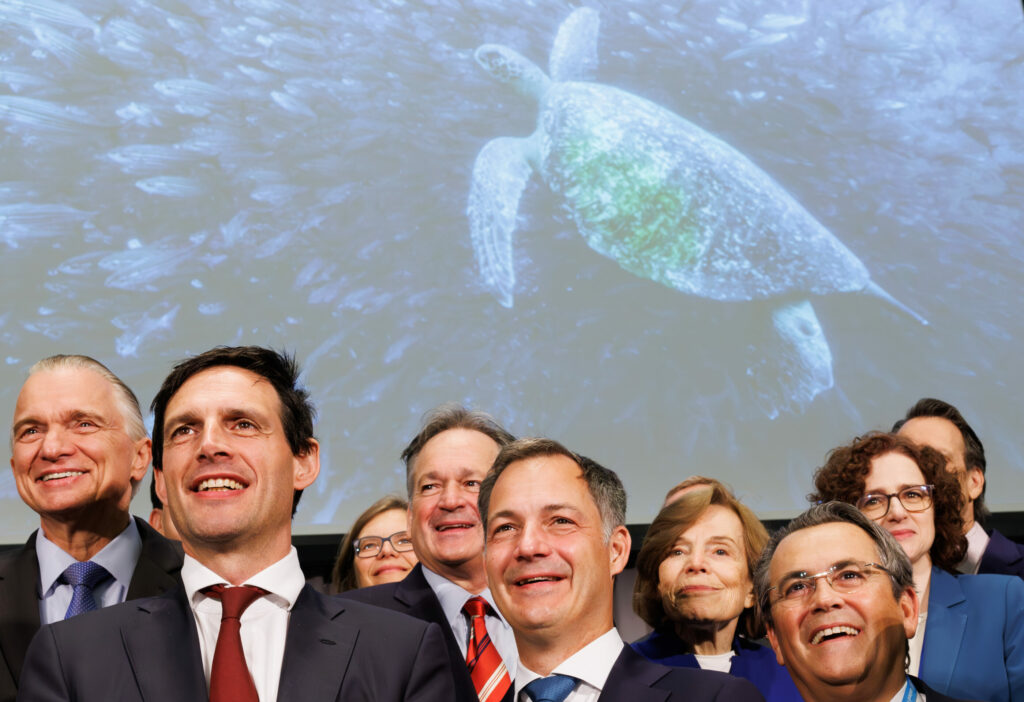
Prime Minister Alexander De Croo pictured with Wopke Hoekstra at a meeting on 'High Ambition for the High Seas', 24 September 2024. Credit: Belga
Luc Triangle, General Secretary of the International Trade Union Confederation, said after returning from Baku that the sentiment there was not positive. "If there is no progress in Baku, there won’t be any progress at next climate change conference (COP30) in Belem, Brazil."
Much depends on the Nationally Determined Contributions (NDCs) that will be decided in the next 12 months. These commitments outline the efforts and actions a country intends to take to reduce its greenhouse gas (GHG) emissions. He also highlighted the issue of global justice and finance to mitigate or adapt to the impacts of climate change.
The countries that suffer most of global warming are often the least responsible for it. Reaching the climate goals requires a just transition, which leaves no-one behind. Not only must the transition protect low-income countries from climate disasters. It should also compensate workers everywhere when losing working days because of extreme weather events and ensure that they can earn a livelihood in new green economies.
The Paris Agreement in 2015 set out that by 2025 signatories agree on a climate fund of at least USD 100 billion per year. But a recent report showed that the amount needed is far greater and recommends the parties at COP29 to focus on mobilising USD 1 trillion per year by 2030.
Will the EU pay up?
In October, the Council of the EU adopted a negotiating mandate which was intended to guide Commissioner Hoekstra, the chief negotiator.
This calls for an ambitious and balanced outcome in Baku that keeps the 1.5°C temperature goal within reach. It also urged ambitious NDCs to achieve this. The EU will also pressure other parties to contribute to the global transition from fossil fuels and as soon as possible phase out fossil fuel subsidies that do not address energy poverty or a just transition.
The mandate also underlies the importance of aiming to achieve a fully or predominantly decarbonised global power system in the 2030s, leaving no room for new coal power, since cost effective zero emissions measures are already widely available in that sector.
On global finance, the EU and its Member States urged developed nations to double their collective climate finance to developing countries by 2025 (compared to 2019 levels). They also committed to enhancing the synergies between finance for climate, biodiversity and sustainable land management agenda. Deforestation is mentioned as a global threat to sustainable development.
Related News
- Belgian Climate Minister calls COP29 text 'unbalanced and unacceptable'
- COP29: Countries pledge not to open new coal-fired power stations without CO2 capture
Some EU countries are more ambitious and signed a voluntary pledge on Wednesday not to open any more coal-fired power stations without carbon capture equipment, in the hope of leading other countries to end coal energy. Belgium, one of the signatories, closed its last coal-fired power station several years ago. China, India and the United States did not sign the pledge.
How much should global finance increase? When should subsidies to fossil fuels be phased out? Asked to comment on these and other issues raised in the mandate, a Commission spokesperson declined to comment in the heat of the ongoing negotiations. It remains to be seen if EU will welcome the final agreement as a success or even historic document as it did last year in Dubai.
