
Nearly 200 dinosaur footprints were discovered last summer in a quarry in Oxfordshire, southeast England, Oxford and Birmingham universities announced on Thursday.
This is possibly one of the largest sites of its kind ever found in Britain.
The impressive tracks, left by five dinosaurs 166 million years ago, will be revealed on 8 January in the BBC Two programme 'Digging for Britain.'
The longest track stretches over 150 metres in Dewars Farm Quarry, a “dinosaur highway” where herbivores and carnivores crossed paths during the Middle Jurassic period.
Very rarely are so many prints found in one place and such extensive tracks discovered, according to Emma Nicholls, a vertebrate palaeontologist at the University of Oxford. She suggested that this could be one of the world’s largest sites of dinosaur footprints.
Gary Johnson, a worker for Smiths Bletchington, discovered the prints in June. “I realised I was the first to see these footprints, it was surreal,” he told the BBC.
In the following days, about 100 people participated in excavations supervised by the two universities.
Scientists are not sure how the tracks were preserved on the site, which used to be a warm-water lagoon.
“Sediments may have covered the footprints during a storm, causing them to solidify,” said Richard Butler, a palaeobiologist at the University of Birmingham.
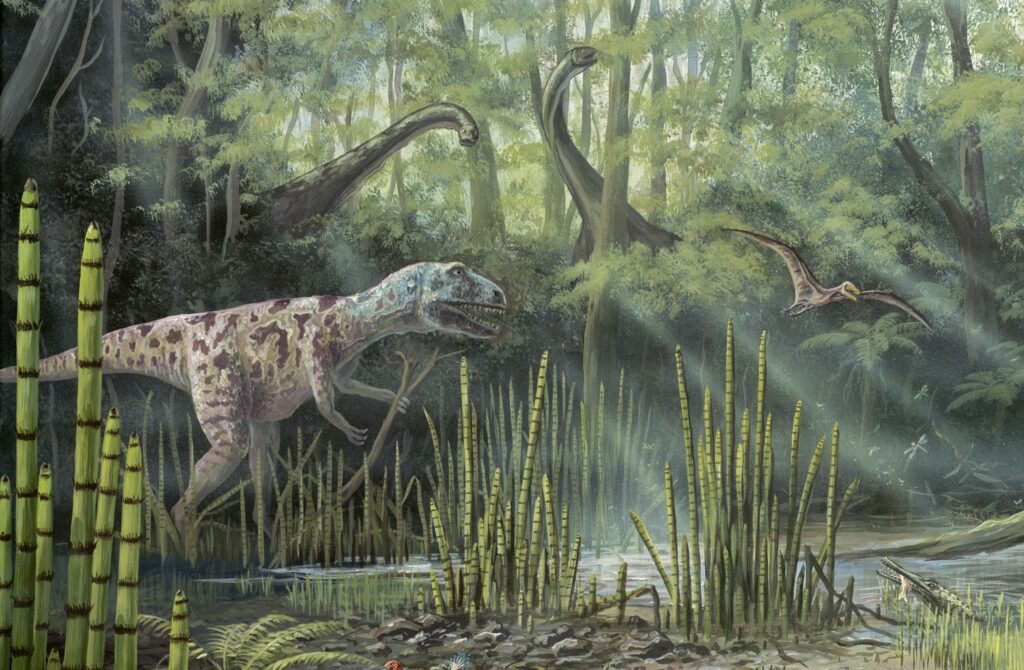
Four of the prints were left by sauropods, long-necked herbivorous dinosaurs. These animals grew up to 18 metres long. Their footprints resemble those of elephants but are much larger.
The fifth footprint likely comes from a megalosaurus, the largest predator in Jurassic-era England, which walked on two legs with three distinct claws.
The quarry has been extensively photographed by drones to create 3D models and preserve the exceptional find.
