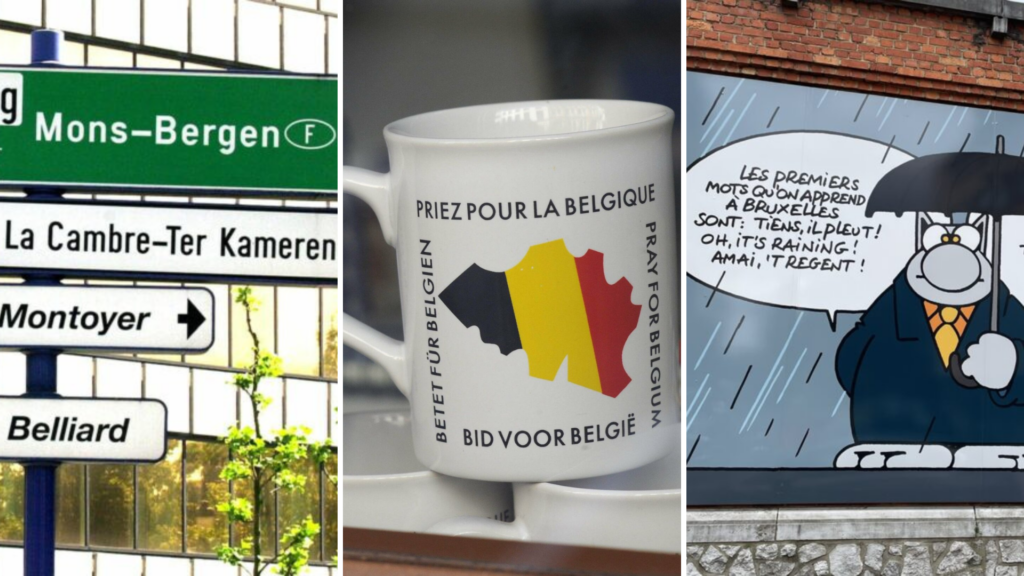
Belgium's language laws never fail to fascinate and frustrate. Their history is central to Belgium's history and many of the country's idiosyncrasies stem from the effort to balance power between the French and Dutch -speaking populations.
But although intricate layers of administration have been devised to distribute authority between the communities of each national language, many feel these systems are now counter-productive and inefficient, even if the principle of equal representation throughout the public services is valid.
The absurdity of the laws was highlighted in an incident last month, when a train conductor received a complaint for welcoming passengers aboard in both French and Dutch, despite being about 10km into Dutch-speaking Flanders. Though the affair was deemed to be pettiness in the extreme and no action was taken, the folly of Belgium's language laws was picked up by media channels around the world.
Taken to their full extent, the rules dictating which languages must be used in which contexts are indeed ridiculous. But the lack of legal flexibility regarding official language use is rather less amusing, serving instead as a barrier to integration and demanding significant resources to uphold. Moreover, there is an inherent impracticality in trying to fit language development within a defined legal framework.
Modes of human communication are fundamentally organic, they evolve irrespective of written rules. This much has been made clear by multiple analyses of language use in Brussels – a city famously cosmopolitan that thrives on its international community.
Almost 40% of the capital's residents are non-Belgians and use English as lingua franca, serving to bridge the language gap between French and Dutch. Prominent philosopher (and esteemed Brussels Times columnist) Philippe Van Parijs observes "a huge gap between the legislation and the current reality in Brussels." This will ultimately be to the detriment of the Capital Region, and Belgium more broadly.
But how to initiate a more reasonable approach to language use in Brussels? A helpful starting point must surely be to recognise the progress of different languages, which is enthralling in itself. See here for the latest effort to map languages in the city.
Belgium in Brief is a free daily roundup of the top stories to get you through your coffee break conversations. To receive it straight to your inbox every day, sign up below:
1. Will English ever become an official language in Brussels – and should it?
Brussels' residents are increasingly turning to English as it is the second most widely-spoken language. But should it become the region's third official language? Read more.
2. How to get a driving licence in Brussels as an English speaker
Learning to drive in Belgium can be daunting. The Brussels Times has created a guide to ensure a smooth ride. Read more.
3. New leak shows how Arizona plans to slash social spending and save billions
"In the absence of major political changes, the financial viability of Belgian pensions is seriously threatened." Read more.
4. Man rescued from drowning in Brussels canal
When emergency services arrived, the drowning man had just sunk underwater. Read more.
5. Decomposing body of woman found near European Commission
The authorities found the body in an advanced state of decomposition inside a hotel room. Police are wondering how staff failed to notice. Read more.
6. Brussels police sued for violence during anti-Bardella protest
Police clashed with sections of the 1,000 antifascist demonstrators who were protesting against the normalisation of the far-right. Read more.
7. Belgian consumer confidence plummets to lowest level in two years
Families have less faith in the overall economic outlook. Read more.
