
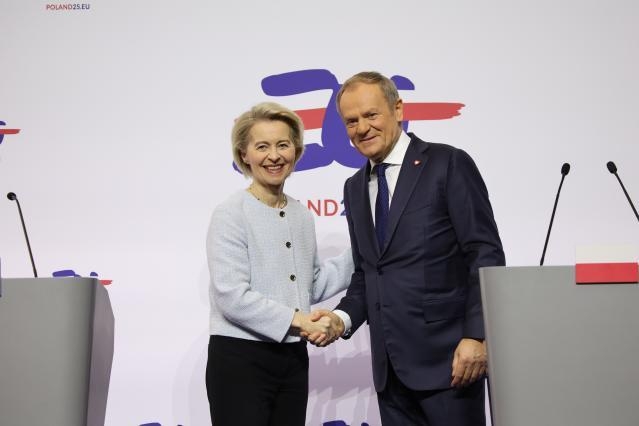
The College of the European Commission, headed by Commission President Ursula von der Leyen, visited Gdańsk in Poland on 6 and 7 February to attend the delayed inaugural meeting of the Polish EU-Presidency which started on 1 January 2025.
It was no coincidence that the meeting took place in the European Solidarity Center. The center is dedicated to the Solidarity movement in Gdańsk where Poland’s fight for freedom and democracy started, led by Lech Wałęsa.
As previously reported, Poland intends to “mainstream” security and safety in its Presidency programme. In his remarks at the concluding press conference on Friday afternoon, Donald Tusk, the Polish president and a former president of the European Council, confirmed that security is the main priority and that everyone has agreed on that.
“We want to make the EU and its Member States secure,” he said, referring primarily to Russia’s war of aggression against Ukraine and the need for the EU to stand united in solidarity with Ukraine. During the first Polish EU-Presidency in 2011, no-one would have thought that security would become such an important issue, he added.
“In Poland, we feel secure and it is a good place to live,” he said. Everyone needs security, wherever they live in Europe – above all against war but also against climate change and its consequences on the economy. Among other security threats he focused on illegal migration and did not mention poverty, terrorism, discrimination, antisemitism and racism.
He was in particular satisfied that the Commission has agreed to fund security measures at Poland’s long eastern border as “common EU actions” against the weaponization of migrants by its neighbors. The new Migration and Asylum Pact was not discussed at the meeting but was highlighted at the press conference by both Tusk and von der Leyen.
Poland has received over 2 million Ukrainian refugees, more than any other Member State. Although Poland and Ukraine share a common history and enemy, and most of the refugees will probably return to their home country after the war, Tusk made it clear that Poland is not prepared to increase the number of migrants.
According to Tusk, the Pact is not intended to reduce illegal migration. Poland is not prepared to shoulder additional burdens and will not participate in the relocation of migrants. According to the Pact’s solidarity mechanism, Member States can choose between relocations, financial contributions, and operational support.
As regards the European Green Deal, Tusk said that Europe cannot make any decisions that will increase energy prices. He admitted that Poland needs to invest in cheap renewable energy and will build wind farms in the Baltic Sea. In the meantime, it will have to rely on an energy mix of gas fueled power plants and nuclear power.
“Since Russia brought war back to the European continent, security lies at the heart of everything we do,” the Commission President said in her press remarks. “You have made security the central theme of your Presidency, and rightly so”.
Listing the different security challenges, she largely agreed with the Polish host while trying to convince him to make difficult decisions now and accept sacrifices for a better future.
“As you said Donald, on the goals, we stay firm, Europe stays the course on its climate neutrality goal by 2050. Because we all know that the young people, the next generation, our children, would never forgive us if we did not act now. The transition is needed. But on how we get there, on the way forward, we have to be flexible, we have to be pragmatic. This transition has never happened before.”
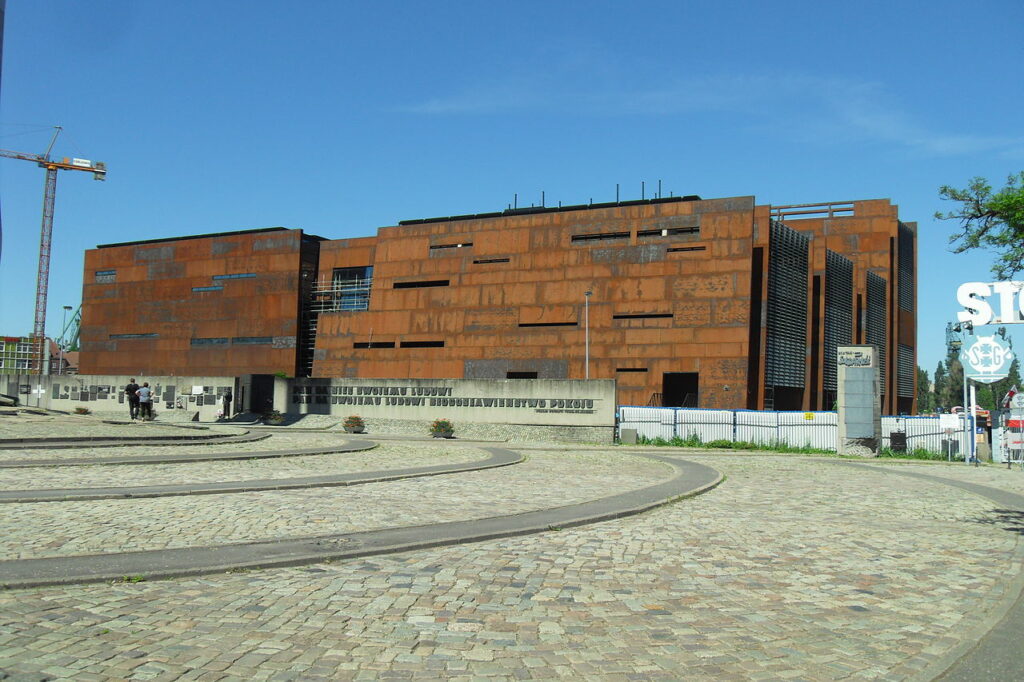
The European Solidarity Center dedicated to the Solidarity movement in Gdańsk, credit: Wikipedia
“The Polish presidency so far has gone smoothly, including some critical decisions to support Ukraine and continue sanctions policy on Russia against opposition from Hungary,” Wojciech Przybylski, Editor-in-chief of Visegrad Insight and President of the Res Publica Foundation, told The Brussels Times.
In which way has security and safety been mainstreamed in all seven priorities? "While military production funding remains the primary concern, Warsaw’s key objective for the term is also border protection. Poland has also highlighted health security and aims to make progress on pharmaceutical legislation.”
The 15th sanctions package against Russia and the European Health Data Space are examples of files that already have been dealt with. What are the most difficult files which may risk not being finalized during its Presidency?
“The European Defence Industry Programme, the accession process of new member states and a comprehensive drug safety policy might be at risk depending on other partners,” he replied. “But the Presidency is the first in a trio (followed by Denmark and Cyprus) and is therefore primarily tasked with opening rather than finalizing major files.”
Crucial presidential elections will be held in May to elect a successor to the incumbent president Andrez Duda. Is the Polish EU Presidency affected in any way by the upcoming elections?
“Should an opposition candidate win election it would affect the Presidency but only in the last month of the Presidency. But we can expect that a number of politically appointed ministers will focus on the domestic campaign especially in May.”
In his speech yesterday, President Tusk said that he wants Europeans to feel as secure as Poles feel in Warsaw and Gdansk. Is Poland more secure than other Member States?
“He stressed that security is a crucial concern for citizens in Member States. Accordingly, he advocates for his government's well-received agenda in Warsaw or Gdansk, emphasizing military spending, border security, migration review, and economic security. He proposes that such a perspective should be adopted across the bloc to benefit all EU citizens.”
President Tusk has also highlighted the need to strengthening EU’s air defense. Some EU Member States have already acquired Israeli air defense systems. Will EU encourage Member States to acquire such systems from Israel?
“I would not imagine encouragement but from the Polish side there will be pressure for prioritising speeding up arms buildup over country of origin.”
M. Apelblat
The Brussels Times
