
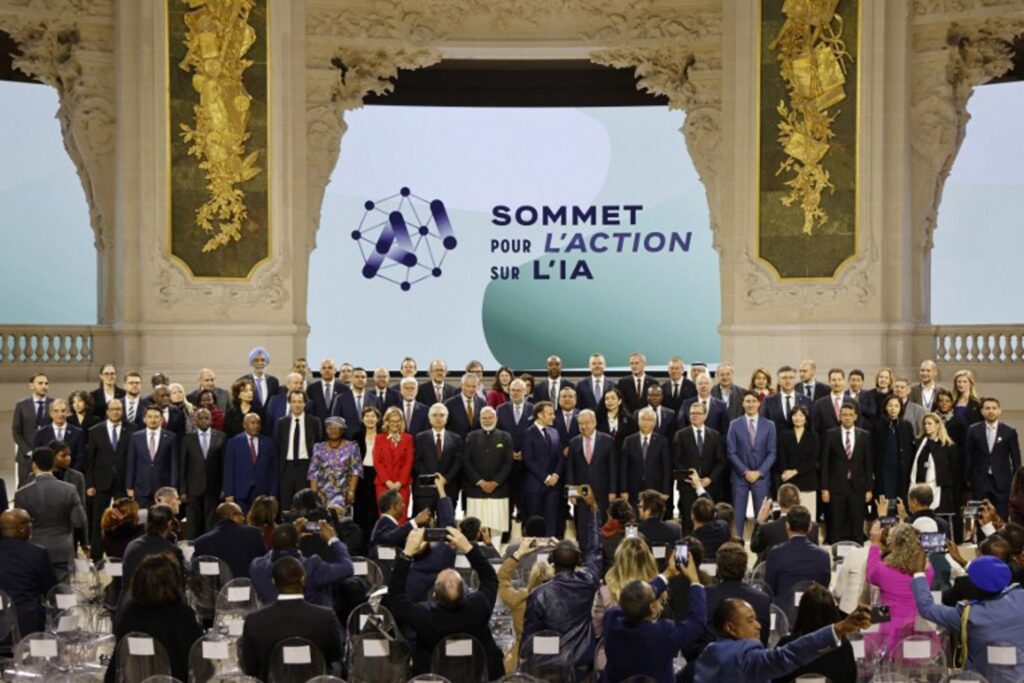
Fifty-eight (58) countries signed a declaration calling for “open,” “inclusive,” and “ethical” artificial intelligence (AI) at an AI Summit in Paris on Tuesday, but the United States of America was not among them, nor was the United Kingdom.
Signatories, including China, France, India (co-organisers of the event), the European Union, and the African Union Commission, called for enhanced AI governance through a “global dialogue” to increase technology accessibility, and urged against “market concentration.”
They prioritised making AI sustainable for people and the planet.
To achieve this, an AI energy impact observatory led by the International Energy Agency was established, along with a coalition for sustainable AI uniting leading companies in the sector.
French President Emmanuel Macron emphasised the importance of trust in AI development and sustainability at the summit, held at the Grand Palais.
The absence of the US and UK among the signatories highlights divisions on the issue. US Vice President J.D. Vance warned against “excessive regulation” that could stifle the burgeoning industry, while the UK government cited “national interest” as its reason for not signing the summit’s final declaration.
In response, Macron stressed the need for “rules” and a “framework of trust” for AI development, announcing a €109 billion private investment plan for France.
Indian Prime Minister Narendra Modi, who co-chaired the summit and will host the next one, highlighted the challenge of not leaving the “global South,” including his 1.4 billion citizens, behind in the tech revolution.
The European Union on Tuesday revealed a €200-billion investment plan, with €150 billion coming from major corporations, as it aims to advance its position in the AI race.
