
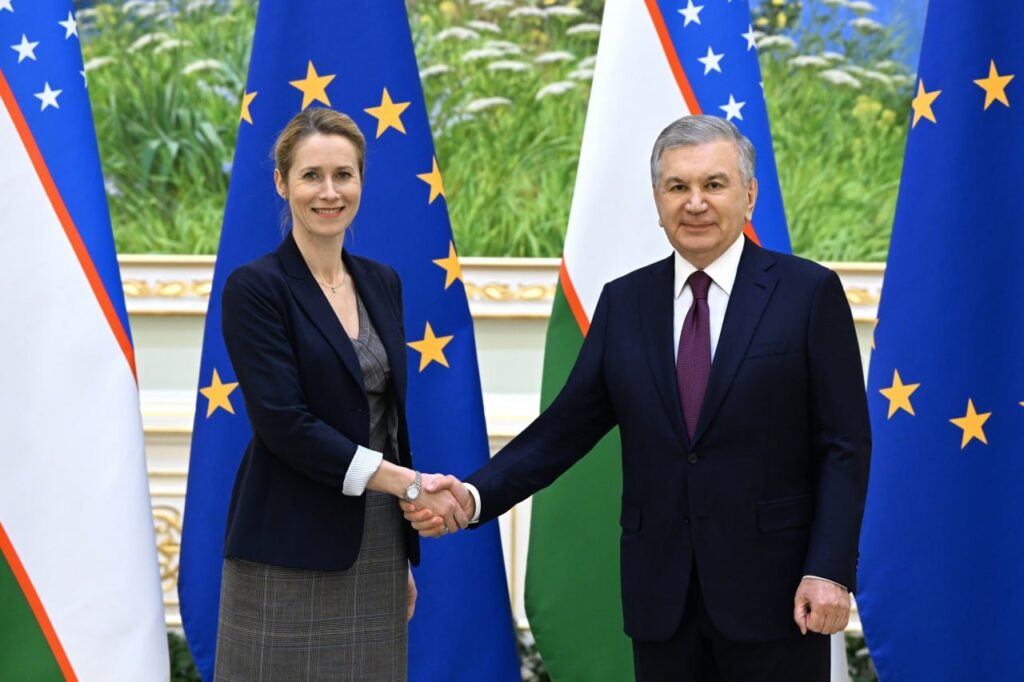
Leaders of the European Union will meet in the critically climate-vulnerable Central Asian nation of Uzbekistan this week to discuss economic and security cooperation, along with energy transition and environmental issues.
European Commission chief Ursula von der Leyen and European Council head Antonio Costa will meet with the leaders of all five Central Asian nations during a series of events in the city of Samarkand.
On April 3-4, Uzbekistan will host the first-ever EU-Central Asia summit. According to an EU statement, there will be a focus on deepening cooperation in key areas of mutual interest, including economic development, transport, security, and the green agenda.
"The very first EU-Central Asia summit will solidify our commitment to work together for peace, security and sustainable development in full respect of international law," Costa said in a statement.
Uzbekistan has increasingly emerged as a key economic, political and cultural centre in Central Asia in recent years, driven by reforms aimed at doubling the country's GDP, improving living standards and boosting foreign investment.
In an interview with Euronews earlier this week, Uzbekistan’s President Shavkat Mirziyoyev emphasised that “Central Asia can become a reliable partner, capable not only of ensuring stable energy supply but also of making a significant contribution to global decarbonisation.” This vision aligns with the region’s ongoing efforts to meet Europe’s energy needs, while also advancing green energy and decarbonisation goals.
EU remains key investor in central asia
The EU is the region's second-largest trading partner and accounts for more than 40% of total investment in Central Asia.
On April 4-5, Samarkand will also host an international climate forum titled "Central Asia Facing Global Climate Challenges – Consolidation for Common Prosperity."
The event will bring together top EU officials, the presidents of Kazakhstan, Kyrgyzstan, Tajikistan, Turkmenistan and Uzbekistan, as well as leading environmental experts, to discuss joint efforts in tackling climate-related challenges across the region.
Uzbekistan, a double-landlocked country bordered by Afghanistan, Kazakhstan, Kyrgyzstan, Tajikistan and Turkmenistan, is actively seeking solutions to its water challenges and working to implement global best practices to help its economy adapt to the growing impacts of climate change.
"Climate change is now emerging as a major global threat and directly influencing the escalation of geopolitical tensions," Mirziyoyev said at the UN climate conference in Baku in November.
"In Central Asia, we feel these problems especially acutely," he added. "Climate challenges are posing new barriers to improving the quality of life of our people and implementing national development strategies."
The Samarkand Climate Forum aims to facilitate the creation of a "unified regional vision" of green development for the entirety of the Central Asian region, according to the event's website.
With a population of 35 million people, Uzbekistan is the most populous nation in Central Asia, where over the past half-century the average temperature has risen by 1.5 degrees Celsius. That is twice the global average.
"Climatic stresses already give rise to prolonged droughts, resulting in loss of livestock, reduced agricultural production and decreased groundwater," the World Bank said in a 2023 assessment.
"Uzbekistan is projected to be one of the most water-stressed countries," the report added. "Climate-smart agricultural practices and integrated approaches to management of water resources and landscapes will be crucial for sustainable growth."
