
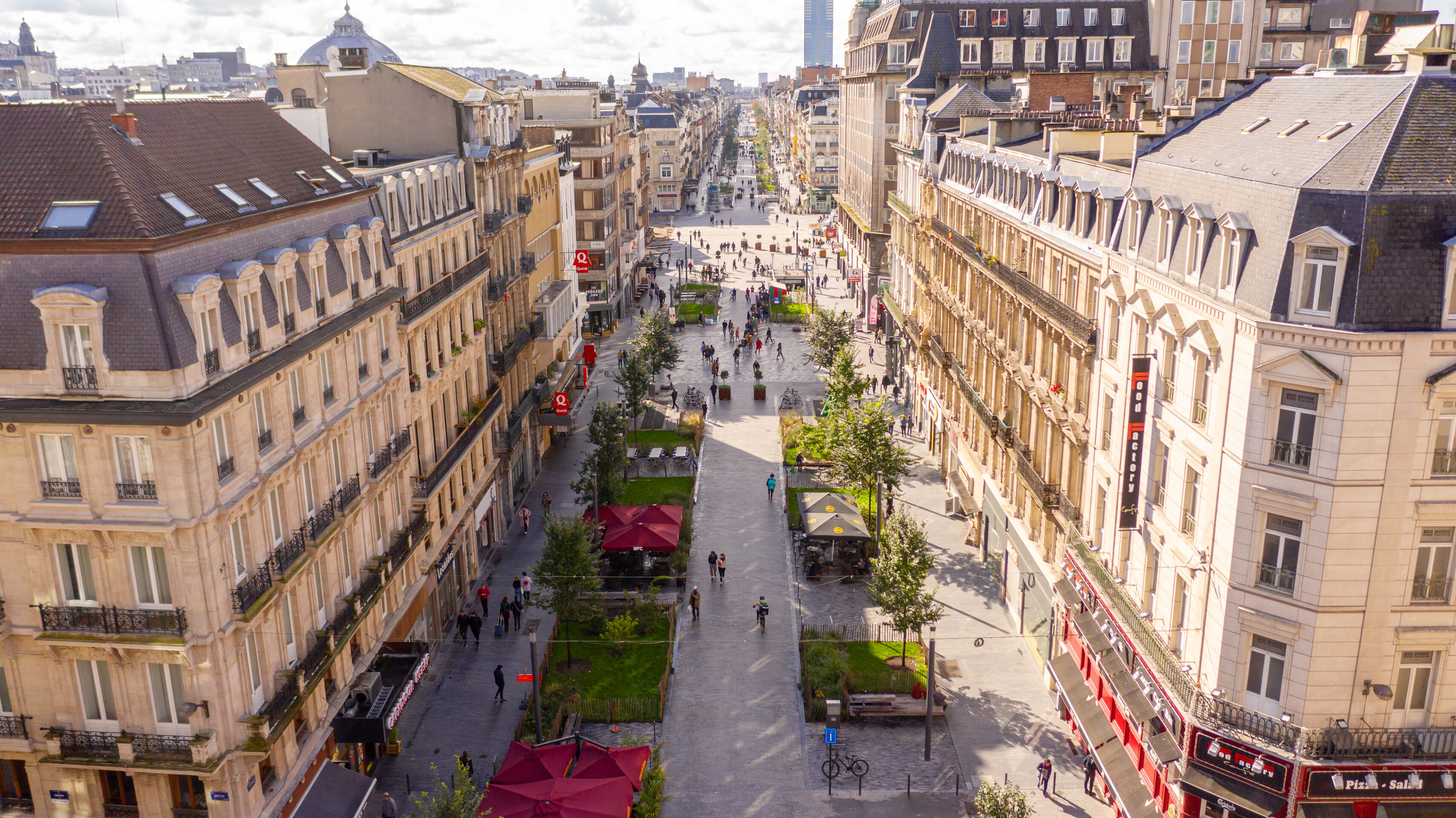
Launched with great fanfare in 2015, Brussels’ city center pedestrian zone continues to stir mixed reactions.
Designed as a response to environmental and urban challenges, this major transformation remains divisive nearly a decade later. While some praise a greener, quieter, and more pedestrian-friendly city, others denounce a hastily and poorly executed project that has weakened the commercial fabric of the downtown area.
For José Garcia, representative of the Tenants’ Union, the pedestrian zone is, overall, a positive development. He highlights the reduction in noise and air pollution in the affected neighborhoods. "It’s better for tenants to live in a city without cars. It’s definitely a step in the right direction," he tells The Brussels Times.
However, he does note an increase in complaints related to nighttime disturbances, due to more public events taking place in car-free spaces. When it comes to housing prices, Garcia remains cautious: “Yes, rents are going up, but we have no evidence that this is directly linked to the pedestrian zone."
He also acknowledges the beginning of a gentrification process, although public housing in some areas continues to shield certain residents from rent increases.
Pedro De Doncker, a notary whose office has been located near the pedestrian zone since 2012, is a firm believer in its positive impact on the city center. "The pedestrian zone has significantly improved the quality of life, especially in terms of reduced noise pollution," he tells The Brussels Times.
According to him, the real estate market has seen a clear upswing, driven by the emergence of a new, high-end segment that didn’t exist before. "It’s not the pedestrian zone that caused the gentrification of the city center, but it did improve quality of life."
Projects like Oxy on boulevard Anspach 2 and the ongoing development above De Brouckère station have sold at record speed, first attracting Dutch-speaking buyers, and now increasingly appealing to expatriates eager to live in the heart of the city. While acknowledging that the pedestrian zone isn’t perfect, he insists it has helped transform the city center into a more livable and desirable neighborhood: "It wasn’t a pleasant place to live before, but I believe it is today."
Contrary to common criticism, he doesn’t believe safety has declined in the area, and says he has no regrets about choosing to base his office there.
A raise of 35%
Immoweb, the leading real estate listing website in Belgium, reports that in the City of Brussels, the median price per square meter is €3,478 for an apartment and €2,864 for a house. However, these figures reflect an average across the entire municipality, not specifically within the pedestrian zone.
Over the past ten years, apartment prices in the City of Brussels have risen by 35.86%, while house prices have increased by 35.55%. "That said, I would like to point out that property prices have gone up across all Brussels municipalities over the past decade — sometimes even more sharply than in the city center. So it is difficult to isolate the specific impact of pedestrian zones on this trend," explains Yousra Dahraoui, spokesperson for Immoweb.
Safety and parking issues
Among shopkeepers, the tone is much more critical.
Olivier Sokolski, who runs a leather goods store on Rue Neuve and whose parents were also longtime merchants there, paints a bleak picture: "All my contacts tell me they no longer come to the city center. The clientele has completely changed. It’s mostly tourists now, and they don’t spend like local Brussels residents used to."
He believes the pedestrian zone has driven away loyal customers, discouraged by limited car access, expensive parking, and a growing sense of insecurity. "People don’t even know there are parking lots downtown anymore. And those who do come end up paying a fortune," he complains.
Related News
- Brussels’ Big Bet on Pedestrianisation: Where do we stand three years on?
- How Anspach remade Brussels
- The benefits of Brussels Pedestrianisation Project: Mixed feelings, promises and delays
- The tangled roots of Brucity, the city’s new flagship
- What are Brussels' most expensive and cheapest communes?
Despite relocating his store to a busier section of Rue Neuve, his turnover hasn’t improved. He also owns another store in Brussels where sales are significantly higher. "In Woluwe, I sell more — including items that don’t move at all here."
Another shop owner, Didier Tollet, from the Tollet jewelry, has decided to shut down its city center store by December 31, 2024, after 70 years of activity in the heart of Brussels. The decision reflects a broader disillusionment with the evolution of the pedestrian zone and mobility policies such as Good Move. According to Didier Tollet, the transformation of the area — particularly the connection between Brussels South and North stations — has brought a "lower population that does not consume," changing the commercial environment.
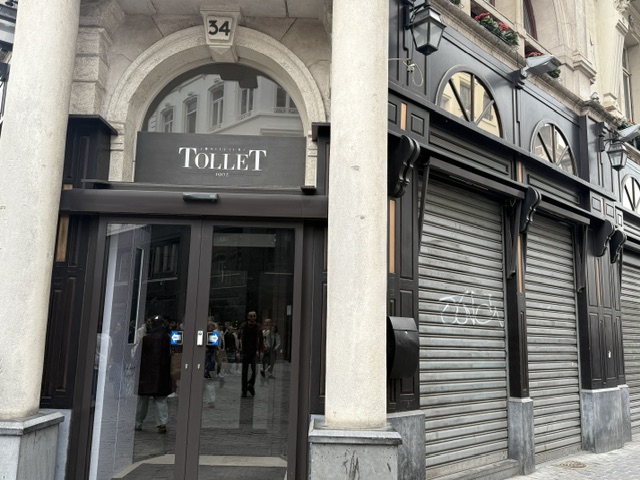
Tollet shuts its doors after 70 years in the city centre
Concerns about security, especially customers fearing theft after leaving the store, and the lack of car access have further accelerated the decision. "You don’t carry jewelry on the metro," Didier Tollet told The Brussels Times.
Tollet has since focused on its boutiques in Woluwe and Waterloo, with a second store set to open in the latter. The city center, he says, has become unsuitable for luxury retail, citing the presence of people sleeping in the streets and the decline in the area’s overall image. "We’re very happy to have left the center of Brussels," he concludes.
Quentin Huet, the representative of Shopera, an association of businesses active between Bourse and Rogier, shares this frustration. For him, the concept of a pedestrian zone is sound, but its implementation in Brussels has been a "disaster".
He points to the lack of viable alternatives to car travel: no metro at night, insufficient park-and-ride options, poor transport links. "We removed cars without offering real solutions. As a result, people from the outskirts no longer come in the city center, except for big events." He also raises concerns about security: "No one wants to go back to how things were, but safety isn’t where it should be. The city centre is poorly frequented, and that scares off customers."
Increase of commercial vacancy
Florence Ortmans, spokesperson for hub.brussels, presents figures she says reflect a positive commercial trend: 26 new retail units have opened in the area, although 15 are still vacant. The commercial offering has shifted, with a surge in food and leisure establishments (restaurants, bars, karaoke, cinemas), which now represent nearly half of all businesses.
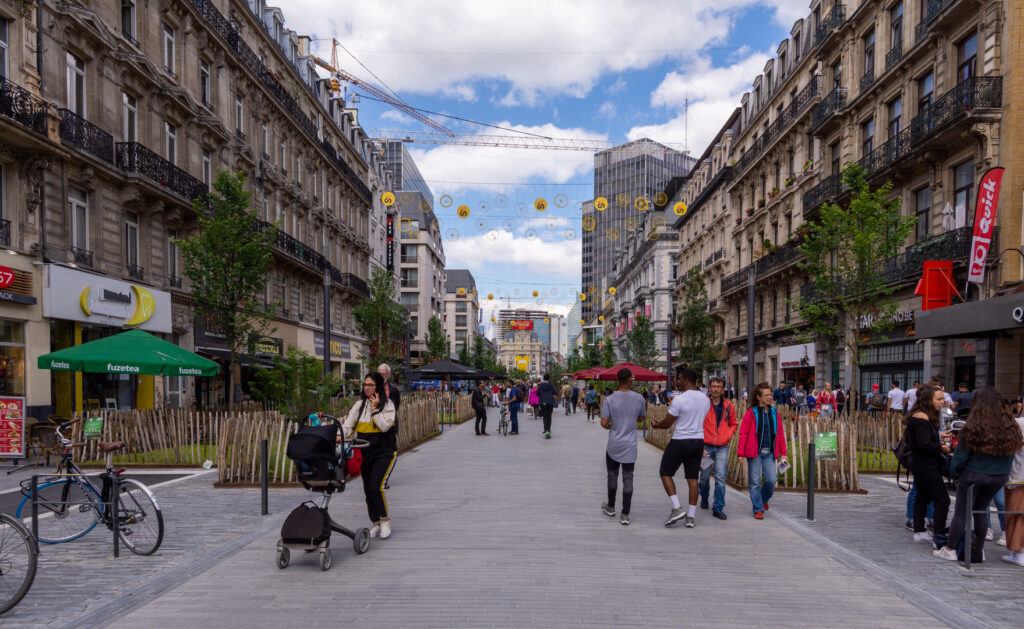
Boulevard Anspach
Meanwhile, shops selling personal goods, travel agencies, and banks have declined — trends she attributes more to broader market shifts (online shopping, digital services) than to the pedestrian zone itself.
While commercial vacancy has increased (from 14% to 19%), Florence Ortmans considers this manageable and concentrated in areas undergoing redevelopment, such as Place de Brouckère and the surroundings of the Bourse.
She also challenges the idea of a commercial downturn by pointing out that 43% of businesses present in 2018 were still operating in 2024 — a relatively stable figure considering the typical turnover rate in urban retail zones. "Yes, the offer has changed quite a bit, but not more than elsewhere in Brussels," Florence Ortmans adds.
Ultimately, Brussels’ pedestrian zone embodies the tensions inherent in urban transformation projects. It symbolises a city striving to reinvent itself around pedestrians, climate concerns, and a better quality of life. But it also reveals the pitfalls of a poorly supported vision, where mobility, safety, and commercial vitality were, according to many local stakeholders, overlooked.
To win over skeptics, the City will now need to move from theory to action — investing in efficient infrastructure, clear communication, and a stronger presence on the ground. In short, the challenge is to turn the pedestrian zone into a shared opportunity, not yet another fault line in a city already marked by deep divisions.
