

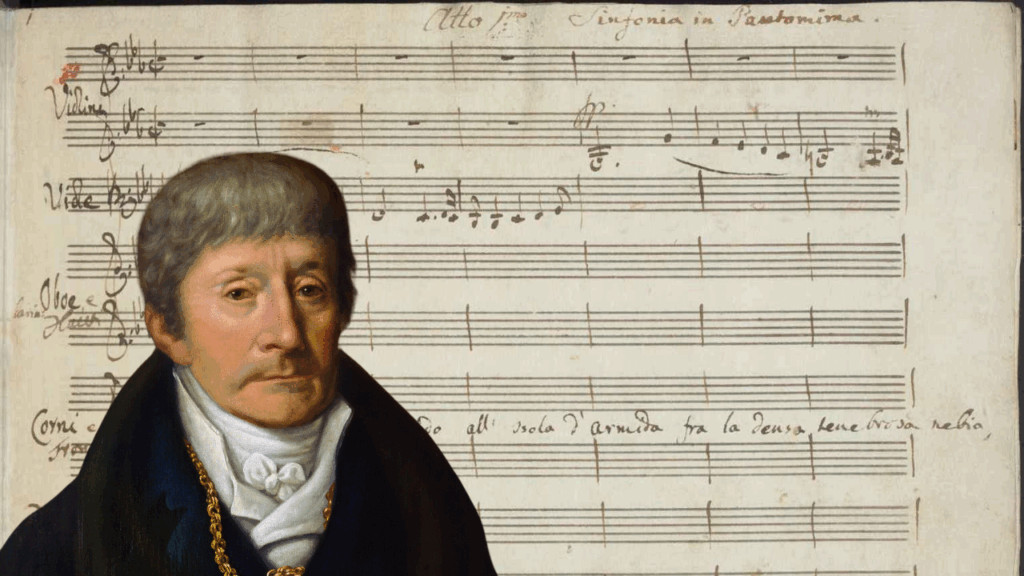
Two centuries ago, Antonio Salieri, the renowned Italian composer and teacher of the Classical period, died in Vienna, within the Austrian Empire. Salieri's life spanned an era that witnessed the emergence of extraordinary musical talent, including figures of the stature of Haydn, Beethoven, and Mozart. The Classical period itself remains one of the most celebrated in music history, distinguished by its emphasis on balance, clarity, and elegance, and for nurturing enduring masters who sought to create works of lasting significance. Popular narratives suggest that Salieri was consumed by envy, particularly towards Mozart, but the veracity of this claim deserves careful examination.
Antonio Salieri was born in Legnago, in the province of Verona, on August 18, 1750. His initial musical training came from various sources, and at the age of fifteen, he was already studying singing and theory in Venice. In 1766, right after the death of his parents, his mentor Florian Leopold Gassmann took the young Salieri to Vienna. Gassmann, a prominent figure in Viennese musical circles, introduced Salieri to influential figures such as Metastasio and Gluck, paving the way for a prestigious future.
Salieri quickly established himself in Vienna, gaining recognition as a composer and securing the patronage of the court. He held significant positions, including court composer and director of the Italian opera, becoming Kapellmeister of the Emperor in 1788. These were among the most important and well-paid musical positions in Europe at the time. His influence in the Viennese musical scene was substantial. But it was not only limited to Vienna: he achieved international acclaim with operas performed in Milan, Venice, Rome, and Paris.
Beyond his own compositions, Salieri dedicated himself to nurturing the next generation of musical talent. His pupils included some of the most celebrated names in music history, such as Ludwig van Beethoven, Franz Schubert, and Franz Liszt. This commitment to education, along with his own artistic achievements, firmly establishes Salieri as a significant figure in the history of classical music. He died in Vienna on May 7, 1825.
Two centuries after his death, Antonio Salieri remains one of the most fascinating and mythologized figures of the late 18th and early 19th centuries, a witness and protagonist of an era that privileged beauty over sentiment and sought the complicity of the spectator's intelligence. A leading operatic composer in his time, Salieri has, ironically, become best known through the distorting lens of the big screen, remembered by many as the alleged envious rival of one who was, in reality, a colleague: Wolfgang Amadeus Mozart.
The ’Amadeus’ Effect: Shaping Salieri’s Image
The enduring image of Antonio Salieri as a jealous rival to Wolfgang Amadeus Mozart owes much of its potency to a compelling, albeit largely fictional, narrative. Miloš Forman's 'Amadeus' premiered in Los Angeles in 1984, a film that would go on to win eight Academy Awards, one year later. 'Amadeus' presents a dramatic account of Mozart's life, interpreted by Tom Hulce, as seen through the eyes of a tormented Salieri, played by the magnificent F. Murray Abraham. The film's central premise rests upon Salieri's supposed envy of Mozart's extraordinary talent, a portrayal that has fuelled the misconception of Salieri as a mediocre composer consumed by such animosity that he may have even murdered Mozart. This, however, is a gross misrepresentation, a romanticized exaggeration of a rivalry that was far less bitter, and a significant underestimation of Salieri's importance and talent, which were widely acknowledged by connoisseurs of classical music.
While Mozart's operas and symphonies are among the most celebrated in history, and his biography, beginning with his childhood prodigy tours, is widely known, Salieri's story is less familiar to those outside classical music circles. Salieri spent much of his life in Vienna, where he was appointed court composer by Emperor Joseph II of Habsburg in 1774, among many other positions. But today, he is often overshadowed or remembered primarily through the lens of 'Amadeus'. The narrative of the alleged complicated relationship between the two composers was initially popularized by Russian poet and playwright Alexander Pushkin in his 1830 theatre play 'Mozart and Salieri'. This story circulated throughout the 19th century and was subsequently amplified by the film, despite a lack of concrete historical evidence. Given that 'Amadeus' is an adaptation of Peter Shaffer's 1979 play of the same name, itself inspired by Pushkin's work, some have argued that 'Salieri did not kill Mozart, but Salieri was certainly killed by Pushkin'. This narrative arc, spanning nearly two centuries, draws upon rumours that circulated during Salieri's final years, rumours that found fertile ground in Austro-German and French periodicals and cemented Salieri's image as a jealous and murderous figure. Popular culture narratives picked up on this portrayal of Salieri, even coining the detrimental term ‘Salieri’s Syndrome’. The Salieri’s Syndrome is not an official medical or psychological term, but rather a cultural metaphor used to describe the feeling of envy, resentment, or frustration experienced by a competent individual who finds themselves overshadowed by someone with extraordinary talent, often within the same field. It represents a psychological struggle between mediocrity and genius, particularly in competitive or creative environments.
Both composers lived and worked in Vienna during the same period, inevitably leading to comparisons and competition. And the 19th-century reception of Mozart and Salieri was influenced by the rise of nationalism and the tendency to define artistic greatness along national lines. The concept of Mozart as representing 'Germanic purity' contributed to a narrative that positioned him in opposition to other European composers, potentially exaggerating existing tensions or creating new ones.
However, historical evidence suggests a more complex and less hostile relationship than commonly portrayed. There are accounts of collaboration between the two, with Salieri even conducting some of Mozart's operas, such as 'Le nozze di Figaro' in 1785. Furthermore, there is no concrete evidence to support the claims that Salieri conspired against Mozart or sabotaged his career. The accusations of poisoning are considered unfounded, likely stemming from gossip and misunderstandings. While the exact cause of Mozart's death in 1791 remains a subject of some debate, many historians attribute it to renal failure resulting from a pulmonary infection complicated by rheumatic fever. Despite this, rumours of poisoning persisted, fuelled by Mozart's own suspicions in his final days, as documented by Mary Novello in 'A Mozart Pilgrimage' (1829).
Reputation in the Digital Age
The distortion of Antonio Salieri's posthumous reputation offers a compelling cautionary tale, one that finds a striking resonance in the complexities of the 21st century. In an era defined by the influence of the internet and social media, the inherent fragility of reputation is undeniably amplified. The digital landscape facilitates the rapid dissemination of misinformation, and online narratives, once entrenched in the collective consciousness, can prove extraordinarily resistant to correction.
The Salieri myth emphasizes the inherent perils of uncritically accepting a singular, dominant narrative, a lesson that translates directly to the contemporary emphasis on media literacy, responsibility and the imperative to rigorously evaluate sources. Just as historical accounts of Salieri were susceptible to the distorting influence of biases and agendas, so too is online information vulnerable to manipulation and decontextualization.
Furthermore, the mechanisms by which historical gossip propagated in Salieri's time bear an uncanny resemblance to the viral propagation of online rumours and fake news. The unparalleled speed and reach of digital communication possess the capacity to amplify falsehoods exponentially, thereby underscoring the critical importance of sustained vigilance in combating misinformation. As poignantly illustrated by the production of 'Amadeus’, the phenomenon of 'fake news' is not a novel invention of our time; rather, it constitutes a recurring challenge that necessitates unwavering critical engagement.
Therefore, the Salieri story serves as a reminder of the enduring importance of truth, accuracy, and critical thinking. In a world where reputation can be made or broken with a few clicks, the lessons from Salieri's experience are more relevant than ever.
