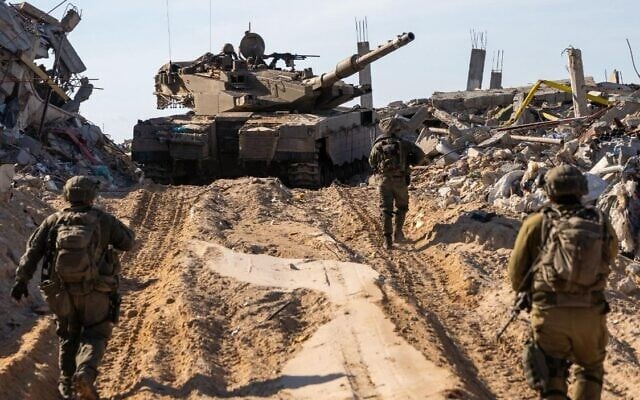
Since Israel imposed a total blockade on Gaza and resumed its military operations there in March, in breach of the ceasefire-hostage agreement with Hamas, the situation is on the brink of the abyss. The war drags on with no end in sight, unless a new deal can be agreed following President Trump’s visit in the region this week.
But that is not on Trump’s agenda, nor the normalisation of relations between Israel and Saudi Arabia. He will visit three Arab countries, Saudi Arabia, The United Arab Emirates and Qatar, but not Israel, which has been sidelined by the American President. Trump’s main goal during the visit is to make trade deals with Saudia Arabia.
Possibly one hostage with dual Israeli – American citizenship will be released by Hamas on Monday as a gesture of good will. For the families of the remaining 20 hostages still believed to be alive, this is a “selection” not based on humanitarian criteria.
They fear that their loved-ones will die in Gaza if Israel intensifies the war and launches the planned ground-offensive after Trump’s visit. The Israeli hostages risk being killed, together with many more Palestinian civilians, in indiscriminate air bombardments, or being abandoned in Hamas’ tunnels without any food.
The Israeli army has warned for this scenario but the government is not listening and believes that only more military pressure will force Hamas to give up and agree to release the hostages. It is not even clear if saving the hostages or the dismantlement of Hamas as a military and civilian force in Gaza is the government’s main goal. Both goals are not achievable.
Neither goal has been achieved
Despite 19 months of a war, which was supposed to end after some months, neither of the two goals have been achieved. For the far-right extremists in the government, but also for some think tanks, the hostages were always collateral damage. The main objective of the far-right parties is recolonisation of Gaza and displacement of its Palestinian population.
After Hamas’s horrific terrorist attack on 7 October, the extremists in the government and part of the public opinion do not distinguish between Hamas and non-combatant civilians and claim that there are no innocents in Gaza. During the war, far-right groups in Israel even tried to stop aid convoys to Gaza and continue to oppose the resuming of aid.
Hamas, a terrorist organisation which started the attack to ignite a multi-front war to destroy Israel, supported by Iran and its proxies, refuses to surrender. It does not care about the losses and suffering of the civilian population. This does not absolve Israel of its obligation to respect international and humanitarian law and allow full access to humanitarian aid.
Hamas can only be removed from power if Israel would agree to offer an alternative to its rule and a political horizon towards a solution of the Israeli-Palestinian conflict. But that might lead to the breakdown of the Israeli government. The war continues for political reasons, with no clear exit strategy, to avoid snap elections, which the government would lose according to the opinion polls.
Permanent ceasefire necessary
Hamas has reportedly agreed to release all hostages in one exchange for a large number of Palestinian security prisoners. But on one basic condition – that Israel agrees to a permanent ceasefire which effectively would end the war. This is also the demand of the families of the hostages and is supported by a majority of Israelis, including those who voted for the ruling coalition government.
The government has since long lost international legitimacy for the war. It has also lost internal legitimacy for continuing the war, which it did not see coming, and fears a state investigation of its responsibility. Despite the war, the government continues plotting for a judicial overhaul of the judiciary system which would transform Israel to an illiberal democracy.
In her press remarks following the informal foreign affairs council meeting in Warsaw last week, Kaja Kallas, High Representative for EU Foreign Affairs and Security Policy, said that the majority of EU Member States agreed that the situation in Gaza is untenable and rapidly deteriorating.
“These plans to intensify military operation in Gaza will lead to further suffering of civilian population. We reject any attempt of demographic or territorial changes in [the] Gaza Strip as well forced displacement of Palestinian population. We urge Israel to lift the blockade on Gaza immediately and ensure that the humanitarian aid reaches the people who are in need.”
In the meantime, humanitarian aid which was delivered before the blockade has run out and the population is starving. Kallas and fellow Commissioners referred to UN agencies that reported last week that food stocks are now exhausted and most households lack safe water. Looting of warehouses has restarted while tons of aid, representing supplies for three months, are waiting at the border.
More sanctions planned
The Commission also expressed concerns about the new delivery mechanism which Israel has announced. Instead of the up to 600 aid trucks that entered the Gaza Strip via several crossing points after the ceasefire-hostage deal, only reportedly 60 trucks would enter. The aid would be distributed in a specific area to which the displaced population from other parts of the Gaza Strip would have to come to collect the aid.
The mechanism would shift the responsibility for the distribution of aid to non-humanitarian international actors and private security contractors. This runs counter to humanitarian principles, as underlined by UN agencies and its partners. It also fuels allegations that Israel is “weaponizing” the aid. In fact, this is what the government is admitting that it is doing to exert pressure on Hamas.
Kaja Kallas said that the frustration about Member States that the war in Gaza cannot be stopped is tremendous. She mentioned the possibility of more sanctions against violent settlers at next foreign affair council on 20 May. She did not mention if extremist ministers, that are inciting to violence and calling for the weaponization of humanitarian aid, will also be sanctioned.
While trying to keep a diplomatic tone, Kallas referred to the discussions in the European Parliament to get a flavour of the differences between different Member States. In fact, the EU has agreed on a common position, condemning Hamas’ terrorist attack, recognizing Israel’s right to self-defence in line with international law, and calling for the implementation of the two-state solution.
Everything goes in the Parliament
The Israeli – Palestinian issue is divisive in the Parliament but some MEPs deviate strongly from the EU common position. A recent seminar in the parliament, organised by four members of the Greens/European Free Alliance (EFA), was inspired by the Russell Tribunal and aimed at raising awareness about human rights violations and war crimes in Gaza.
In fact, the conference (“Can we call it genocide?”) focused on proving Israel’s “genocidal intent” in the war before the International Court of Justice (ICJ) has issued its final ruling regarding the application of the genocide convention in the Gaza Strip. Pending its final decision, the court directed Israel to take certain measures to protect the rights of the civilian population in Gaza.
This the Israeli government has largely ignored and the humanitarian situation in Gaza has only deteriorated since the ICJ ruling in in January 2024. The court directed among others Israel to do everything in its power to avoid deaths and injuries in the Gaza Strip and to allow humanitarian assistance and access for the Palestinian people.
Speaker after speaker at the event adopted a Palestinian narrative and claimed that the Gaza war is the last stage in a colonial settler project aiming at ethnic cleansing of the Palestinian population. Overall, the speakers rejected any historical connection between the Jewish people and the land and its right to national self-determination. The EU was accused of being complicit in genocide. Israelis were demonized.
Asked whether the event was sponsored by the Greens/EFA, a spokesperson replied that no political endorsement is required for events that MEPs organise. The MEPs concerned defined the programme and invited the panellists. The MEPs did not respond to a written request from The Brussels Times for comment.
