
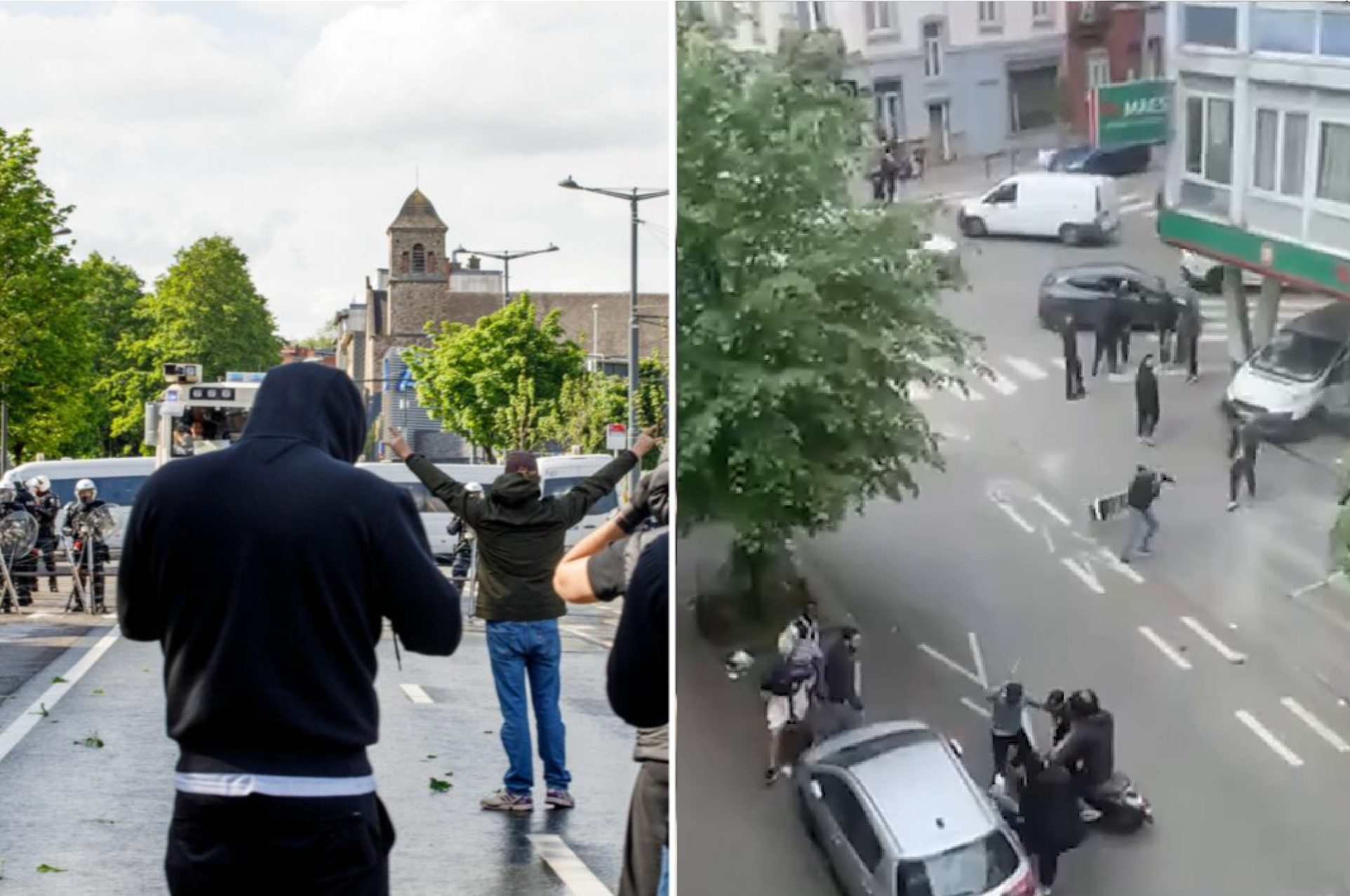
Before and after the Belgian football cup final just under two weeks ago, violence erupted in the streets of Brussels. Belgium is still struggling with football hooliganism. How eradicable is the problem?
Suddenly they were there, dressed in black, their faces covered, with only one goal: to fight.
In Molenbeek, more than six kilometres away from the King Baudouin Stadium, Bruges hooligans went on an extraordinary rampage against residents hours before the kick-off of the Belgian cup final on 4 May.
It was the start of a wave of violence and destruction that swept through the streets of the capital. The outside world reacted with shock, Anderlecht mayor Fabrice Cumps (PS) decided not to allow Club Brugge supporters to attend the league match against Anderlecht on Sunday 18 May, citing "the unacceptable behaviour of so-called supporters".
Hooligan specialist Jean-Michel De Waele, a sociologist at the Université Libre de Bruxelles, tells The Brussels Times he was very surprised by the extraordinary violence of the far-right supporters of Club Brugge. “It is unheard of in Belgium for hooligans to go to a particular neighbourhood to insult and beat up strangers. These were not ordinary hooligans; these were fascist groups that terrorised the streets of Brussels. It is normal for people to defend themselves when they are attacked, but the ferocity of the residents' reaction was also impressive.”
Speaking to The Brussels Times, former police commissioner and football security officer Steven De Smet, co-author of a book on hooliganism believes "the violence in Brussels had nothing to do with football. It was pure hooliganism: people who organise violence in advance and look for ways to cause trouble. I think it's too easy to say that it's a problem with football. It goes further than that. This is a problem of violent young people, of youth gangs."
"You have to distinguish between the overwhelming majority of football fans, who are peaceful, love football and just want to have fun," says De Waele. "It was striking that there were no scarves or T-shirts of any football club to be seen in the images circulating about the riots. It is quite possible that those extremist perpetrators of violence did not even go to the stadium on that day."
Belgium is still struggling with football hooliganism 40 years after the Heysel tragedy. De Smet is not surprised: "Hooliganism has been a problem in Belgium since that tragedy. That's when it came onto the political agenda. The then Minister of the Interior, Louis Tobback (Vooruit), took a number of tough measures to tackle it. For his successor, however, it was no longer a priority."
No policy on hooliganism
Since then, things have not improved. There is no policy on hooliganism.
De Waele notes that "there is a hooligan culture in Belgium. It's not just in Bruges, but everywhere: in Anderlecht, Antwerp, Liège. Many people and the media think of hooligans as unemployed alcoholics, but that image is not accurate. You find them in all walks of life: lawyers, office workers, good family men. They do have one thing in common: they are almost always young men. You don't see many 60-year-old hooligans. Why is violence and hooliganism attractive to them? It is always difficult to explain something that is inexplicable to us. Violence is attractive to some people; it is a way of solving problems. To a certain extent, we also live in a society that glorifies violence: look at films, games, television series. There's constantly violence."
"Young people and violence have always existed," says De Smet. "We need to be aware of that. Youth violence has gradually become associated with football. For some mayors, that suits them fine: the violence moves from the cities to the football stadiums, relieving them of the problem. They can lean back and say that football has a problem. That's too easy."
Today, hooliganism is once again drawing a lot of attention, although De Waele does not believe that the problem has worsened in recent years.
"I don't know the exact figures for the number of football incidents, but I don't think there is a significant increase. Many things are getting more attention through social media and because people can film more easily. Violence in football only takes place in a small proportion of large stadiums. What surprises me is that there is not more media attention for violence at matches involving children aged 13 or 14. I find that even more problematic. Every week in Belgium, France and the rest of Europe, parents get into fights or scratch the referee's car at youth matches, looking to relieve their anger. That's where you see the most violence, even though there is no television or media present, and the stakes are very low. What message are you sending to young people? If we want to tackle hooliganism, we also have to tackle that."
How should the problem be tackled? "There should be a central policy," says De Smet.
"The Minister of the Interior should take charge of this, instead of passing the buck to mayors. That doesn't work. Some local politicians are too close to a football club or have no interest in tackling the problem. As a result, there is simply no policy. In addition, the police need to organise themselves differently. It still has a pyramid-shaped decision-making structure, while hooligans are organised in networks. You must do the same if you want to tackle them. The police have to adapt."
De Waele: “I think you also have to work with supporters. You can't just impose laws on them. Of course, it's not easy, I know there is no supporters’ union with which politicians and the police can consult. But still: cooperation is important. Fabrice Cumps' decision not to allow Bruges supporters to attend the match in Anderlecht on 18 May is stupid. It's panic football. I fear that Bruges supporters will come to Brussels anyway and buy tickets on the black market, which will cause things to go wrong. You need repression, I won’t deny that, but repression alone is not the solution.”
