
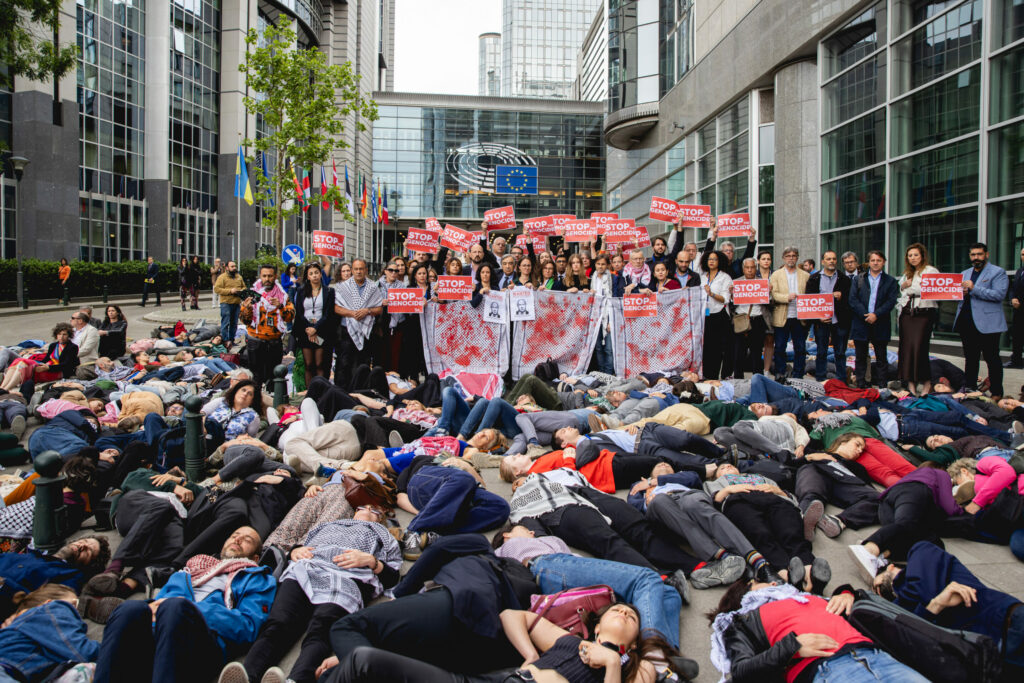
The Foreign affairs Council meeting on Tuesday ended with calls on Israel to immediately enable full humanitarian aid access to Gaza and to end to the war but the deliveries are still insufficient and no breakthrough has been reported in the talks on a new ceasefire-hostage deal.
On the contrary, in one of his rare press conferences, Israel’s Prime Minister Benjamin Netanyahu on Wednesday continued to defy both world opinion and domestic public opinion. Although he admitted that Hamas has largely been defeated and does not pose any threat to Israel, he threatened to expand the ground operation in Gaza and doubled down on his conditions to end the war.
He said that he would only agree to end the war under conditions that will ensure the safety of Israel: “All the hostages come home, Hamas lays down its arms, steps down from power, its leadership is exiled from the Strip, Gaza is totally disarmed, and we carry out the Trump plan,” referring to a plan for the transfer of Palestinians from Gaza to other countries which the US has realized is unfeasible.
There is an understanding in the EU that there is no place for a terrorist organisation in Gaza. But to completely dismantle Hamas’ military capabilities and remove it from power in Gaza there must be an alternative to its rule. Until now, the far-right Israeli government has refused to agree to replacing Hamas by a reformed Palestinian Authority and failed to translate the military achievements in the war against Hamas and Hezbollah to political solutions.
Even the Israeli ambassador in Brussels to the EU and NATO, Haim Regev, spoke out with a group of Israeli journalists visiting Brussels on Thursday for a background briefing on EU-Israel relations and the challenges ahead. As reported by Haaretz, he criticized for the first time his own government for its handling of the war and the relations with the EU.
In the beginning of the war, he used to say that Israel fought a war against Hamas and not against the Palestinian population in Gaza. He dismissed any concerns that the international legitimacy for responding to Hamas’ terrorist attack on 7 October 2023 would evaporate if the war continued with no end in sight and a high death toll among the population and the devastation of civilian infrastructure.
But this is what happened. "This is a war for which we got legitimacy for the longest period ever,” he said. In fact, Israel lost the legitimacy after a few months of disproportionate bombings. “Now they see massive destruction and (killing of) babies, 70% of Gaza destroyed, tens of thousands of dead. They say: Do you want to release the hostages? End the war and release them."
The ambassador said that if the humanitarian situation in Gaza does not improve and the war continues to claim many more civilian victims, there will be a breakdown in the relations with the EU and the international community. "The humanitarian aid was the straw that broke the camel's back," he said, referring to the EU decision to launch a review of the EU-Israeli Association agreement.
The relations between Israel and the EU began to recover in 2022, when the Association Council met after a suspension of ten years. The relations seemed to improve during the previous government of change, but after that the situation changed. "Netanyahu did not count on the EU despite its importance as Israel's partner in the economic and technological fields."
The EU decision to launch a review of the Agreement, more than a year since it was first requested by Spain and Ireland, was discussed in the European Parliament on Wednesday. The debate was intensive and messy with calls for order in the plenary and MEPs talking past each other. Overall MEPs agreed on the need to respect international humanitarian law and the immediate entry of humanitarian aid at scale into Gaza.
Some MEPs accused colleagues of being complicit in a “genocidal” war in Gaza and demanded that the EU should suspend the agreement with Israel and impose further sanctions. Other MEPs expressed support for Israel’s new offensive to crush what is left of Hamas in Gaza.
The Left political group commented that it was an insult to the European Parliament and to the gravity of the situation that the European Commission had sent a junior Commissioner, Glenn Micallef, to the debate instead of High Representative Kaja Kallas, who had chaired the Foreign Affairs Council meeting. Micallef has no responsibility in the area of EU foreign policy, the group said.
