

It is time to discuss how to increase economic growth in the EU and boost its international competitiveness through more inclusive policies that address current gaps in the labour market between the general population and the Roma minority.
That was the conclusion at a recent conference in Brussels (19 May) on ‘Europe’s quest for competitiveness’, held by Politico EU in partnership with the Roma Foundation for Europe. The event took place against the backdrop of the reports last year by Enrico Letta and Mario Draghi, warning that EU’s competitive edge will erode if it does not mobilise all its resources, especially its human capital.
It came also at a critical time as the European Commission has launched the preparations for next Multiannual Financial Framework (MFF), that will start in 2028 and cover at least five years. Central to the new MFF is the need to expand Europe’s workforce and invest in regions and communities historically left behind.
With over 10 million Roma living across the continent, many in areas facing labour shortages, they represent untapped economic potential. “Demography and skills are two sides of the same coin—fewer people of working age mean Europe must equip everyone to be as productive as possible,” said Zeljko Jovanovic, President of the Roma Foundation for Europe.
Sharing the report “The Ten Billion Euro Opportunity: Unlocking the Potential of Roma Youth” during the event, he focused on the situation of millions of young Roma—Europe’s youngest demographic—that are excluded from economic life.
While nearly two million workers exit the EU labour market annually, 56 per % of Roma youth (15–24) are not in education, employment or training (NEETs), compared to the EU average of ca 12 %, according to the report.
“Every untapped worker or unskilled employee is a luxury Europe cannot afford in a tightening labour market. The EU doesn’t need to look outside of Europe to strengthen its labour force. Europe’s Roma population is overwhelmingly young, multilingual and mobile.”
Roxana Minzatu, Executive Vice-President and EU Commissioner for Social Rights and Skills, noted that Europe’s untapped potential lies in its women, migrants, minorities and people with disabilities.
She stressed the role that the largest minority in Europe could play in enhancing Europe’s competitiveness: “For Roma, we have been looking at how we should support communities of Roma from the perspective of fighting discrimination, of pushing towards inclusion. We really need to understand that we need a new paradigm.”
She spoke about incorporating this agenda into groups with untapped potential through increased investment in basic education, vocational education, and setting targets for specific job types. “And then we need to scale the kind of intervention that can be rolled out more widely.”
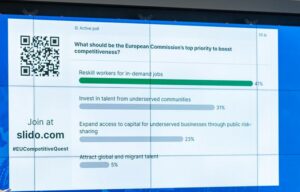
Opinion poll: What should be the European Commission’s top priority to boost competitiveness? More than 70 % think that it should reskill workers for in-demand jobs and invest in talent from undeserved communities.
Structural barriers
As previously reported, the current level of ambition is insufficient to guarantee the achievement of the minimum progress set by the EU 2030 targets in the national Roma strategic frameworks, according to the European Commission's own reports on the implementation of the strategic frameworks.
Has the European Commission proposed any concrete proposals and new initiatives?
“Yes, the Commission launched several concrete initiatives under the Union of Skills package, revealed on 5 March,” Commission staff told The Brussels Times.
“These include an Action Plan on Basic Skills with 2030 targets to reduce underachievement and boost top performance, and a pilot Basic Skills Support Scheme in cooperation with Member States—also addressing the needs of vulnerable groups, including the Roma population."
Furthermore, the European Innovative School Award will recognize schools innovating in in science, technology, engineering, and mathematics (STEM) education and citizenship education. Additionally, Erasmus+ calls are open to support implementation, including one focused on basic skills in schools with a €3 million budget and a 27 May deadline.
“While no formal proposals were announced at the event, Executive Vice President Roxana Mînzatu expressed a strong ambition to make Erasmus more accessible,” commented Zeljko Jovanovic. “Her vision is that all children—regardless of background—should have the opportunity to benefit from an Erasmus experience by the time they reach high school or university.”
This has not yet been politically agreed or included in the current EU budget but the Commission is actively working toward the “Erasmus for all” vision. Jovanovic’s key takeaway from the event is that many of the funding instruments already exist. But they are not adapted or directed toward those who need them most, including the Roma.
How can the NEET gap be reduced in the short term?
“Member states need to strengthen efforts under the Youth Guarantee and the EU Roma Strategic Framework 2020-2030,” the Commission applied. It admitted that the progress made so far with support from programmes such as Citizens, Equality, Rights and Values (CERV), Erasmus+ and the European Social Fund is too slow.
“Immediate action should focus on targeted education and job opportunities for Roma youth, better use of EU funding, and closer monitoring of results.”
“Reducing the NEET gap especially among Roma youth in the short term requires targeted, practical interventions that align with real labour market demand,” added Jovanovic. “Our analysis shows that training Roma youth for occupations already identified by the EU as facing critical labour shortages can deliver returns in just 1–4 years."
Vocational training and upskilling for some jobs where there are labour shortages are feasible within months—not years. But training alone is not enough. Structural barriers—such as lack of transportation, unaffordable childcare, welfare disincentives, and inaccessible employment services—must be removed simultaneously.
Many Roma youth are currently invisible to schemes like the Youth Guarantee due to poor outreach, lack of digital access, or discrimination at the point of contact. Antigypsism and discrimination in recruitment and the work place are pervasive, according to a survey by the European Roma Grassroots Organisations (ERGO) Network last year.
