
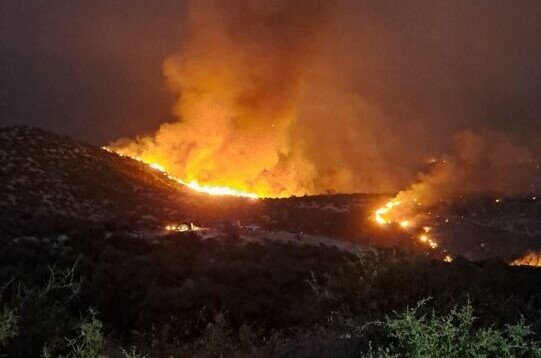
The European Commission announced on Monday that the EU stands better prepared this year to support the Member States affected by wildfires.
To prepare for the increased wildfire risk during the upcoming summer months, the EU has put together teams of firefighters and aircraft that can be requested via the EU Civil Protection Mechanism
To quickly support local fire brigades, throughout July and August, almost 650 firefighters from 14 countries will be strategically positioned in key high-risk locations in South Europe (France, Greece, Portugal, and Spain). In addition, 22 firefighting airplanes and 4 helicopters will be stationed in 10 Member States to intervene in case of need.
As reported last November, the EU has at its disposal a pool of 28 firefighting planes which can be deployed at relatively short notice. In total, there are more planes in the Member States but most of them are old and used for spare parts. An agreement with Canada on the production of 12 new amphibious firefighting planes will increase the active pool and improve its capacity.
Asked when the Canadian plans will be delivered, a Commission spokesperson told The Brussels Times that they are not available yet and are expected to arrive in 2026 and 2027. Som Member States have put amphibious airplanes to EU’s disposal. The number of pre-positioned firefighters, however, have increased significantly compared to last year.
In addition, a further 19 ground firefighting teams, of around 30 firefighters each, and one advisory and assessment team, are ready to be mobilised by the EU in close collaboration with Member and Participating States via the EU Civil Protection Mechanism (UCPM). Any country in the world affected by wildfires can request assistance through the Mechanism (UCPM).
Once activated, the EU's 24/7 Emergency Response Coordination Centre coordinates and co-finances the delivery of assistance, offered voluntarily by EU Member States and ten additional UCPM Participating States (Iceland, Norway, Serbia, North Macedonia, Montenegro, Türkiye, Bosnia and Herzegovina, Albania, Moldova and Ukraine).
“Extreme heat and wildfires in Europe have sadly become the new normal;” commented Hadja Lahbib, Commissioner for Equality, Preparedness and Crisis Management. “Our support is tangible and makes a difference on the ground. This wouldn’t be possible without a strong team effort across borders thanks to countries working together to make Europe safer in the face of this changing reality.”
Last year, Europe, the Middle East and Africa suffered some of the worst wildfires since 2000. According to the Commission’s annual forest fires reports, approximately 96% of wildfires in the EU are caused by human actions. About half of them are intentional, including arson, and the other half accidental and due to negligence. Only few of the wildfires are investigated.
