
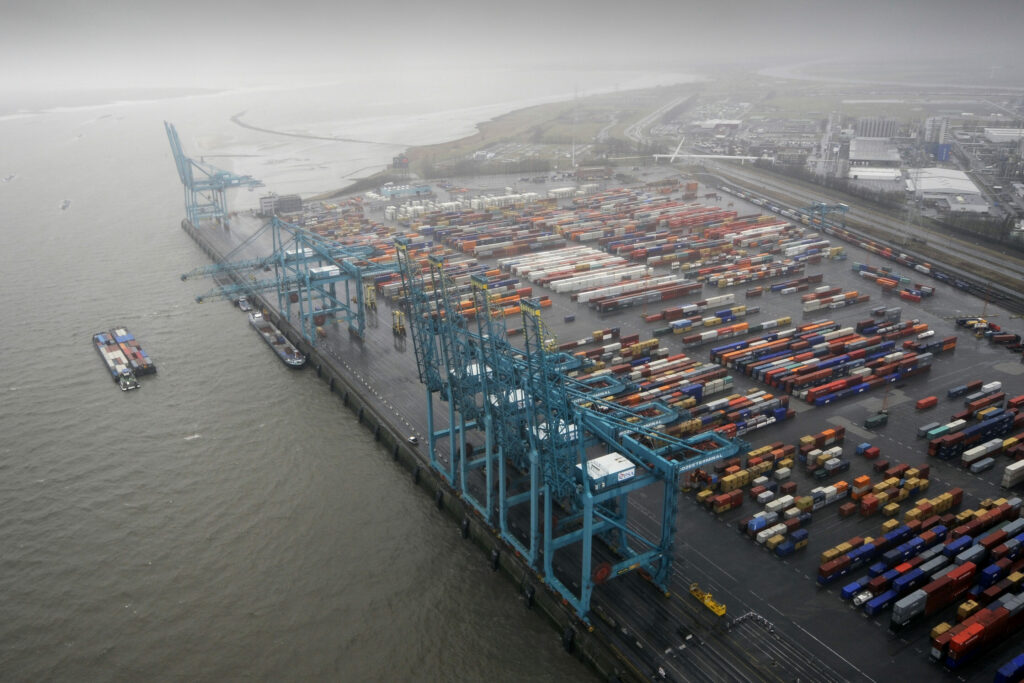
United States President Donald Trump's threat to impose 50% import tariffs on goods from the European Union would have "serious consequences" for the Flemish – and therefore Belgian – economy.
Trump threatened to impose 50% tariffs on almost all EU imports from 1 June. However, in a post on his Truth Social platform, he confirmed a temporary pause after what he described as a "very nice call" with European Commission President Ursula von der Leyen. "I agreed to the extension – it was my privilege to do so," he wrote, adding that talks would begin "very soon."
Flanders accounts for 80% of Belgium's exports. EU countries remain the main export lanes for Flanders, together accounting for 65%. Over 6% of total exports go to the US.
Even though it is not entirely certain whether Trump's tariffs will indeed materialise, Flemish Minister-President Mathias Diependaele (N-VA) spoke of "serious consequences" for the economy. "Flanders exported some €26 billion to the US in 2024. A 50% tariff would make those exports much more expensive in one fell swoop – with a possible additional cost of some €13 billion," he told The Brussels Times.
Room for growth
A few sectors in particular would feel the impact of the tariffs: the pharmaceutical industry would be worst hit, accounting for almost half (48%) of the total impact. This is followed by machinery (8.69%), transport equipment (5.25%), chemicals (4.5%), plastics (3.49%), petroleum products (3.23%) and diamonds (3.12%).
"Together, these sectors would account for three-quarters of the blow," said Diependaele. "So for now, it remains to be seen whether Trump's proposal becomes real policy."
Should it come to that, Flemish companies should be well-prepared and can respond flexibly to the changes, he stressed. "We help them do that, also through Flanders Investment & Trade (FIT). Finding new markets and new trade agreements, but also within the EU, there is still room for growth for exports. The entrepreneurs are not alone."
Diependaele said that financial support for businesses that would be impacted is currently not on the table, and it would make no economic sense either. "Flemish people will not immediately feel this in their wallet. But if it escalates, it could affect our prices. In case of a trade war, everyone will be feeling it. So we are doing everything we can to limit the possible impact."
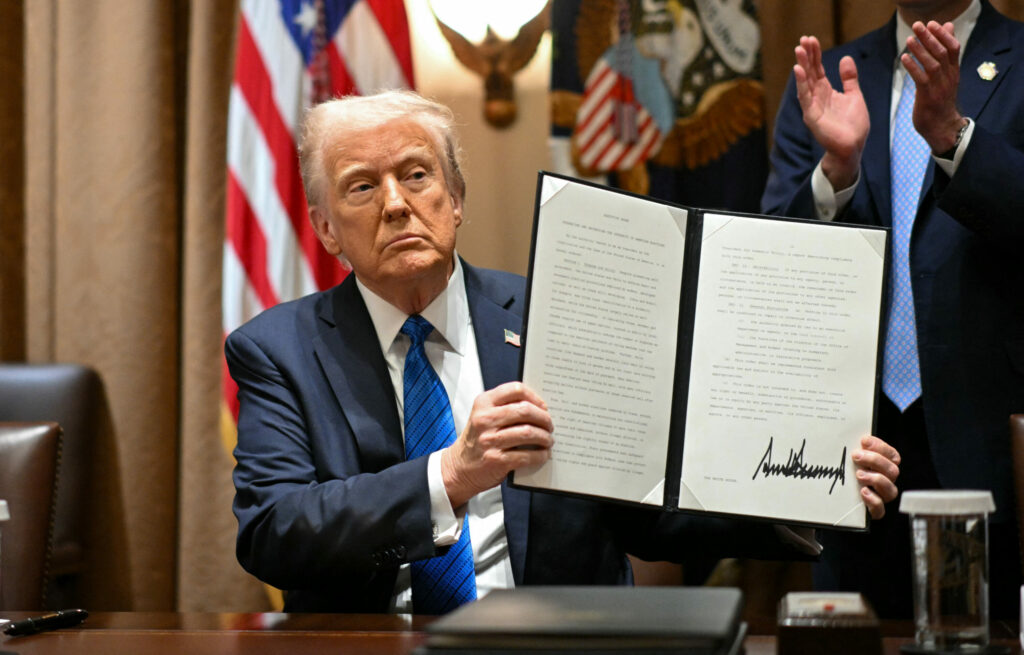
US President Donald Trump displays an executive order after signing it during a meeting with US Ambassadors in the Cabinet Room of the White House in Washington DC, on 25 March 2025. Credit: Belga / AFP
He stressed that the US is not the only market in the world: both Flanders and the EU are looking at new areas, in Latin America or in Asia for example, to sell products.
"There are also still a lot of barriers within the EU single market, a kind of imaginary import tariffs between different EU countries," said Diependaele. "For example, a study by the International Monetary Fund (IMF) shows that for goods that could be over 40% and for services even over 100%."
"Deepening the EU's internal market further would certainly offer huge opportunities for Flanders – 65% of our exports go to other EU countries – but work needs to be done on this," he said.
According to Diependaele, the Flemish economy is also resilient enough to face a turbulent period. "Our entrepreneurs will very quickly look for other opportunities and the Flemish Government will also support them in this. For example, we have set up an internal cell with Flanders Investment and Trade (FIT) that will guide companies around these import duties."
