
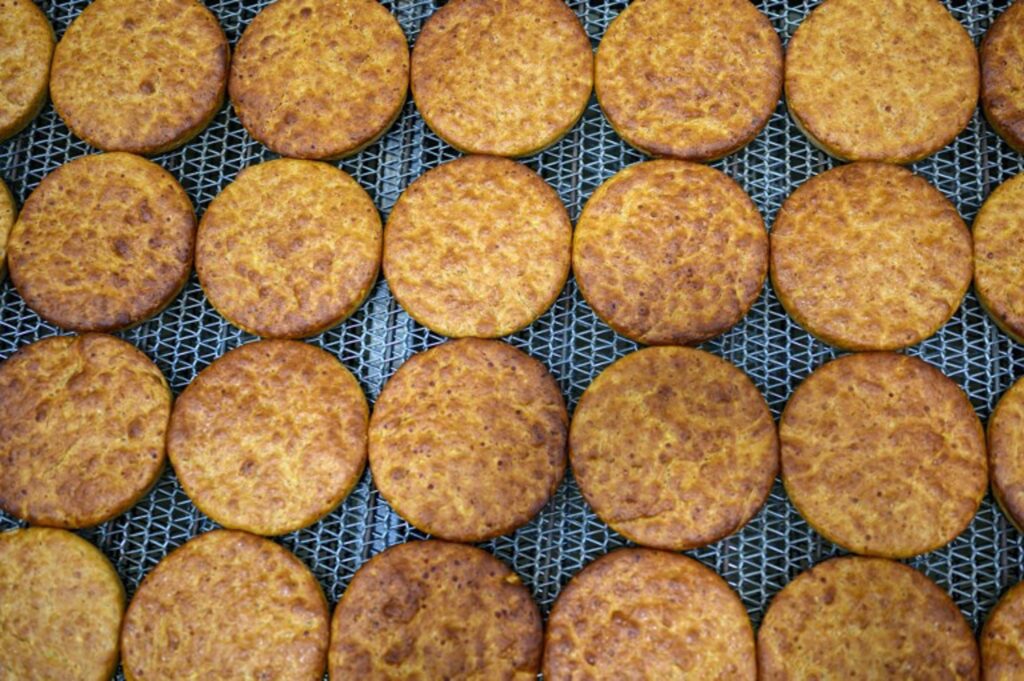
Archaeologists in Turkey have unearthed a 5,000-year-old loaf of bread, prompting local bakers to reproduce it and sparking renewed interest in cultivating ancient, drought-resistant wheat varieties.
Murat Türkteki, the archaeologist leading the excavations at Küllüoba, located 35 kms from the city of Eskisehir in northwestern Turkey, described the find as the oldest raised and baked bread ever uncovered that has largely retained its shape.
“Bread is a rare find in excavations; we usually only come across crumbs. In this case, it was preserved because it had been burnt and buried,” Türkteki told French new agency AFP. He said the discovery was made public last week.
Testament to an ancient civilisation
Round and flat like a pancake with a 12 cm diameter, the bread was discovered in September 2024, charred and buried beneath the threshold of a Bronze Age dwelling dated around 3300 BC.
Before it was burnt and buried during construction, a piece had been removed, suggesting, according to Türkteki, a ritual of abundance.
Without written records, the Anatolian civilisation of Küllüoba remains largely mysterious, including practices like burying homes before relocating or building anew on previous structures, forming mounds.
During the Bronze Age, the Hatti, an Anatolian people predating the Hittites, inhabited the Eskisehir region.
“Küllüoba was a medium-sized urban settlement with commercial activities, crafts, agriculture, and mining. Clearly, there was some degree of family and social order,” archaeologist Deniz Sari explained.
Extinct variety of whaet flour
Analysis revealed that the bread was made from coarse Emmer wheat flour, an ancient variety, combined with lentil seeds, using an undetermined plant leaf as yeast.
The carbonised bread has been displayed at the Eskisehir Archaeological Museum since Wednesday.
“This discovery deeply moved us. Speaking with our excavation director, I wondered if we could recreate the bread,” said Eskisehir Mayor Ayse Ünlüce
To closely mimic the original recipe, the municipality opted to use Kavilca wheat—a similar ancient variety—as Emmer no longer exists in Turkey, along with bulgur and lentils.
First 'remade' loaves enjoy instant popularity
At Halk Ekmek, a municipal bakery offering affordable bread, employees have hand-crafted 300 Küllüoba loaves daily since last week.
“The combination of ancestral wheat flour, lentils, and bulgur results in a rich, filling, low-gluten, preservative-free bread,” said Serap Güler, director of Halk Ekmek in Eskisehir.
The first Küllüoba loaves, sold as 300-gramme pancakes for approximately €1.12, were all bought within hours.
Eskisehir province, once abundant with water sources, now suffers from drought.
“We are facing a climate crisis, yet we continue to cultivate water-intensive corn and sunflower. Our ancestors offer a lesson: we should, like them, focus on less water-demanding crops,” said the mayor, who aims to revive Kavilca wheat cultivation in her region due to its resistance to drought and disease.
