
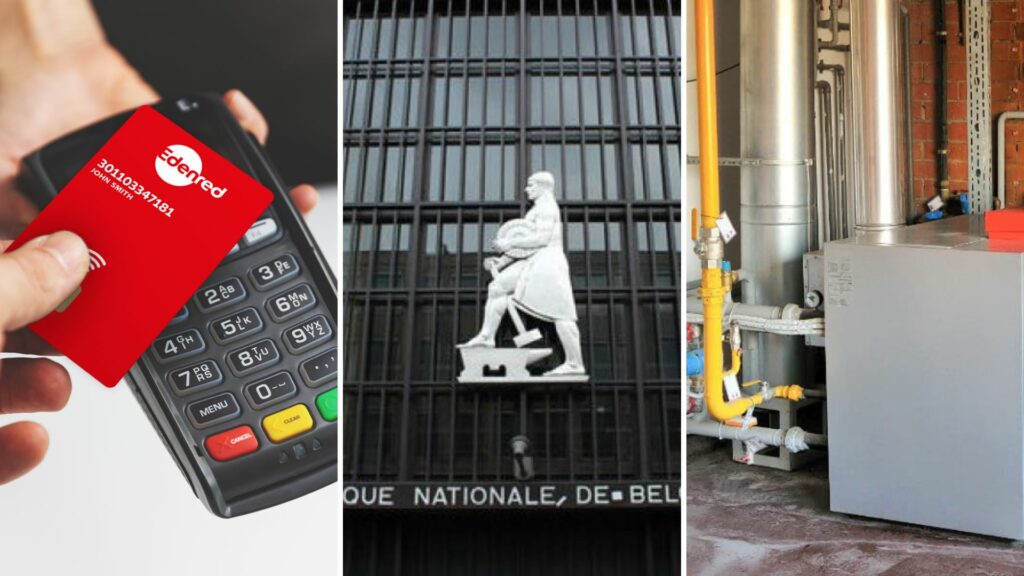
As is customary in Belgium, the start of a new month signifies a series of new rules. From 1 June, new measures and decisions will be implemented across the country. The most important changes and how they will impact people can be found here.
No more paper service vouchers
The paper service vouchers (also called "titres-service") will disappear permanently from 1 June, and will only become available digitally.
The previous Flemish Government decided in 2023 that the paper service vouchers would disappear from 2025. However, already purchased paper vouchers can still be used for up to one year after the purchase date.
Those who still use paper service vouchers will receive a letter explaining how they can order and use electronic service vouchers. Users who are less digitally skilled will be directed to various helplines, including via email or phone.

Service vouchers. Credit: Belga/Dirk Waem
"But the easiest thing is for a person they know and trust to help them," explained Pluxee, a leading employee benefits provider. A family member or acquaintance can then purchase service vouchers for them via a power of attorney system. Currently, 9% of Pluxee customers still use paper checks, 91% prefer digital.
Users can find more information on the Flemish Government website. Electronic service checks can be ordered via bank transfer, the mobile app, the website or the mobile banking app of Belfius, KBC or BNP Paribas Fortis.
Service checks purchased from 1 June will be automatically refunded when they expire. For paper and digital service checks purchased before 1 June, users must request a refund themselves before the expiry date.
Brussels bans installing oil-fired boilers
The Brussels-Capital Region is banning the installation of oil-fired boilers from June. The ban also applies to the replacement of existing boilers, unless an exception is granted.
The measure applies to homes, as well as to co-ownerships and businesses. Currently, 5% to 7% of the boilers in the capital run on fuel oil and these are only getting older: the average age of oil-fired boilers is more than 25 years. This type of heating has a major impact on the environment due to the significant emissions of carbon dioxide (CO2) and particulate matter.
If it is technically not possible to install another type of heating in the building and if the alternatives have been investigated, an exemption can be requested. Existing boilers may continue to be used.
Reimbursements for adapted baby food
Half of the cost for adapted food for babies with a cow's milk protein allergy will be reimbursed, announced Federal Minister for Public Health Frank Vandenbroucke (Vooruit). In order to be entitled to reimbursement, a doctor must first make a diagnosis.
Approximately 4,800 children are born with a cow's milk protein allergy every year. It is one of the most common food allergies in babies under the age of 3. To be clear: this is something different from lactose intolerance. In most cases, the condition is temporary. But in order to get through the first few years without any troublesome symptoms, proper cow's milk protein-free nutrition is crucial.

Baby eating baby food Friday 27 March 2020 in Brussels. Credit: Belga/Laurie Dieffembacq
According to Vandenbroucke, 70% of babies can easily be treated with an intensive protein hydrolysate. If this nutrition is not sufficient, which is the case for approximately 30% of infants, there are also amino acid preparations (already partly reimbursed).
A doctor must prove the diagnosis in order for the patient to be entitled to reimbursement. That doctor must also regularly monitor the baby to see whether adapted nutrition is still necessary. Milk based on an alternative protein source, such as rice, soy or goat's milk, does not count as adapted nutrition.
Consumer credits become a bit cheaper
The maximum rates for various consumer credits are being reduced from June: it concerns a decrease of 0.5 to 1.5 percentage points, according to a statement from the Economy Ministry on Wednesday. The maximum permitted rates, expressed in Annual Percentage Rate (APRs), are set by the Federal Government.
In concrete terms, these maximum APRs will decrease by 1 percentage point from 1 June for credit facilities, such as credit cards sold by banks, supermarkets or mail order companies, and for the possibility of going below zero on a current account.
For credit cards, the new maximum APR will now be between 13.5% (more than €5,000) and 16.50% (less than €1,250).
The headquarters of the ING banking group, Wednesday 22 February 2023 in Brussels. Credit: Belga/ Benoit Doppgane
The maximum APRs for loans and instalment sales up to €1,250 will decrease by 1 percentage point, to 20.5%. For amounts between €1,250 and €5,000, this represents a decrease of 0.5 percentage points – to 15.5%. If the amount is higher than €5,000, the maximum APR remains unchanged at 13.0%.
A similar decrease occurs for financing leases, where you rent a property and have the option to purchase the rented property after the lease term has expired. The maximum APR for this varies from 11% (more than €5,000) to 14.5% (up to €1,250) from June.
The new maximums apply to new credit contracts and to current contracts with a variable debit interest rate. They do not therefore apply to current contracts with a fixed debit interest rate.
