
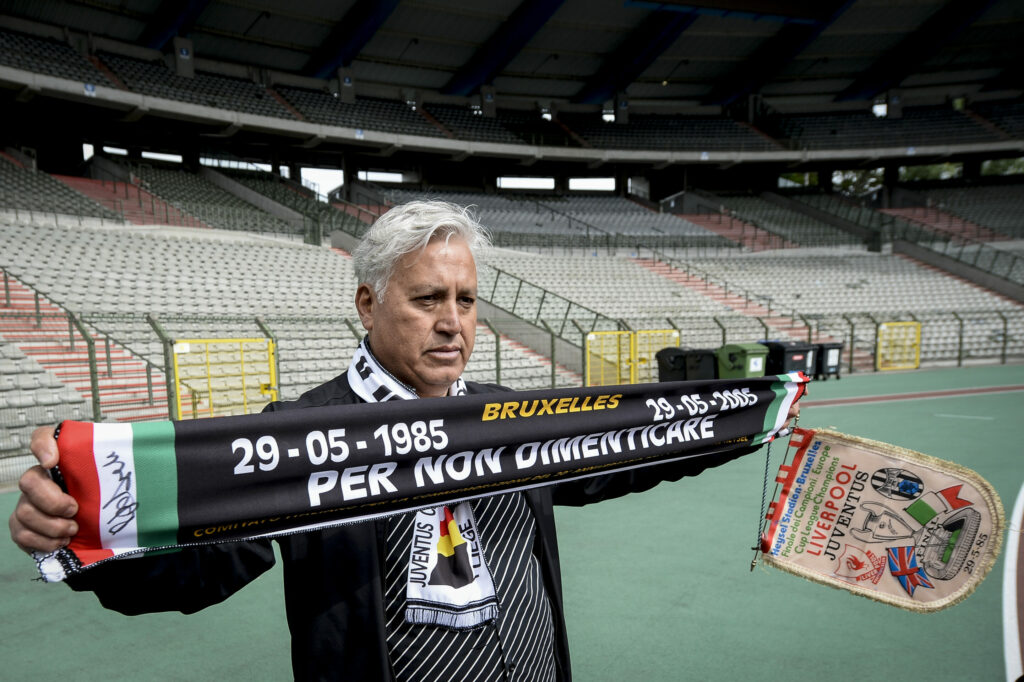
Exactly 40 years ago, on 29 May 1985, the Heysel Stadium disaster in Brussels claimed the lives of 39 people and injured over 600 others.
Football fan Sergio Ninotti, then aged 15, narrowly escaped being among the casualties. He had arrived in Brussels three months before the European Cup final between Liverpool and Juventus, described as an event “uniting all Italians.”
Along with his two brothers, Sergio secured tickets to the final. However, while his brothers managed to exchange their tickets and sit among Italian fans, Sergio found himself alone in Z Block, designated for neutral supporters, but filled with Italians who had bought tickets on the black market.
The atmosphere was strange from the start
“The atmosphere was very strange from the start,” Sergio recalls. “I saw many English fans entering without tickets, carrying crates of beer. They were drinking, acting aggressively, and insulting us. Unlike in Rome, where police presence was heavy at matches, there were only a few officers here. I felt uneasy and unsafe from the beginning.”
Related News
- The Heysel stadium disaster, 40 years on
- New film about Heysel 1985 tragedy to be released next year
Only a thin fence separated the English and Italian sections. “Hooligans managed to bring it down—a flimsy chicken wire—and started attacking people.
"There were still no police around. I moved towards the wall of the stadium. Panic ensued, and people crowded where I was. I couldn’t move. The scene reminded me of Dante’s ‘Inferno’: people entwined and faces of fear.
"People fell on me, and I was crushed to the ground, suffocating, unable to breathe, feeling nothing but intense anxiety and hopelessness. I realised I was dying.”
Mental recovery took much longer
Sergio was among the first to be rescued. “I ended up at the Brugmann Hospital, where I regained consciousness. It was like a war hospital; we were all on the floor. I went home on my own,” he recounts. “My mother was petrified when she saw my face.”
There were no mobile phones then, so there was no way to inform his family. “My brother searched for me among the dead from Block Z. It traumatised him for days,” Sergio recalls.
He soon returned to school. “At school, I grasped what happened through the reactions of other students, their fears and anxieties. That’s also where I learned about the 39 deaths and that I could have been the 40th.”
Physically, Sergio, who was an athlete, recovered swiftly. Mentally, it took him years to move past the trauma.
'They were too well organised...'
“In the summer of ’85, I felt a choking sensation while eating and stopped eating for months. I saw a psychologist in September 1985, but we didn’t even discuss the event. It was a different era. I eventually got through it alone. At 23, I had a nervous breakdown, which forced me to truly revisit the incident and overcome the shock.”
Sergio “partially” followed the ‘Heysel trial’ four years post-disaster. “The authorities bore significant responsibility: they were unprepared and did not react promptly," he says. "Hooligans were placed next to peaceful fans, in a stadium comparable to a fourth-division stadium in Italy. The notion of shared responsibility and mutual provocation sickened me.
"Some hooligans acted like murderers. In group incidents, there are always followers, but I am convinced there was a motive —perhaps revenge for what had happened in Rome a year earlier during the AS Roma - Liverpool final. They were too well-organised. Some haven’t faced justice for their actions, which is unforgivable.”
