
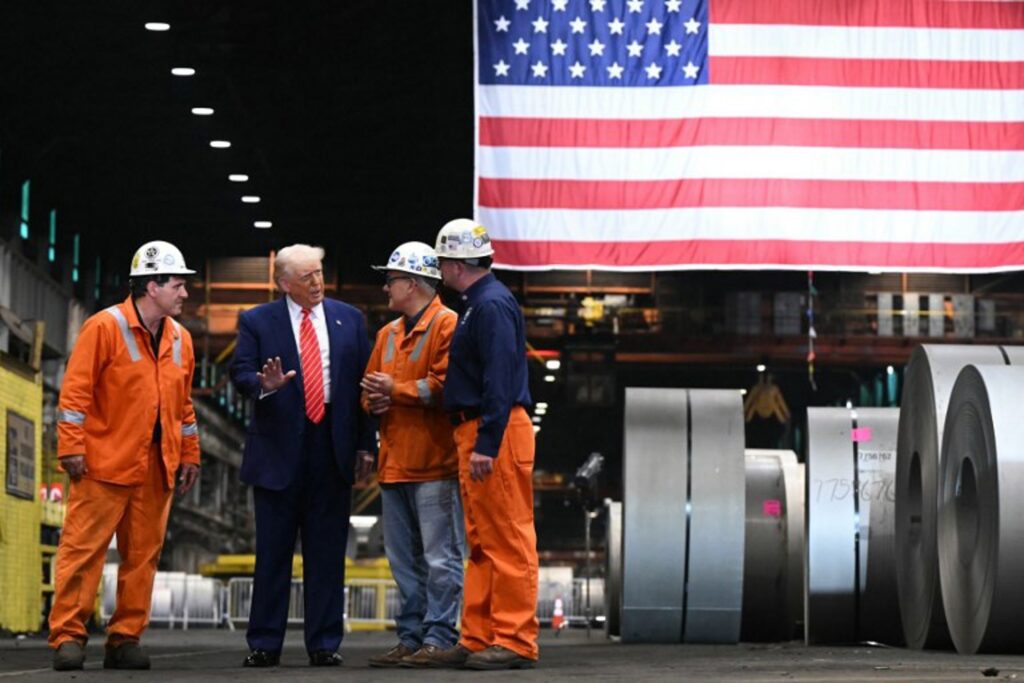
US President Donald Trump announced plans to double the import tariff on steel from 25% to 50% during a visit to a US Steel plant in Pennsylvania.
Following this announcement, Trump also revealed on his platform, Truth Social, that the aluminium tariff would be doubled, with the new rates to take effect on Wednesday, 4 June. This declaration came shortly after Trump accused China of violating an agreement to reduce import tariffs.
The increased tariff aims to reassure steelworkers in battleground state Pennsylvania that the deal between US Steel and Japanese corporation Nippon Steel will benefit them. Investors reacted positively to the news, with shares in American steel companies such as Nucor, Cleveland-Cliffs, and Steel Dynamics surging in after-hours trading.
During his visit to the steel plant, Trump also unveiled multi-billion dollar investments in the steel industry. He assured that US Steel would not announce layoffs or outsourcing, and that the blast furnaces would continue operating at full capacity for at least another 10 years.
Since returning to the White House, import tariffs have become a cornerstone of Trump’s policy, used to extract concessions from foreign countries and protect domestic industries.
Earlier this week, the US Court of International Trade in New York ruled that Trump overstepped his authority by imposing general tariffs on imports from countries that sell more to the US than they purchase. The court deemed Trump’s use of the International Emergency Economic Powers Act (IEPPA) of 1977 to impose tariffs unconstitutional. However, tariffs on steel, aluminium, and vehicles remained in place, and a federal appeals court later overturned the block on most of Trump’s trade tariffs.
