
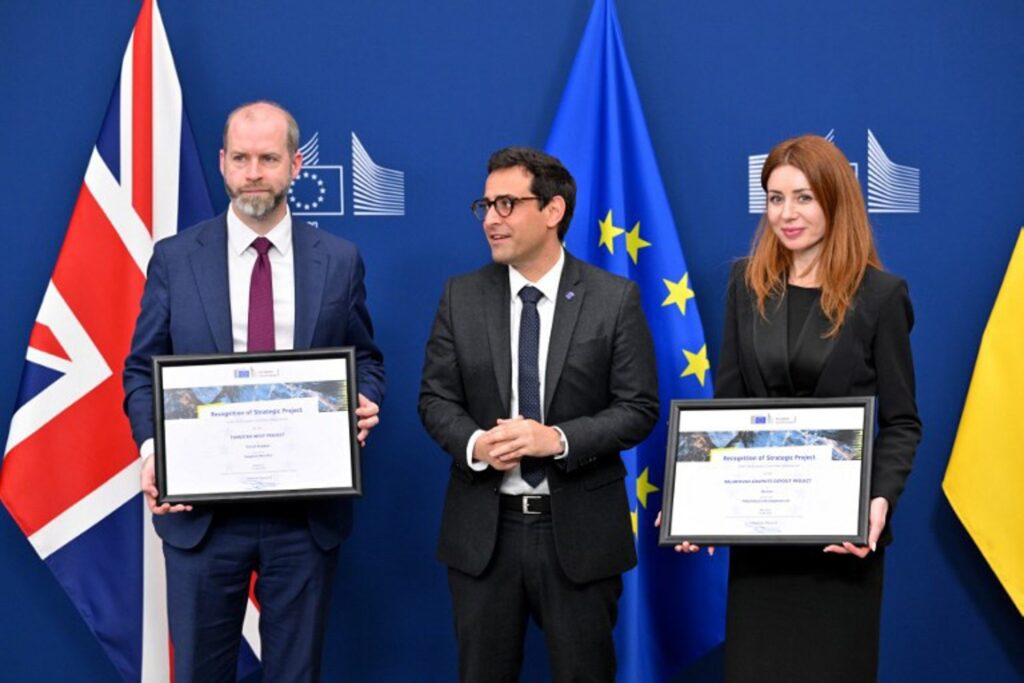
The European Union has identified thirteen strategic projects outside its borders to diversify its supply of critical raw materials, including tungsten from the United Kingdom and graphite from Ukraine.
For months, the EU has been working to reduce its heavy reliance on China and ensure the security of its industries.
This diversification is crucial for maintaining the European Union’s independence during future geopolitical and diplomatic crises, European Commission Vice President Stéphane Séjourné said at a press conference in Brussels on Wednesday.
Rare metals: focus on third countries and overseas territories like New Caledonia
After announcing around 50 mining extraction projects within Europe in late March, the EU is now focusing on third countries and overseas territories like New Caledonia.
The new initiative targets strategic raw materials vital for electric vehicle batteries and storage, such as lithium, nickel, cobalt, manganese, and graphite. It also includes the extraction of rare earth elements key to the production of magnets used in wind turbines.
Flanked by UK Trade Minister Jonathan Reynolds and Ukraine’s Minister for Environment and Natural Resources, Svitlana Gryntchouk, Séjourné highlighted the “two projects” being conducted with these “partners and friends.”
Tungsten from Devon, graphite from Ukraine
In Devon, South West England, a project called Tungsten West'' has been selected. Tungsten used primarily in the defence and space industries.
In Ukraine, the EU has chosen a graphite extraction project named Balakhivka Graphite Deposit.'' Graphite is a component of electric batteries.
However, a month ago, Washington secured a comprehensive agreement with Ukraine for resources such as gas, oil, titanium, lithium, and rare minerals.
Is the EU lagging behind? Not necessarily. Brussels’ partnership with Kyiv “does not prevent other projects” in the future, Séjourné remarked. “I hope this will be the first of many.”
Securing the supply chain
The projects approved by the Commission on Wednesday will receive EU financial support.
Last year, Europe adopted legislation to secure its supply chains, listing 17 strategic raw materials such as cobalt, nickel, and aluminium, with specific targets set for each.
The EU aims to ensure at least 10% of extraction, 40% of processing, and 25% of recycling within its territory for each of these materials by 2030. It also plans not to depend on any single third country for more than 65% of its needs.
The COVID-19 pandemic and the war in Ukraine have demonstrated that excessive dependence on imports for critical raw materials can disrupt EU supply chains, officials say.
