
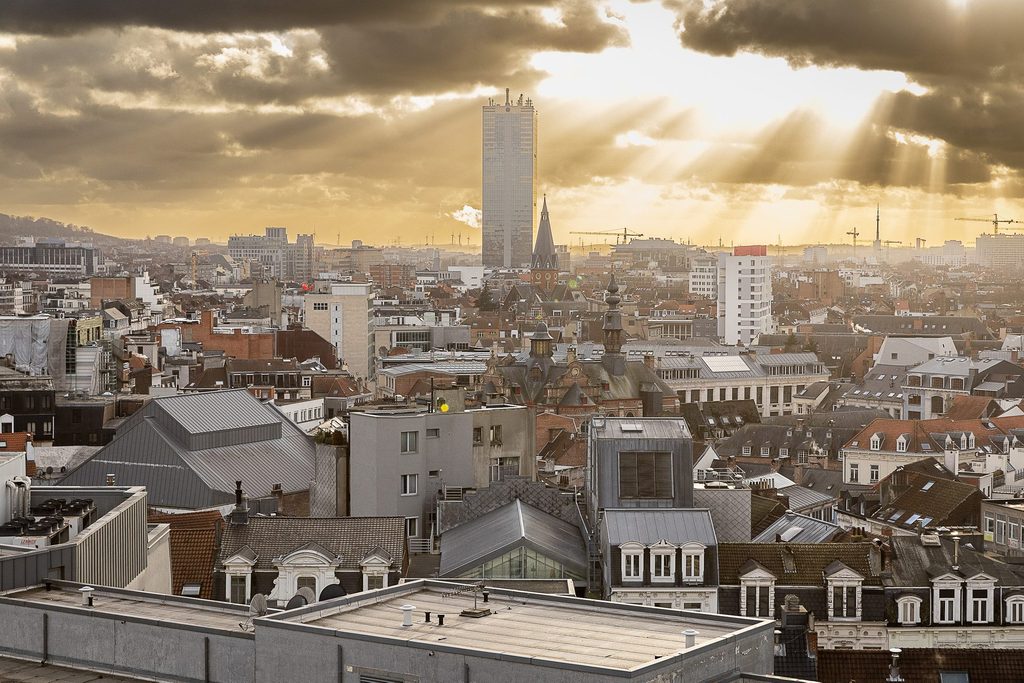
Exactly one year after the regional elections on 9 June 2024, the next Brussels Government has still not been formed. How is this possible? And how does the Capital Region get out of this deadlock?
Barely four days after the elections, Belgium's German-speaking Community found a new government agreement. Within a month, the Walloon Region and the French-speaking Community followed. And while it took 234 days, a fully-fledged Federal Government has been in charge of the country since February 2025.
The Brussels-Capital Region, however, seems to be a tougher nut to crack this time around, explains political scientist Dave Sinardet (VUB).
"In the past, the Brussels Government was always one of the first to be formed – usually about a month after the elections," he told The Brussels Times. "But looking at the situation, it is perhaps a miracle that it hasn't gone wrong earlier."
Brussels region flag outside the Brussels Parliament. Credit: Belga
The Capital Region's electoral and government formation system is very complex: parties cannot submit mixed-language lists but have to work with two separate electoral colleges: a Dutch-speaking and a French-speaking one.
The Brussels Parliament is made up of 89 seats – 17 on the Dutch-speaking, and 72 on the French-speaking side. After the elections, both language groups need to find a majority on their own side: a Flemish team with at least nine seats in the Parliament and a Francophone one with at least 37. These two groups then form one unified government for the entire Brussels-Capital Region.
"The system definitely does not make the process of forming a government any easier. And this is just maths, we have not even gone into the parties' political standpoints," Sinardet explained.
Extra difficult cards
The election results are making the government formation exceptionally difficult – much more so than usual, he admits.
"At the federal level, many people feared that Flemish and Walloon people would vote even more differently than in the past, that radical parties would rise further, and that traditional parties would become more fragmented," he said. "This did not really happen nationally, but all of it happened in Brussels."
The results in the Dutch- and French-speaking electoral colleges were very different: while right-wing liberal MR became the largest party on the French-speaking side, the progressive green Groen party won convincingly on the Flemish side. "On pretty much all levels, they are polar opposites," Sinardet said.
Secondly, radical parties are gaining ground: the radical left Belgian Workers' Party PTB-PVDA made significant gains, and many also see the controversial regionalist newcomer Team Fouad Ahidar as a radical party. "In any case, many others do not want to cooperate with the party (yet). But they won three seats out of 17 in the Dutch electoral college – that's not nothing."
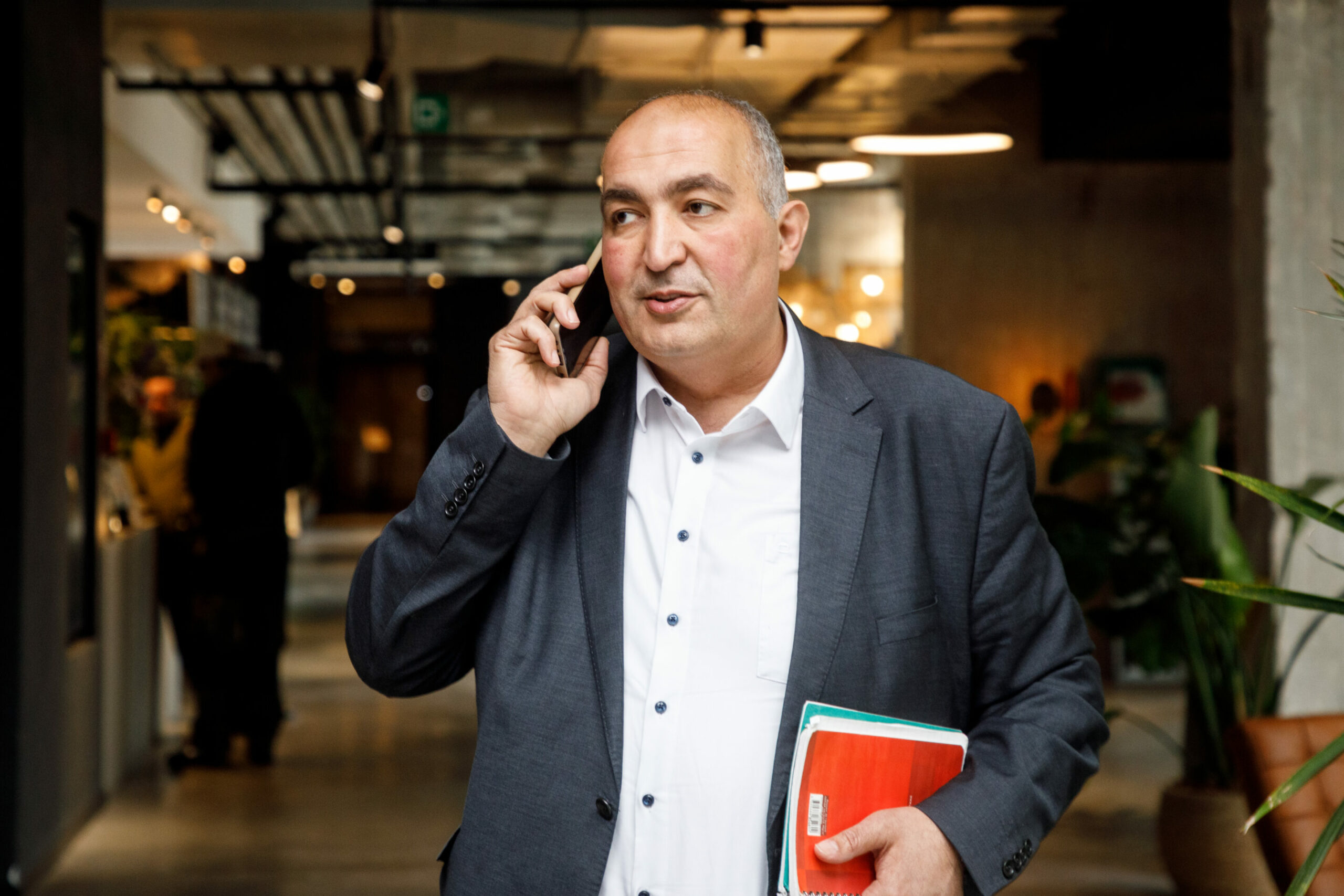
Fouad Ahidar. Credit: Belga / Hatim Kaghat
And thirdly, fragmentation is also greater in Brussels: on the Flemish side of things, they need four parties to find a majority, while the system – which only provides three ministerial positions – is only designed for three coalition partners.
On the French-speaking side, Sinardet explained that it is not so simple either. "In the Walloon Region and the French-speaking Community, MR and centrist Les Engagés have a majority together. But not in Brussels."
Due to this fragmentation, the two parties are forced to include either the socialist PS on one hand, or greens Ecolo and regionalist DéFI on the other. "As a result, they need more parties, and therefore have to reconcile more opposites."
A stillborn proposal
Still, Sinardet stressed, the election results are not an excuse. "Sometimes the cards that are dealt are difficult, but the parties just have to play with them. Instead, they are getting bogged down in all kinds of vetoes and exclusions, party politics and strategies."
At the end of May, MR presented an 80-page policy statement to "save Brussels" in a supposed attempt to bring all "willing" parties around the table. For Sinardet, this was nothing more than a communication stunt – and not necessarily a good one either.
"You know in advance that it is not going to work," he said. "There is no majority for the text, but it is also a strange way of working: they propose a text like that without having consulted enough parties to get a majority."
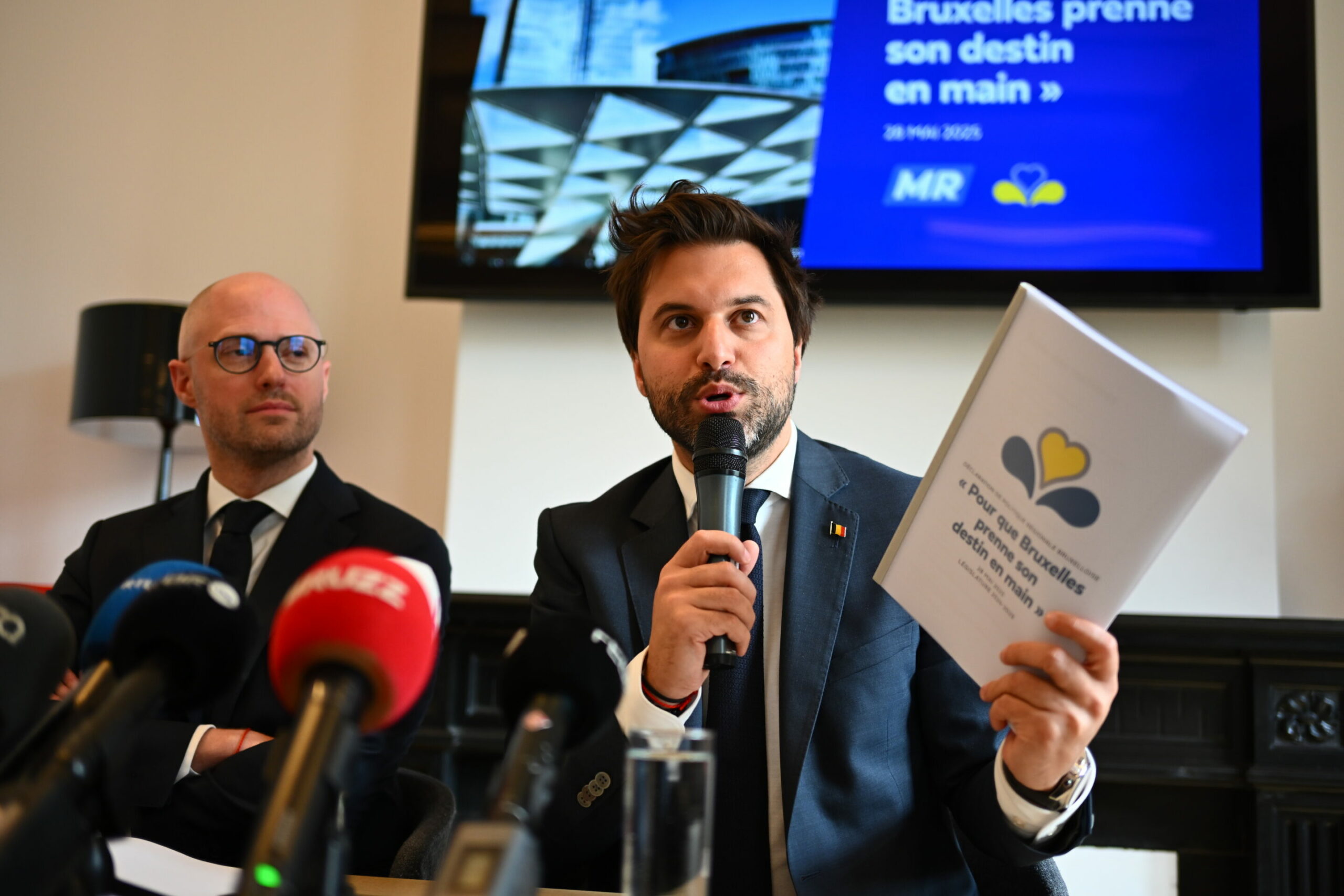
MR David Leisterh and MR leader Georges-Louis Bouchez during a press conference about a proposal for the negotiations to form a new government for the Brussels Capital Region. Credit: Belga/Eric Lalmand
According to him, MR is well aware of the fact that they do not have enough support for this text. "MR is just using this meeting so they can say 'look, we are doing our best, it's the others who do not want it.' But they know full well that this will not lead anywhere. The so-called 'effort' is a bit of a stillborn child, really."
In the same week, PS launched an initiative to form a progressive coalition and had talks with PTB-PVDA, Ecolo, Groen, Team Fouad Ahidar and Dutch-speaking socialist Vooruit.
While Sinardet feels "more or less the same" about the PS initiative as about the MR one, he admits that PS at least brought together six parties that do have a majority in both language groups. "So they are certainly a step further than MR, but that is where it ends."
No government before autumn
He speaks of "many stumbling blocks" on to way to such a left-wing coalition, not least the question of whether PTB-PVDA would even be willing to join the government. In the past, the party has always pursued a strategy of remaining in opposition.
"After the local elections in October, they have now joined a few local governments in several Brussels municipalities. So they may change their strategy. But I do not think there's much chance of them doing so in this context, which is one of severe austerity measures – not exactly something a radical left-wing party would want to get involved in."
And even if they do take that leap, Sinardet considers it "very unlikely" that the other parties are willing to form a government with them.
The biggest problem is that MR and PS are ultimately both needed to form the government in Brussels, he believes. "But they have not been talking to each other for months. In fact, they are both trying to form a coalition separately. But these initiatives could be interpreted as a way of demonstrating to their voters that they have tried their best not to include the other party, but that it is impossible."
Brussels PS federation leader Ahmed Laaouej arrives for a press conference in Brussels region parliament, in Brussels, Wednesday 29 January 2025. Credit: Belga
However, we are not anywhere near a new government yet, Sinardet fears. "It will be autumn, at the earliest. Maybe people will have some time to think about everything over the summer. But I am afraid it will not be any sooner than that. Unless a miracle happens."
Before it comes to that, however, the Capital Region is marking a full year without a government. While symbolically very significant, Sinardet underscored that there are no real consequences for politicians. Meanwhile, Brussels residents are the only ones affected.
"While the big agencies will of course continue to run, no policy can be made. That means, for example, that the budget deficit cannot be reduced, but also that certain organisations and projects can no longer receive funding, leading to uncertainty," he said.
Where do we go from here?
This government crisis – whether it is resolved in the short term or not – is an opportunity to make a number of "very necessary" reforms, according to Sinardet.
"A sense of urgency is lacking, so perhaps we should put a bit more pressure on the formation of a government. At the federal level, there has been talk of imposing a six-month deadline. After that, either new elections could be held, or party funding will start to decline," he said. "Maybe we can look into something similar at the regional level."
Most important, however, is reforming the electoral system. "A system that does not allow mixed-language lists in a predominantly multilingual region is completely at odds with society."
While several parties were previously not so keen on changing this, they are now finding that it may be necessary. "For the federal and local elections in Brussels, most parties do run with mixed-language lists. So it's absurd to ban that at the regional level."
A large ULB study recently also showed that a significant proportion – and often even the majority – of voters on Dutch-speaking lists are French-speaking. "Voters clearly do not care about the system, partly because it is no longer adapted to the current reality. So why keep it? Without it, we would not be in this mess."
