
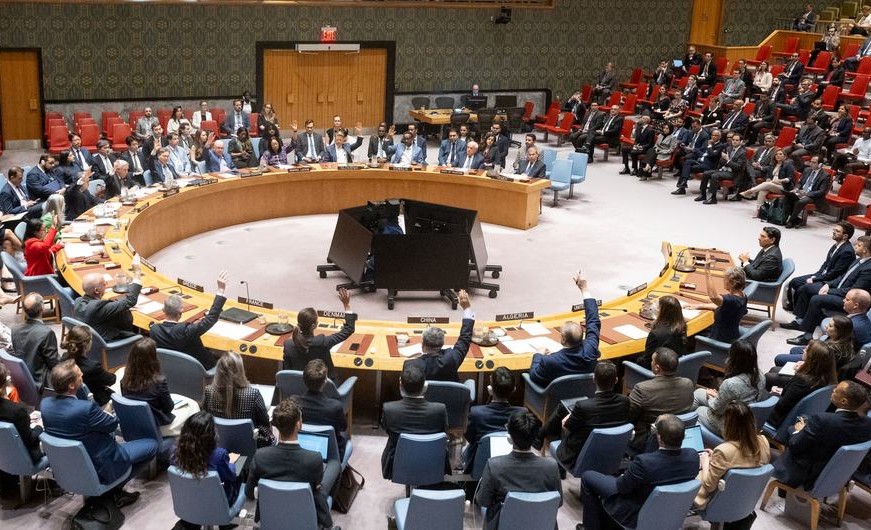
After Israel and Hamas failed to agree on the new US proposal for a ceasefire-hostage deal in Gaza, the US vetoed on Wednesday a draft resolution in the UN Security Council calling for a ceasefire, the release of the hostages, and unrestricted humanitarian access in Gaza.
The draft text was introduced by Slovenia on behalf of the nine other non-permanent members of the Security Council (Algeria, Denmark, Greece, Guyana, Panama, Pakistan, Republic of Korea, Sierra Leone, Somalia).
In his introduction, a Slovenian diplomat explained that the resolution was prompted by their deep concern over the catastrophic situation in Gaza, which has deteriorated further after the resumption of hostilities in March, and after disturbing reports from the ground by UN and the humanitarian community.
While continuing to support the ongoing diplomatic efforts mediated by the US, Egypt and Qatar aimed at achieving a return to the ceasefire deal, the E10 also believe that the Council must act urgently and decisively to address the humanitarian situation in Gaza.
“The resolution before us is a product of consultations among all Council members,” the diplomat said. “We believe this text reflects the consensus shared by all Council members that the war in Gaza has to come to an immediate halt, all hostages must be immediately and unconditionally released, and civilians in Gaza must not starve and must have full and unimpeded access to aid.”
The US, however, was not satisfied with the consultations and vetoed the resolution which was accepted by the other 14 Council members. In a press statement, US Secretary of State, Marco Rubio, described the resolution as counterproductive and “targeting Israel” although it did not mention Israel by name.
“We will not support any measure that fails to condemn Hamas, does not call for Hamas to disarm and leave Gaza, draws a false equivalence between Israel and Hamas, or disregards Israel’s right to defend itself,” he wrote. “Hamas could end this brutal conflict immediately by laying down its arms and releasing all remaining hostages.”
In principle this does not differ from the EU’s common position which condemns Hamas for the 7 October terrorist attack on Israel and states that there is no room for Hamas in ruling Gaza “the day after”.
The E10 group in the Council consists of three elected EU Member States (Denmark, Greece and Slovenia), besides France which is one of the five permanent members. Any condemnation of Hamas would probably have been opposed by the Muslim countries in the E10 group that do not recognize Israel, and by China and Russia that also have veto power in the Council.
In this situation, the priority was to reach consensus behind an urgent demand to immediately increase humanitarian aid to the starving population in Gaza and to send a political signal to both sides to return to the ceasefire which Israel had breached on 18 March.
The latest reports about the Gaza Humanitarian Foundation (GHF), an American organization reportedly funded by Israel for delivering humanitarian aid into Gaza instead of via UN agencies and humanitarian partners, are not encouraging. It was never intended to reach all Palestinians in all parts of Gaza and the distribution of aid has been disrupted by violent incidents.
In fact, the American veto contradicts its own efforts to bring about a ceasefire-hostage deal, which was recently proposed by US special envoy Steve Witkoff, and plays into the hand of the far-right Israeli government which refuses to commit to a permanent end of the war.
The proposal consists of 13 points under the headline ‘Framework for Negotiating an Agreement to a Permanent Ceasefire’. 10 living hostages and 18 dead hostages out of the total 58 hostages will be released on day 1 and day 7 of a 60-day ceasefire.
Despite the vagueness in the Witkoff proposal, if the ceasefire is implemented in good faith, it would likely lead to a permanent cessation of hostilities under pressure by the US administration. Once sufficient humanitarian aid starts to enter the Gaza Strip and the first round of hostage release will take place, it will be difficult by either side to violate it and take the situation backwards.
At least, that was the assumption until the American veto. Without pressure by the Trump administration on the Israeli government, the previous ceasefire-hostage deal in February would not have entered into force.
Although Israel’s Prime Minister Benjamin Netanyahu has admitted that Hamas does not pose any threat to Israel any longer, he has doubled down on his conditions to end the war and included resettlement (displacement) of the Gazan population. It was proposed by Trump in his ‘Riviera plan’ but even he has forgotten it after protests by the Arab countries.
While a majority of the Israeli population wants to end the war and bring home all hostages, Netanyahu continues to repeat his mantra that only military pressure on Hamas will achieve the war goals. Imposing a blockade on humanitarian aid into Gaza was not only against international law but did not make any sense if Hamas does not care about the suffering of the civilian population.
Furthermore, two ultra-orthodox parties are currently threatening to bring down the government over the issue of compulsory conscription. Netanyahu himself, whether or not he believes that the war is a historical opportunity to rewrite the map in the Middle East, is admittedly under pressure by the far-right extremists in his government to continue unnecessarily the war for his short-term political survival.
