
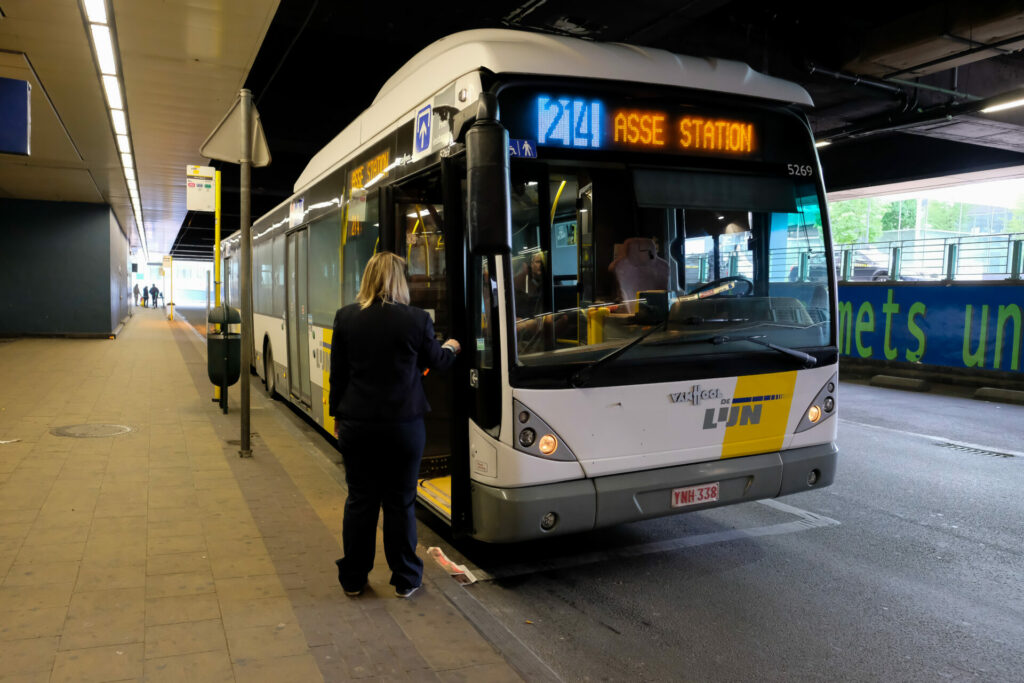
The Flemish public transport operator, De Lijn, is set to launch an action plan on Thursday aimed at curbing fare dodging using data and artificial intelligence to identify high-risk routes and times, with fines increasing by 18%.
The Flemish governing agreement specifies that tackling fare evasion at De Lijn must generate €30 million in annual revenue. Consequently, De Lijn will implement the new plan from the second quarter of 2025.
A key component is the utilisation of data and artificial intelligence to pinpoint high-risk transit lines and times. De Lijn plans to employ surveillance cameras, passenger data, and machine learning for targeted inspections where fare dodging is most frequent. “We are focusing on a strategic approach to deploy our resources more effectively,” stated Ann Schoubs, General Director of De Lijn.
The action plan encompasses various measures. De Lijn is hiring more inspectors and will increase their deployment with specific targets for each region. Bus attendants will also be authorised to conduct checks. Importantly, inspections will no longer be announced in advance. De Lijn will continue collaborating with local police and will explore support from security firms like G4S.
Additionally, as previously announced, entrance gates will be installed in Antwerp’s pre-metro. Boarding at the front of buses will once again be mandatory. De Lijn intends for both controllers and drivers to use bodycams to deter aggression.
The penalty system will be reformed for more efficient collection, potentially through automatic enforcement. Fines will rise by 18% to align with fare increases and will later be assessed in line with the health index. According to Schoubs, who also presented the plan in the Flemish Parliament’s Mobility Committee, the goal is to prevent fare dodging from becoming economically advantageous.
Flemish Minister Annick De Ridder (N-VA) emphasised that alongside fraud prevention, the safety of drivers and passengers is paramount, notably with the introduction of bodycams. “We adopt a zero-tolerance stance towards aggression,” said De Ridder.
De Ridder stated that the plan aims not only to reduce fare dodging but also to boost transport revenue, improve fine processing efficiency, and positively affect customer satisfaction and safety. The initial results are anticipated by the third quarter of 2025.
