
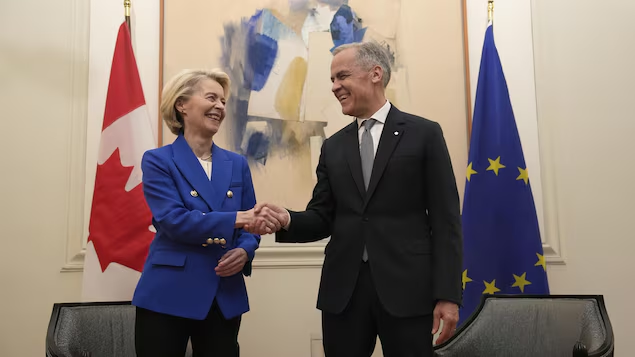
The European Union and Canada signed an agreement on Monday in Brussels to strengthen their defence and trade cooperation amid uncertainties about the reliability of the United States under President Donald Trump.
The agreement marks the beginning of a new chapter in a long-standing friendship between Europe and Canada, according to European Commission President Ursula von der Leyen.
Canadian Prime Minister Mark Carney emphasised, for his part, his focus on enhancing Canada’s cooperation with its “most reliable allies, those who share our values,” without mentioning the recent tensions with Trump’s USA.
The agreement primarily seeks to integrate the Canadian defence industry more closely with Europe’s efforts to revitalise its industrial base. Ultimately, it could allow Ottawa to take part in joint procurement under a €150 billion loan programme recently approved by the EU to boost the rearmament of its 27 members.
It also paves the way for Canadian companies to participate in this programme, although a separate agreement will be required.
The UK signed a similar defence partnership in May, and last week, Australia and the EU announced the start of negotiations for another partnership.
The signing comes just before a NATO summit in The Hague, where allies, including Canada and 23 of the 27 EU countries, are expected to approve increased security spending to reach at least 5% of GDP by 2035, addressing threats such as Russia.
This commitment is seen as crucial to appease Donald Trump, who had threatened to stop protecting “freeloaders.”
Ottawa, spending 1.4% of its GDP on defence in 2024, purchases a significant amount of its military equipment from the United States.
However, relations have soured under Trump, who repeatedly suggested that Canada become the 51st US state.
Canada also recently hosted a G7 summit marked by Trump’s early departure and the absence of a joint statement condemning “Russian aggression” in Ukraine, unlike previous years under Trump's predecessor Joe Biden.
The EU is Canada’s second-largest trading partner, with bilateral trade in goods amounting to €75.6 billion in 2024, reflecting a 64% increase since 2017 when the Canada-European Union Comprehensive Economic and Trade Agreement (CETA) came into effect.
