
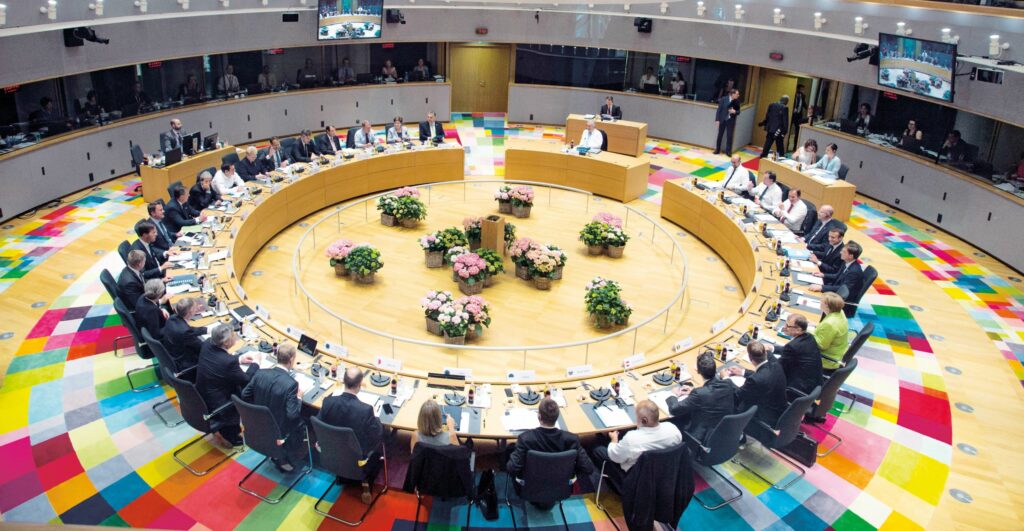
The European Union’s meeting of heads of state and government returns to Brussels this week, but what is the council and why is it important?
Traffic will come to a standstill today and tomorrow as presidents and prime ministers from across the European Union descend on Brussels for one of their regular summits in the Belgian capital.
The summits, known informally as EUCO, bring together the leaders of the 27 member states to make high-profile political decisions that inform the nitty-gritty of EU decision-making.
Meetings are convened by the Council’s president, currently Portugal’s former prime minister, Antonio Costa. He is the fourth man to hold the job after Belgium’s Herman van Rompuy and Charles Michel, as well as Poland’s Donald Tusk.
EUCOs used to be a lot more regular, especially during the pandemic, when the likes of Emmanuel Macron, Angela Merkel and Pedro Sanchez seemed to be showing up at the Council’s HQ every other week.
A minimum of four councils need to be held annually but that number has been exceeded every year without fail. Leaders like these meetings, even if nothing is decided, as it gives them a chance to ‘hold Brussels to account’.
The Council was formally established back in 2009 when the Lisbon Treaty came into force, but meetings between government leaders have been held since the 1960s, as a counterbalance to the executive power wielded by the European Commission.
Big decisions like accepting new members, budgetary matters, climate targets and joint responses to world events are dealt with at the EUCO level, while less politically sensitive or high profile issues are worked out at minister-level meetings.
Depending on the kind of issue on the table, unanimous support or a qualified majority is required. Unanimous voting almost without fail leads to some countries threatening to wield a veto, just to get concessions elsewhere or down the line.
Qualified majority requires 15 countries to vote in favour and for those 15 countries to represent at least 65% of the EU’s total population. This is the reason why large countries like France, Germany, Spain and Italy are so important to the legislative process. You need at least two or even three of them on board to get anywhere.
Unlike the European Parliament, Council members – which includes the European Commission president – do not sit in political groupings. Liberals in one country might have more in common with conservatives in another than with each other, after all.
But voting does at times reflect political families, even if it is no guarantee of who is going to support who.
This rather Byzantine way of making decisions together means that these meetings have often gone on into the small hours of the morning, ruining the sleeping schedules of many a journalist.
At times, the difficulty in getting enough leaders to support a policy has led to EUCOs essentially failing, as a formal set of conclusions cannot be adopted. This has set back climate, foreign affairs and budgetary motions in the past more than once.
All of this of course goes on behind closed doors and security measures have evolved to better guard against ever more sophisticated threats. Leaders often are only able to make decisions because the nature of the talks are confidential.
Ultimately, every prime minister or president’s goal is to come to Brussels, have their say and give a pompous interview on their way out, claiming to have defended the interests of their country.
It’s a repetitive formula that is by no means perfect, some would say it is actually not fit for purpose. But the fact that 27 different countries regularly are able to find common ground means that the Council is arguably one of the wonders of modern democracy in action.
