
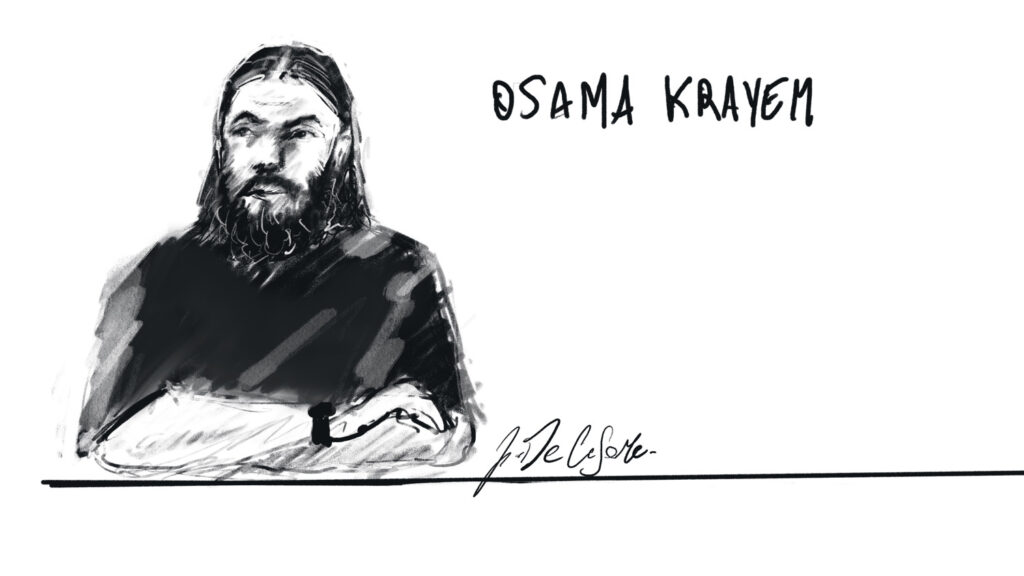
Swedish jihadist Osama Krayem has shown no empathy or remorse during his trial in Stockholm for his alleged involvement in the execution of Muath Al-Kasasbeh, a Jordanian pilot who was burned alive in a cage in Syria, the lawyer for the civil party said on Thursday.
The Swedish court is the first and only one to try Krayem for the barbaric murder, which caused an international outcry in 2015.
His trial began on 4 June, with the prosecution requesting a life sentence for the accused.
No trace of reflection, remorse or guilt
The 32-year-old jihadist, already convicted for the Paris and Brussels attacks, remained silent throughout the hearings. A selection of filmed and written interrogations, included in the investigation file, were read and broadcast during the trial.
"Anyone looking for empathy in his account will have to look elsewhere," Mikael Westerlund, lawyer for the civil party, said in his closing speech. "There is not the slightest trace of reflection, remorse or guilt."
"Most people who witnessed what Muath went through would undoubtedly need lifelong - or at least long-term - treatment to overcome the trauma that this causes in a normal individual," he added. "But Krayem does not seem to have been traumatised, but inspired. Inspired to continue his terrorist activities, which led him to participate in and then be convicted of terrorist acts in Europe."
The Swede was sentenced to 30 years in prison for complicity in the 2015 Paris attacks and to life imprisonment in Belgium for the attacks at Brussels' main airport and on the metro in 2016.
The defence emphasised the "weakness" of the evidence presented by the prosecution, particularly regarding the role Krayem played in the execution of the Jordanian pilot.
Judgement on 31 July
Experts and another jihadist, former British citizen Alexanda Kotey, who was absent at the time of the events, testified on Krayem's membership of the elite Islamic State unit responsible for staging the pilot's death.
‘The fact that Osama Krayem is the only person who can be prosecuted - the others are, in all likelihood, deceased - makes the task even more difficult and delicate for the defence. There is no one who can come forward to support my client's statements,’ said his lawyer, Petra Eklund.
Osama Krayem claimed he only spent 15 to 20 minutes at the scene of the execution, unaware of what was going to happen, before he saw the cameras.
In a video released on 3 February 2015 showing the execution, Muath Al-Kasasbeh, his face swollen and wearing an orange uniform, is placed in a metal cage. The cage is then set on fire by one of the thirteen fighters present, killing the pilot.
The Stockholm court will deliver its verdict on 31 July at 11:00 a.m.
