
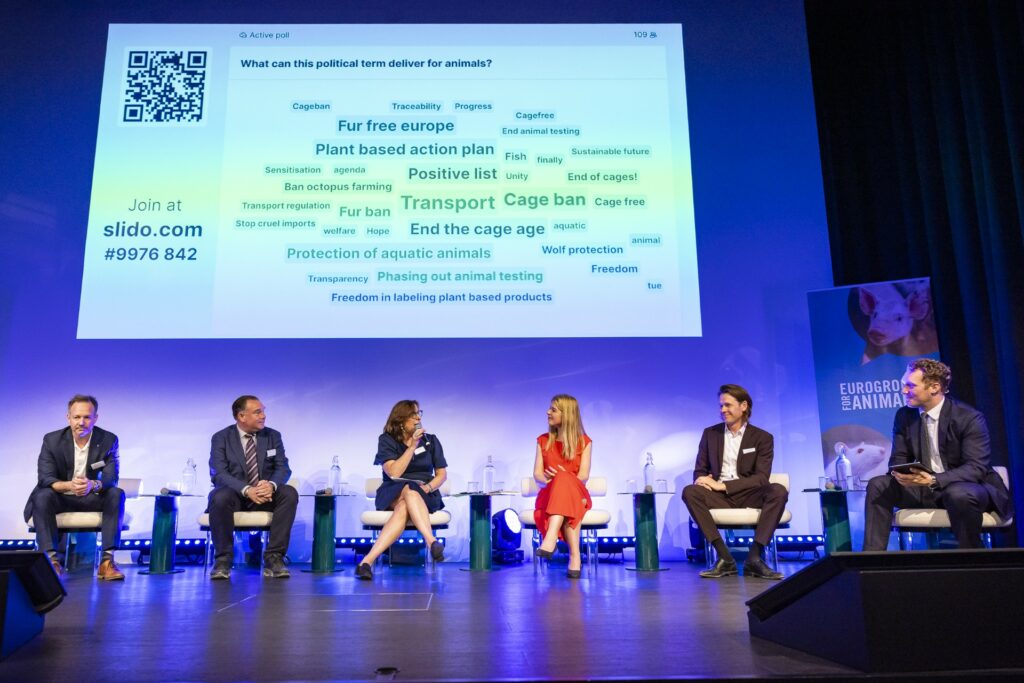
Animal welfare activists gathered last week at a conference in Brussels to discuss how to promote animal welfare legislation in the EU following the appointment of a dedicated European Commissioner for animal welfare.
''Forty years ago, the first animal welfare legislation was passed in the EU,” said Philip Lymbery, president of Eurogroup for Animals, which organized the annual conference. “Now it is time for a full revision of the legislation to align it with the latest science and citizens’ demands for higher standards,'' he added, referring to the outstanding issues in EU’s planned revision of animal welfare legislation.
The demand at previous conferences for an animal welfare commissioner was finally met with the appointment of Olivér Várhelyi as commissioner in charge of Health and Animal Welfare in the second von der Leyen commission.
In a video message to the conference, he thanked the animal welfare NGOs for their efforts to “improve the lives of animals” but said nothing about painful slaughter methods. While expressing his appreciation for their “constructive and pragmatic approach, he said it is a busy time for policy-making around animal welfare. He admitted that it apparently will take years to finalise all legislation.
As previously reported, the Commission proposal for the first ever EU standards for the welfare and traceability of dogs and cats is close to the finish line after the recent adoption of the draft law by the European Parliament. Discussions are also on-going on the Commission's proposal on live animal transport. This proposal is unlikely to meet all animal welfare concerns unless it will be revised.
There are more proposals in the Commission’s pipeline. Várhelyi mentioned the European Citizens' Initiative (ECI) “End the Cage Age”. The previous Commission reneged on a promise to forward a legislative proposal by 2023 to prohibit the use of cages for farmed animals. The ECI was supported by ca 1.4 million citizens across all EU member states.
In his speech, Várhelyi promised that the future modernisation will meet the Commission's commitment to respond to the ECI. The Commission is also looking into making sure that imported products align more with EU animal welfare standards. Concretely, it is also considering whether to cover the systematic killing of day-old male chicks.
“We are considering an approach based more on outcomes, using animal welfare indicators more widely,” he said. “We hope to adopt the first proposal by the end of 2026.”
At the conference, a panel of MEPs and animal welfare experts discussed the issues at stake. Among the take-aways were the success of the legislation on dogs and cats. On the negative side, there is still uncertainty about the transport proposal and pressure on the co-legislators will continue. The importance of supporting farmers in the transitions to higher animal welfare standards was highlighted.
MEP Niels Fuglesang (DK, S&D), President of the Parliament’s Intergroup on the Welfare and Conservation of Animals, received a political recognition award for his efforts in advocating for better animal welfare, especially when it comes to live animal transport.
Denmark, which will take over the rotating EU Presidency on 1 July, writes in its programme that it will be prepared to start negotiations on the Common Agricultural Policy (CAP), setting the framework for the development of the agricultural sector after 2027.
“The future Common Agricultural Policy must support rural development, organic farming, generational renewal, and animal welfare, while ensuring greater coherence with sectoral legislation, including climate and environmental regulations.”
The programme is brief on animal welfare but mentions that “welfare legislation needs modernisation in line with the latest scientific advice and consumer expectations” and that the Danish Presidency will place animal welfare high on the agenda. This includes advancing negotiations on the proposals on live animal transport and the welfare and traceability of dogs and cats with the European Parliament.
The top-priorities in the revised legislation are similar to those listed at previous conferences: an end to the suffering of farmed animals and their confinement in cages, a ban on long live animal transports, a fur free Europe, a Positive List on pets, and a plant-based action plan.
The issue of stunning methods at slaughter does not figure high on the agenda. As regards pigs, most pigs in the EU are stunned with high levels of carbon dioxide gas (CO 2), which is recognised as a painful stunning method. More humane alternatives are emerging according to a new report which was contracted by the European Commission.
According to the report, which was drafted by the PigStun Consortium and recently has been finalized, it is technically feasible to use alternative methods for stunning pigs that are less stressful to the animal than conventional high CO2 stunning. EU pig slaughterhouses should be encouraged to use these non-aversive stunning methods.
Commissioner Várhelyi did not mention the need to enforce already existing legislation on stunning methods. Although the Commission paid for the report, it does not appear that it intends to amend the Slaughter Regulation to phase out the use of high concentrations of CO2 to stun pigs, Peter Stevenson, Chief Political Advisor at Compassion in World Farming, told The Brussels Times.
