
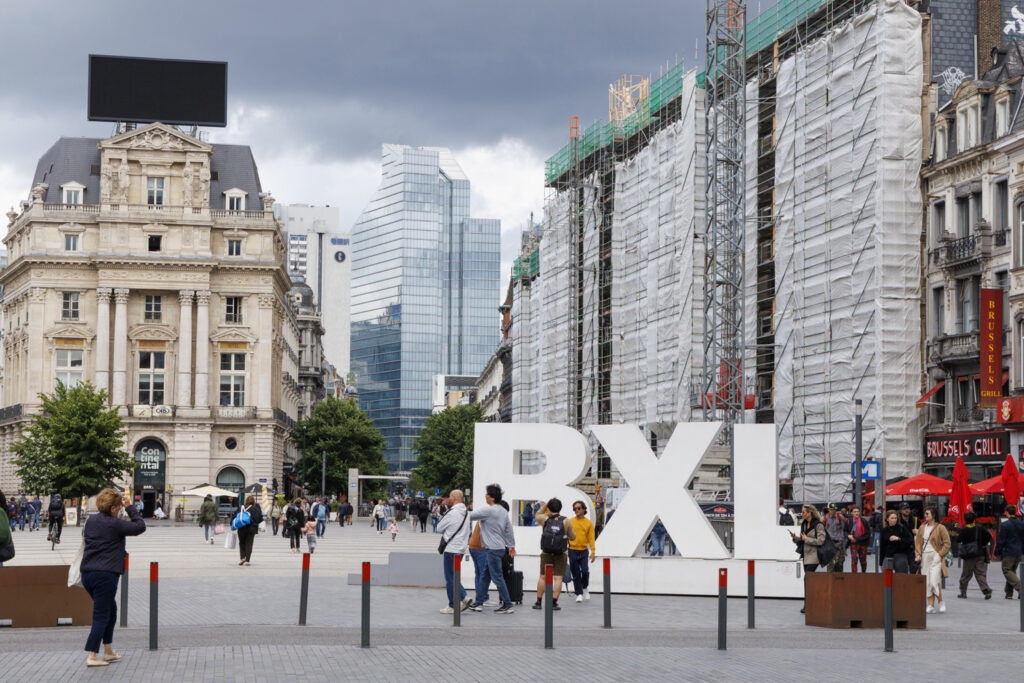
For the past decade, pedestrians and cyclists have freely navigated the major thoroughfares of central Brussels, transformed into pedestrian zones from Place Fontainas to Boulevard Adolphe Max after Boulevard Anspach was closed to motor traffic.
In January 2014, the city unveiled its ambitious plan to “revitalise” the capital’s centre, describing it as “A New Heart for Brussels”. Spearheaded by the ruling PS-MR coalition under former mayor Yvan Mayeur, the project became a reality on 29 June 2015 with the motor vehicle ban on the 800-metre stretch of Boulevard Anspach that runs north to south through the centre.
Originally estimated to cost €20 million and be completed by the end of 2017, the redevelopment will now extend to 2024 with costs rising to about €27.8 million.
Despite significant criticism for the predominance of fast-food outlets—comprising 51% of businesses in the area—the pedestrian zone has become the fourth busiest street in Brussels by 2024, with 29,100 daily passers-by, following Rue Neuve, Porte de Namur, and Grand-Place.
Brussels Environment has noted a slight improvement in air quality based on NO2 levels monitored at three sites around the pedestrian zone, although levels remain too high according to the World Health Organization (WHO) guidelines.
While the city celebrates the revitalisation of the centre, groups like the Atelier de Recherches et d’Actions Urbaines (Arau) and Inter-Environnement Bruxelles (IEB) criticise the focus on commerce and the potential for over-tourism at the expense of residents.
A decade on, the pedestrian zone is firmly established but remains a hotly debated issue in the capital.
